

Orion 55 in Beaugrenelle: architecture photographs of a modernist building in Paris

At times in Paris, some buildings reveal themselves immediately. Others require a detour, a fresh look, a particular light. That is exactly what happened to me with Orion 55, on the Beaugrenelle slab. Having lived in Paris for 38 years, I had only rarely been to this area, without ever really taking the time to photograph it. For a change from La Défense, which I know well from having explored it in every direction, I wanted to discover another territory of Parisian modernity. And as soon as I arrived on the slab, this building made itself felt.
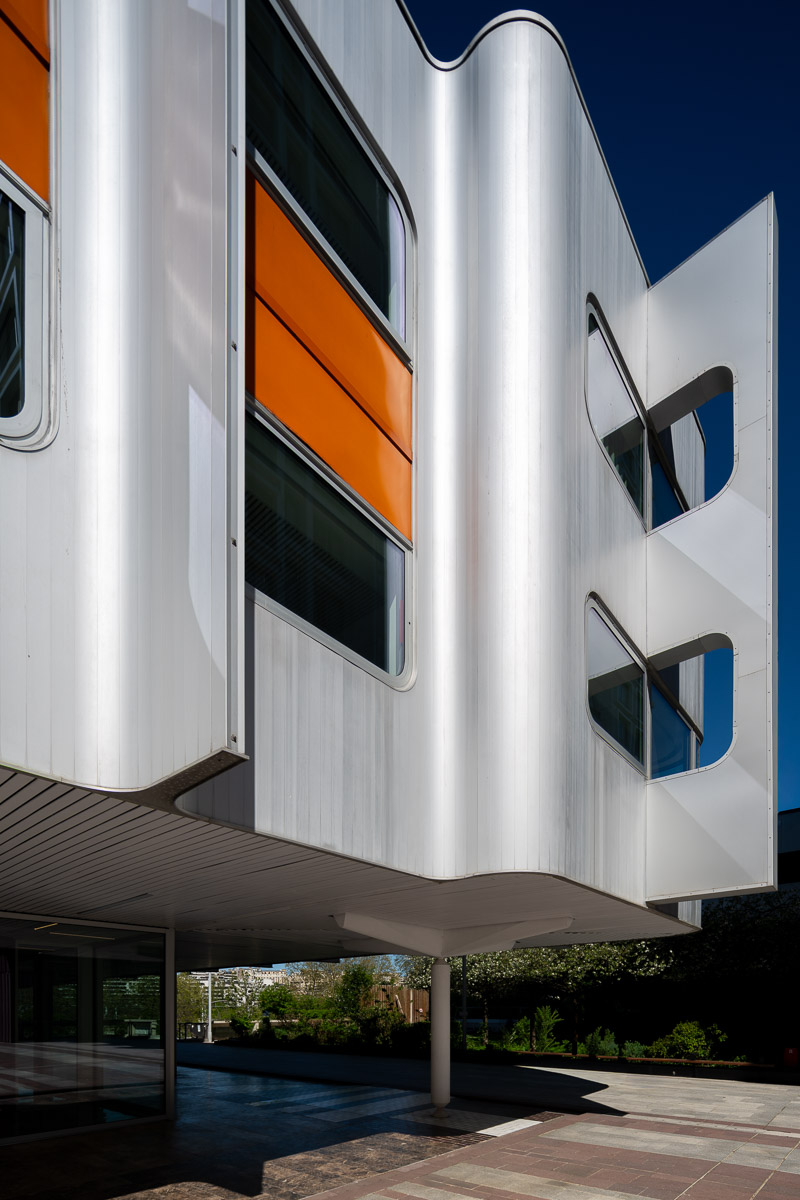
With its aluminium cladding, orange panels, curved forms, largely glazed ground floor and pilotis that give it a sense of levitation, Orion 55 embodies everything that makes 1970s architecture so photogenic when viewed without prejudice. Under a perfectly blue, cloudless spring sky, the building revealed an almost cinematic graphic presence. I then chose to photograph it both as a self-contained architectural object and as an emblematic piece of Beaugrenelle’s urban history.
Contents
- Leaving La Défense to look at Beaugrenelle differently
- Orion 55, a Front de Seine manifesto
- A building that seems to float above the slab
- Aluminium, light and colour: my photographic reading
- Photographing Orion 55: curves, lines and low-angle views
- Why Orion 55 matters in the Parisian landscape
Leaving La Défense to look at Beaugrenelle differently
When you often photograph contemporary architecture or large vertical developments, La Défense almost becomes a reflex. The district offers spectacular density, varied towers, reflections and monumental perspectives. But sometimes it is healthy to shift your gaze. Beaugrenelle, with its slab urbanism and modernist heritage, tells another story of Paris. Here, the city does not only seek height. It also stages a certain idea of modernity, born in the 1960s and 1970s, at a time when fragments of the city were still imagined as laboratories of the future.
This photographic walk reminded me that a little-visited neighbourhood can become a genuine visual discovery as soon as you enter it with curiosity. Orion 55 is the perfect example. Where many might have seen a typical administrative building from another era, I saw a subject rich in contrasts, materials and formal tensions.
Orion 55, a Front de Seine manifesto
Located at 55 quai de Grenelle, on the Front de Seine-Beaugrenelle slab, Orion 55 fully belongs to this Parisian urban adventure that sought to invent a city that was more vertical, more pedestrian and more experimental. Designed in the mid-1970s by Jean-Claude Jallat and Michel Péron, in collaboration with the Jean Prouvé workshops, the building clearly expresses this modernist ambition: prefabrication, precise façade design, a strong relationship to structure, and the search for an architectural language that is instantly recognisable.
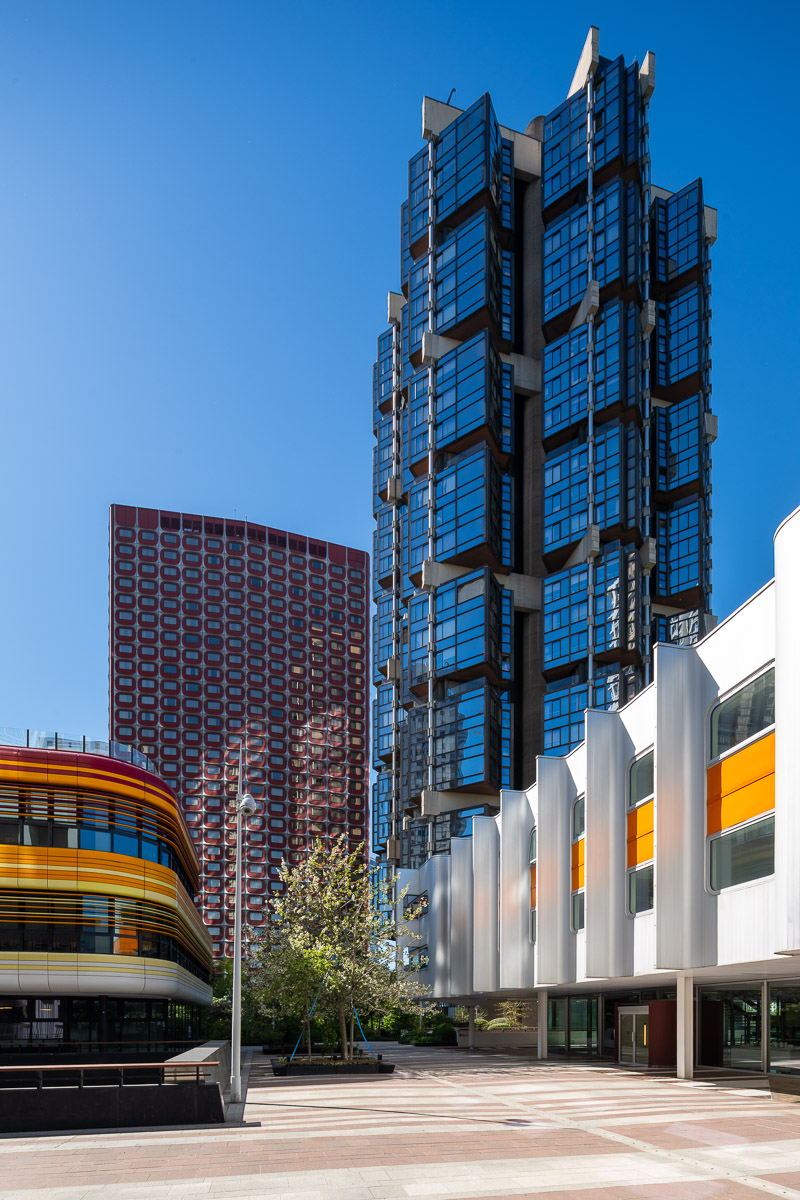
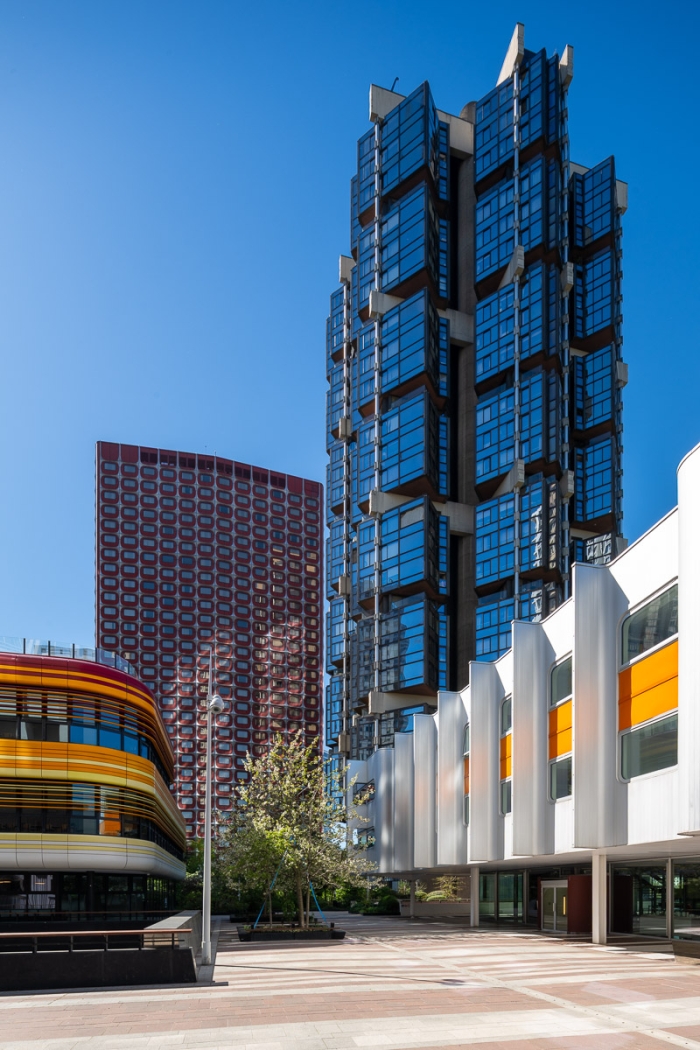
What is striking is its scale. Orion 55 is not a tower. On the contrary, it engages in dialogue with them. Nestled at the foot of Beaugrenelle’s tall buildings, it acts almost as a counterpoint: lower, more compact, more sculptural. Where the towers impose repetition and verticality, it plays with variation, cut-outs, relief and rounded forms. That is probably what makes it so appealing in photography.
A building that seems to float above the slab
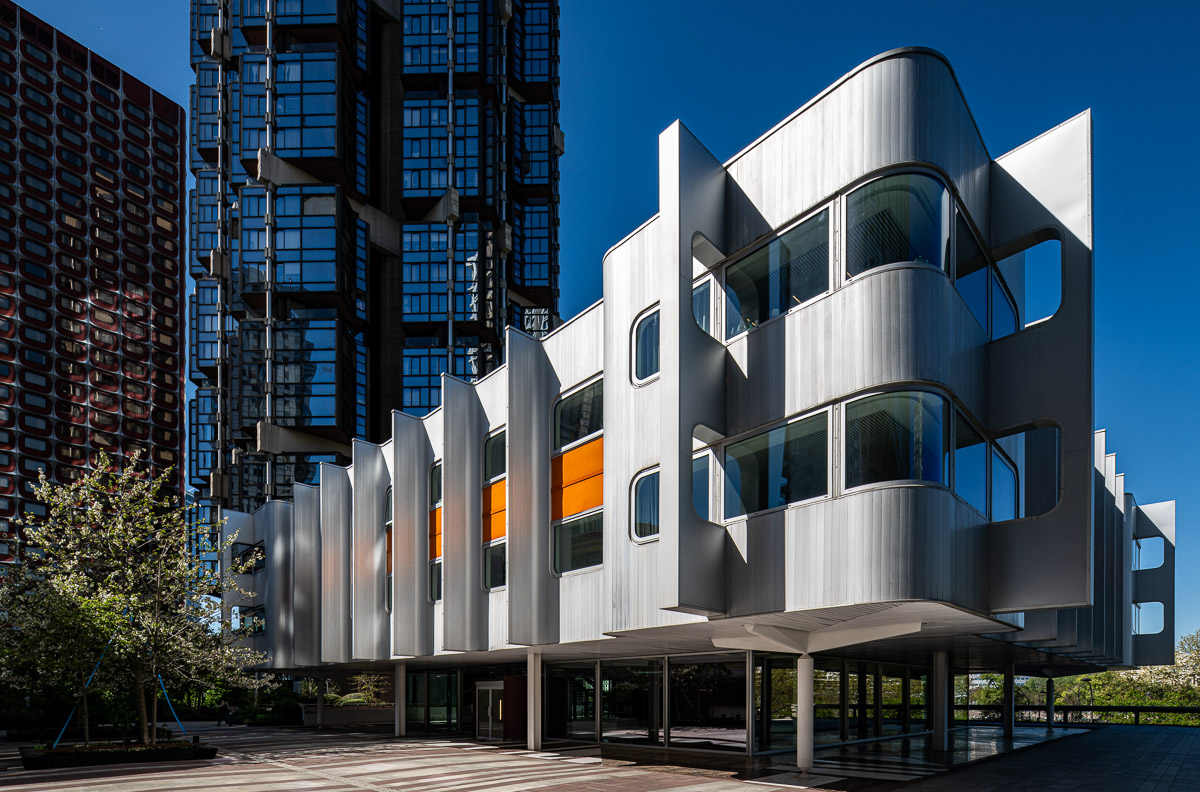
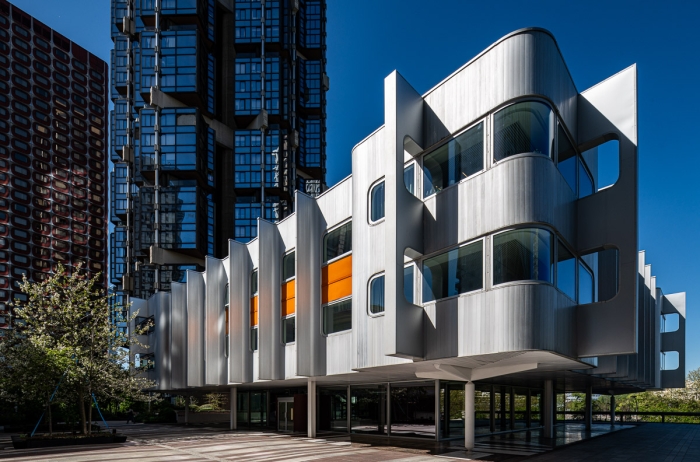
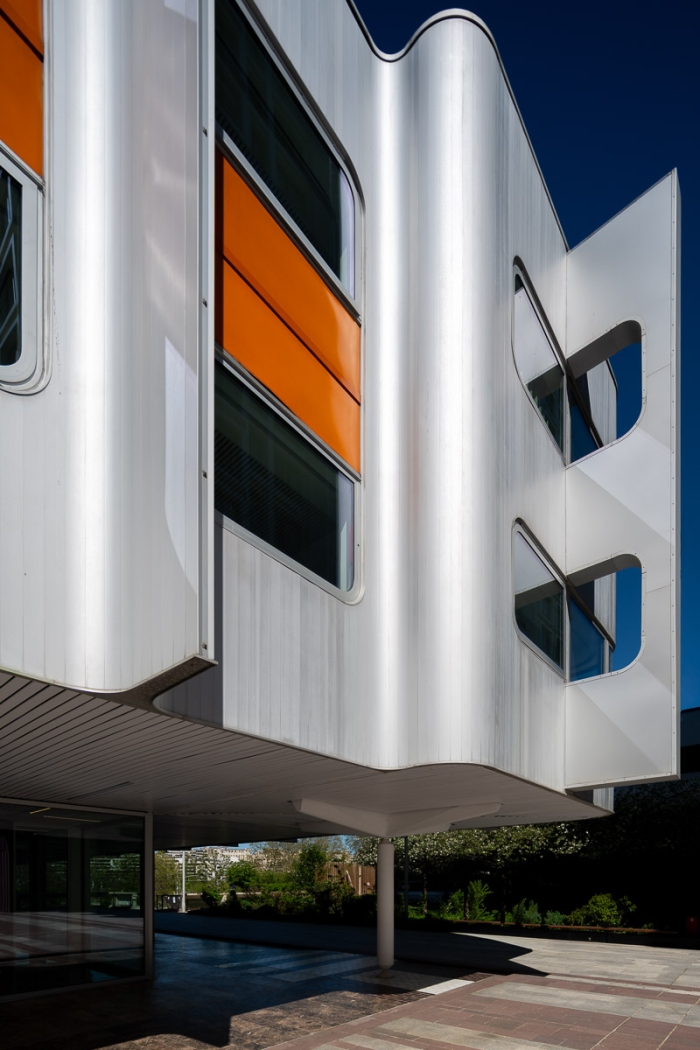
One of the aspects that interested me most on site was this very strong visual impression of a massive volume set down with great lightness. The glazed, widely open ground floor partly erases the base of the building. The pilotis, slender in relation to the mass they support, reinforce this sensation even further. The building does not simply appear to be built on the slab: it seems suspended above it.
This relationship between apparent heaviness and perceived lightness is fascinating to photograph. By walking around the building, you realise that its design rests on a subtle balance between solid and void. The opaque aluminium façades capture the light, while the large transparent areas of the lower level create a sense of breathing space. The architecture then becomes almost choreographic: it advances, recedes, opens, folds back, all while maintaining an immediate coherence.
Aluminium, light and colour: my photographic reading
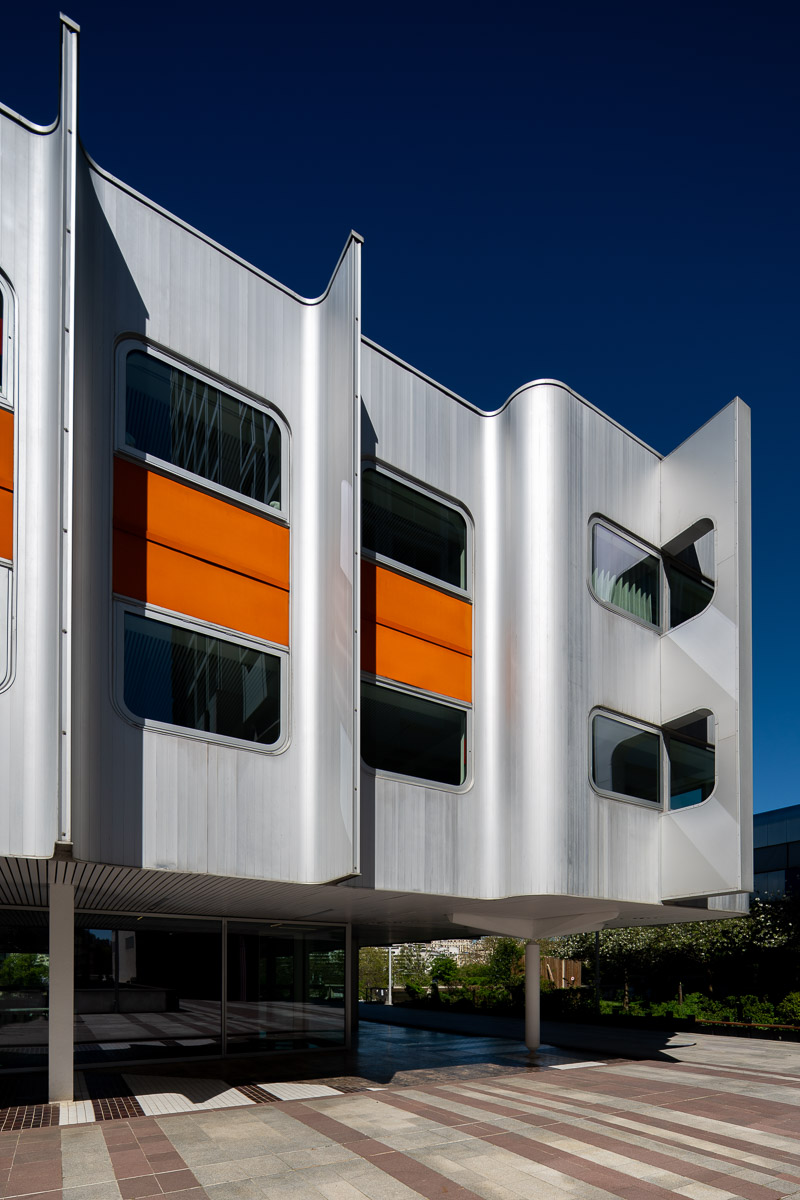
The light on that spring day played an essential role in my reading of the building. Aluminium cladding is never neutral. Depending on the angle of the sun, it becomes matte, satin-like or almost liquid. It reveals very subtle silvery nuances, which the shadows structure without crushing. The edges, the vertical ribs and the curves each catch the light differently, giving unexpected depth to a façade that is otherwise very restrained in its palette.
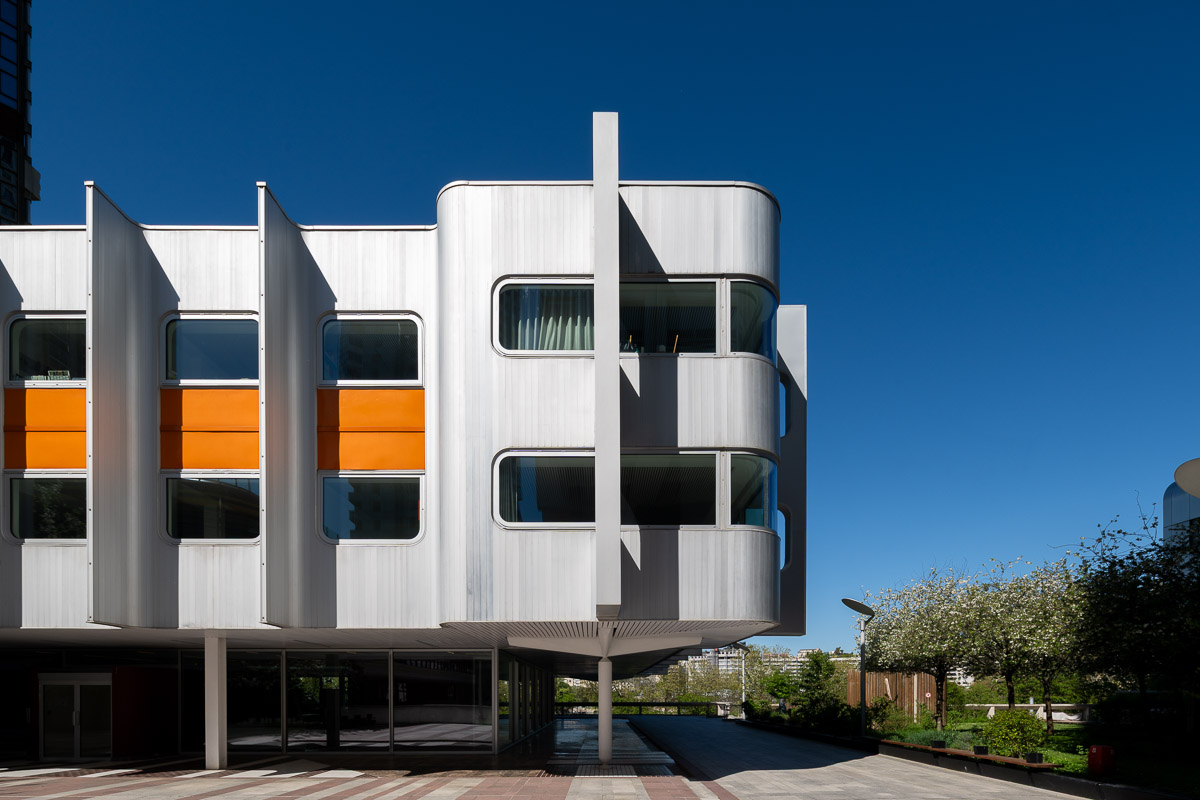
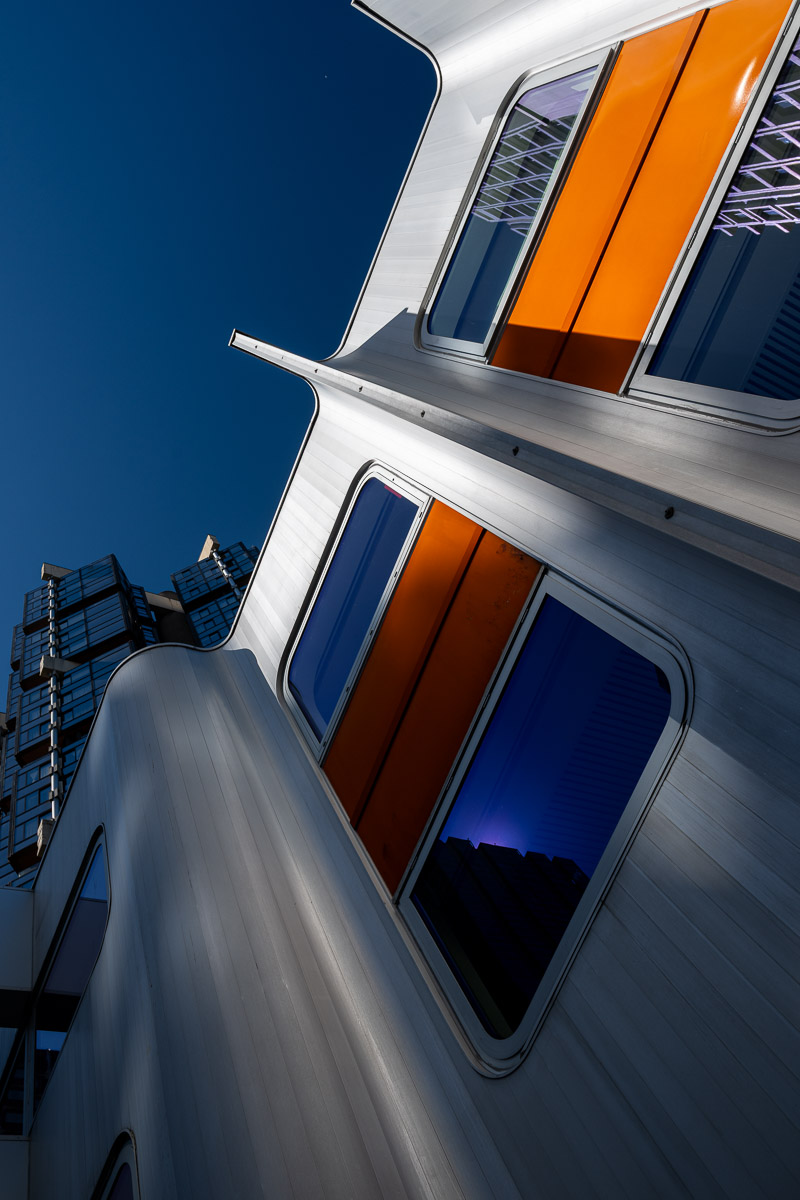
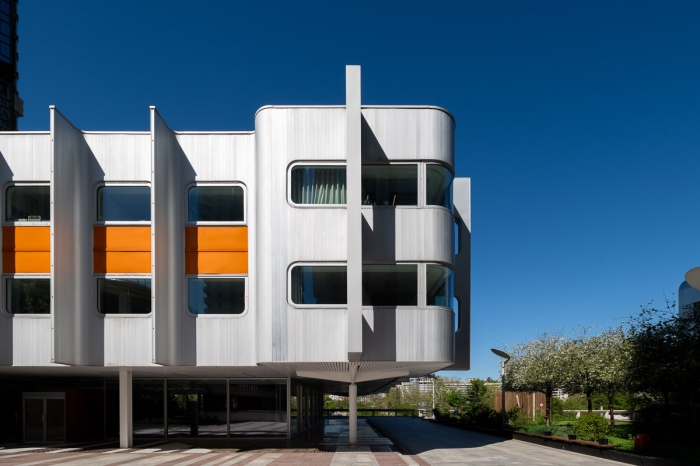
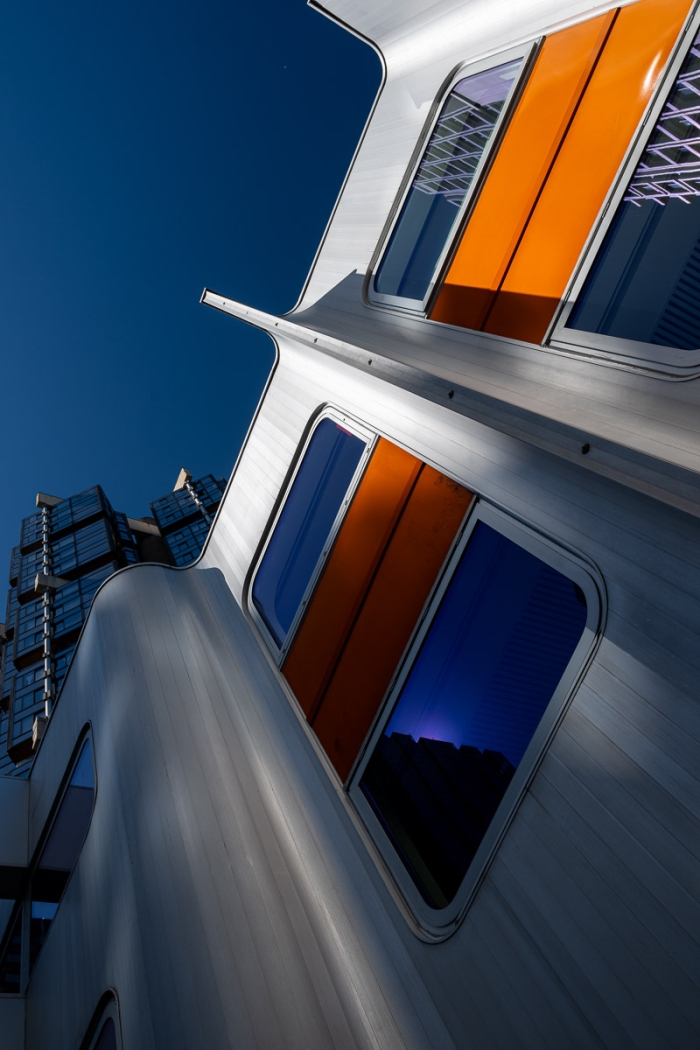
The contrast with the orange panels immediately caught my eye. Against this metallic background, that warm colour acts as a very strong visual accent. And with the pure blue of the sky, the whole composition takes on an almost graphic intensity. I saw in it a simple and effective dialogue between three elements: the silver of the aluminium, the orange of the panels and the blue of the sky. This triad was enough to build strong images, without any need for additional effects.
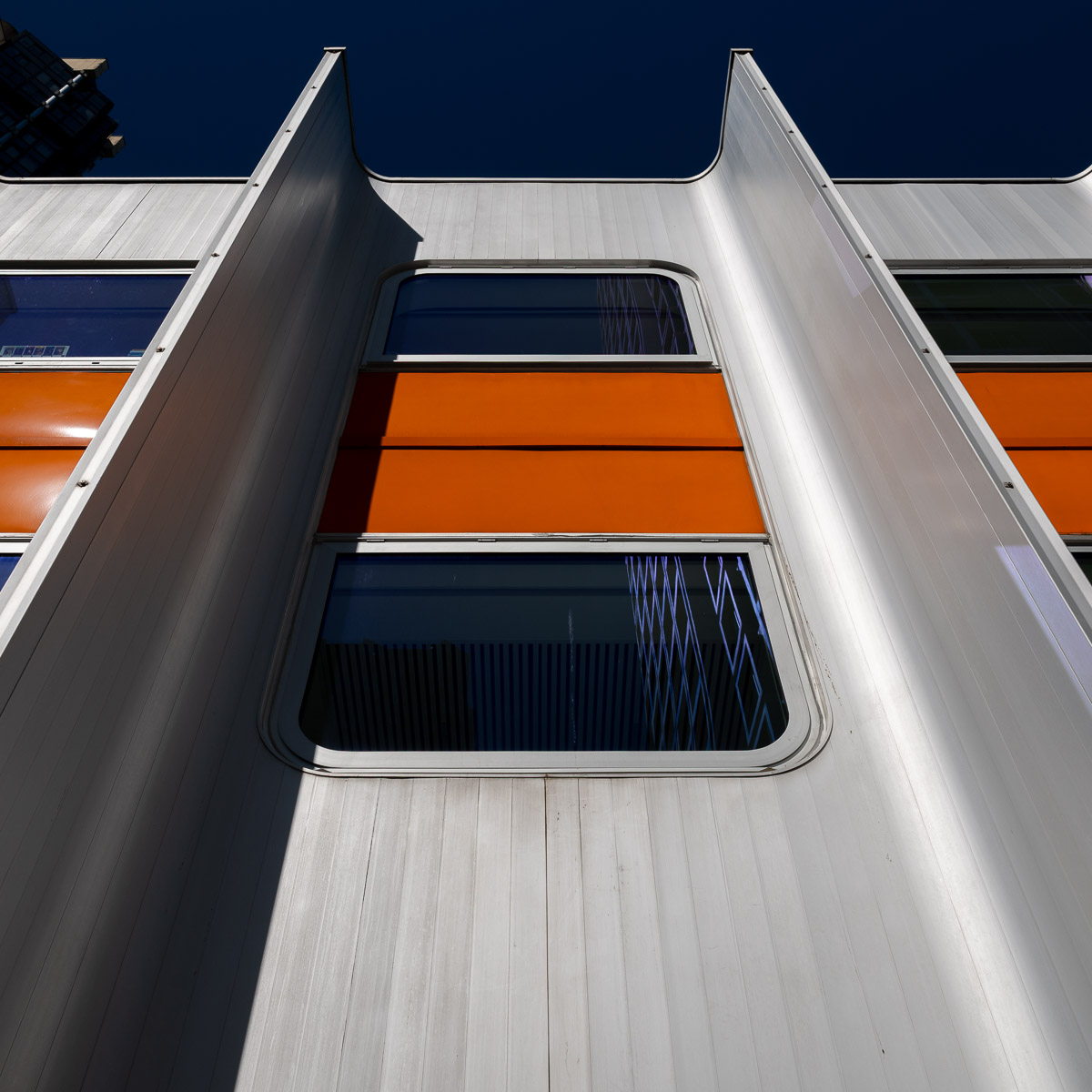
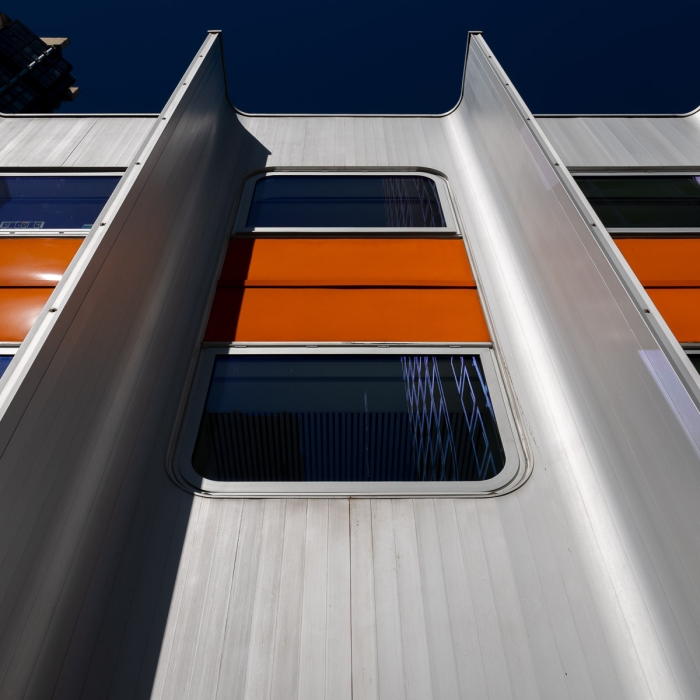
I also liked the tension between the curved forms of the corners and the sharper crispness of certain edges. Orion 55 is not a cold building. It is precise, yes, but never rigid. Its curves soften its industrial character, while the blades and façade setbacks introduce an almost musical rhythm.
Photographing Orion 55: curves, lines and low-angle views
When faced with a building like this, architecture photography is as much about revealing a logic as it is about constructing a point of view. I tried to show Orion 55 through several complementary readings: first as a general volume set within the Beaugrenelle landscape, then as an isolated sculptural object, and finally as a succession of details where the material, joints, glazing and overhangs become subjects in their own right.
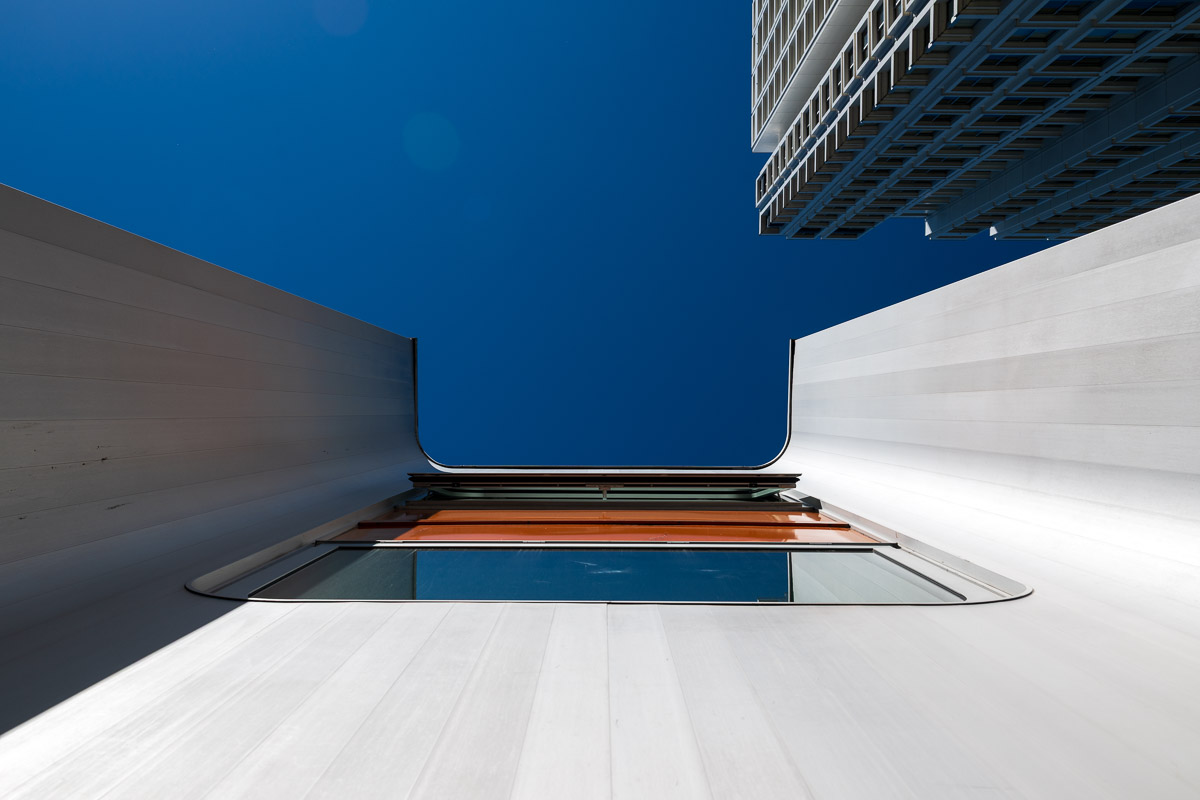
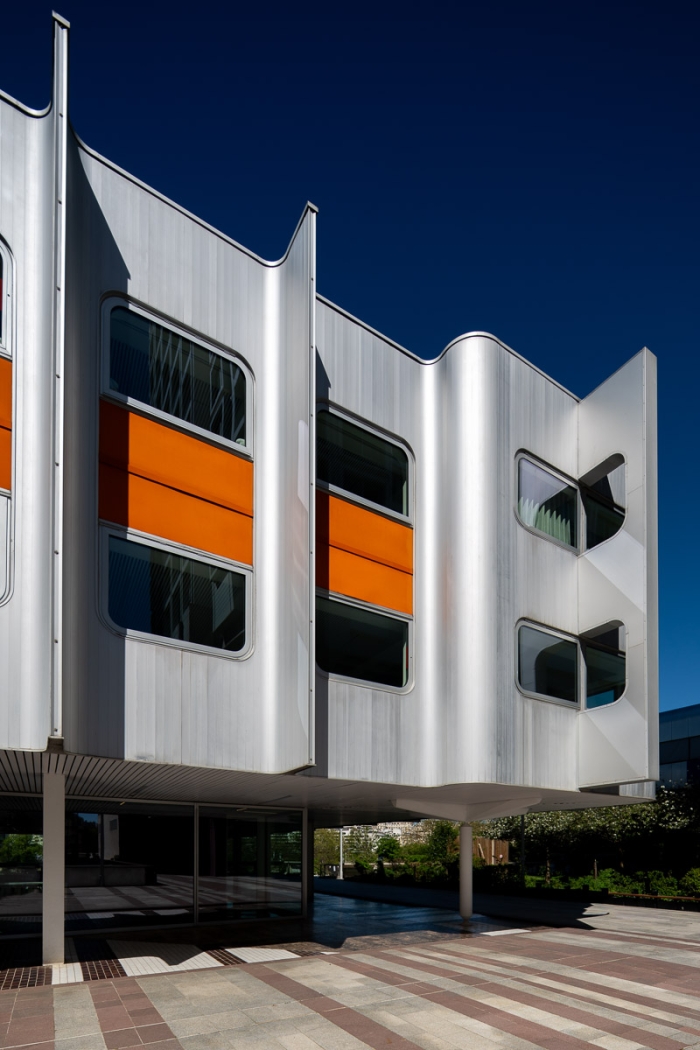
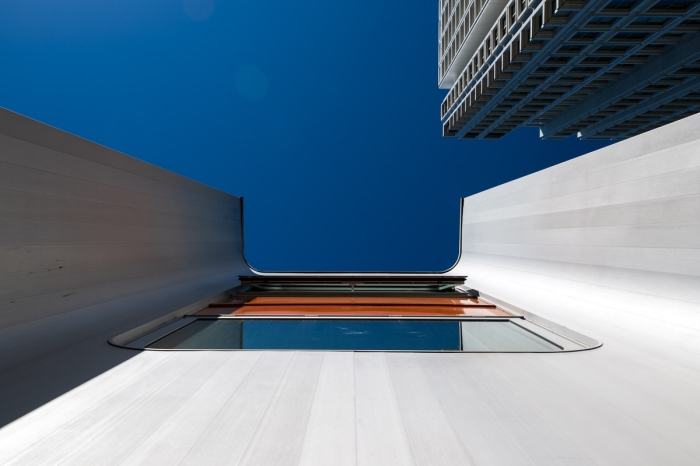
The wider views make it possible to understand its position on the slab and its dialogue with the neighbouring towers. Tighter framings, meanwhile, emphasise the curves, the recesses and the finesse of the design. Low-angle shots were particularly interesting here, because they accentuate the presence of the pilotis and the feeling of floating. They also allow the façades to rise into a uniform sky, ideal for simplifying the image and reinforcing its graphic impact.
In some framings, Orion 55 becomes almost abstract. The rounded-corner windows, the orange bands, the blue reflections and the folds of the aluminium cladding then form an autonomous visual vocabulary. This transition from the real building to a more graphic reading is one of the pleasures of architecture photography.
Why Orion 55 matters in the Parisian landscape
People often speak of great monuments, spectacular architecture or buildings signed by instantly recognisable names. Orion 55 reminds us that a more discreet building can nevertheless encapsulate an entire moment in Parisian architectural history on its own. It condenses the aesthetic of the Front de Seine, the experimental spirit of the 1970s, the constructive intelligence inherited from Jean Prouvé, and this desire to bring metal, glass, colour and structure into dialogue.
Its recent refurbishment has also restored the full readability of this architectural language. Today, the building does not merely survive as a witness to the past: it has become visible, legible and photographable once again. And that is no doubt what pleased me when I discovered it. Orion 55 is not a nostalgic backdrop. It is a living building, one that continues to generate images, sensations and questions about the way Paris once dreamed of modernity.
For a photographer, this type of architecture is precious. It forces you to slow down, to walk around it, to observe the light, to understand the relationships of scale and to accept that a detail can sometimes say as much as the whole. Orion 55 gave me exactly that: an architecture with character, a subtle play between mass and lightness, and visual material of great richness. A fine reason to go and look elsewhere than where one usually photographs.
Click on the photos below to view them full screen.
All the photos displayed on this website are copyright protected © Sebastien Desnoulez. No use allowed without written authorization. Legal notice
About the Author
Sebastien Desnoulez is a professional photographer specializing in architecture, landscape and travel photography. Trained in photography in the mid-1980s, he covered Formula 1 races and reported from around the globe before devoting himself to a more demanding fine art photography practice blending composition, light and emotion. He also shares his technical expertise through hands-on articles for passionate photographers, built on a solid background in both film and digital photography.
Tags