


Saint-Quay-Portrieux diving board, long exposure photography, a mirror and parallel worlds

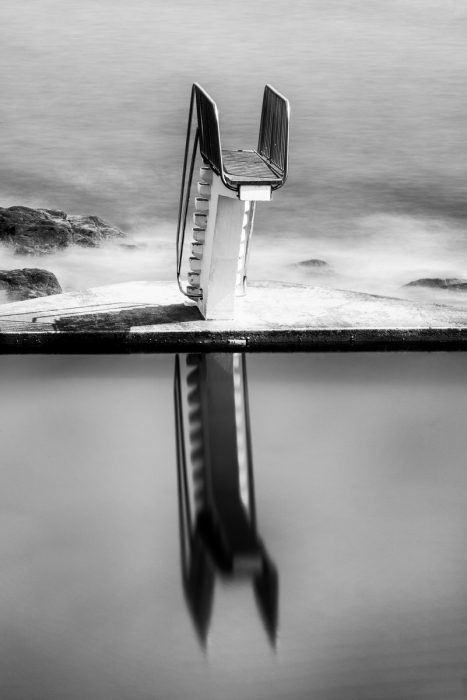
A one-minute exposure at noon is sometimes enough to turn an ordinary scene into a calm, uncanny photograph. In Saint-Quay-Portrieux, the diving board of a seawater pool becomes a graphic sign, cut out against the air and extended by a darker reflection. The sea churns against the rocks, but inside the pool the water smooths out, as if time had shifted rhythm.
A seawater pool in Saint-Quay-Portrieux
Saint-Quay-Portrieux, on the coast of Cotes-d'Armor in Brittany, has that unmistakably maritime presence where built structures seem to converse with the ocean. A seawater pool is not just a basin, it is a threshold. It belongs to the sea through its water, yet it belongs to the town through its concrete, its angles, its railings, its uses.
The diving board itself is purely utilitarian. You see it, then you forget it. On an ordinary day, it tells nothing beyond its function. That is precisely what draws me to it in the Ghosts series: elements of reality that have become too familiar to be noticed, and suddenly turn intriguing when you change the relationship to time, material, and light.
A long exposure at noon, yes it is possible
The photograph was made on 07/05/2018 at 12:00. Noon is often dismissed by reflex, because the light can feel harsh and shadows may flatten volumes. Yet noon also offers something precious: clarity. Shapes are clean, edges are crisp, and the scene becomes almost graphic.
A long exposure at that hour can feel paradoxical. We instinctively associate long exposure with low light, dawn, dusk, or night. At noon, however, long exposure is not about catching light, it is about changing the nature of motion. Here, it turns the ripples on the pool surface into a mirror, while letting the sea express its turbulence against the rocks.
This is not a full backlight. The sun sits to the front-right, catching the side of the diving board. That detail matters: a thin touch of lateral light is enough to reinforce relief, material, and especially the subject's outline against the background.
Three contrasts that structure the photograph
This image holds together through simple, almost physical oppositions. Nothing needs to be added, the subject already carries its own quiet tension.
- Churning sea vs calm water: at the top of the frame, seawater seems to boil against the rocks. In the foreground, inside the pool, the long exposure smooths the surface and turns it into a mirror.
- A crisp diving board vs a darker, slightly soft reflection: the board, mineral and high-contrast, stands sharply in the air. Its reflection is denser, darker, and a bit fuzzy, as if the image had shifted into another state.
- Fixed concrete vs transforming water: the edge, the basin, the diving board, everything is still. The water moves, but long exposure converts it into material, smooth or milky depending on the area.
These contrasts keep the eye working. The photograph reads like a tilt between two regimes: the top is lively, agitated, brighter. The bottom is calm, darker, almost meditative.
Two parallel worlds, a concrete boundary
The concrete edge plays a central role. It is not only a compositional line, it becomes a narrative boundary. It separates two parallel, nearly symmetrical worlds, without being perfectly identical. That imperfect symmetry is exactly what creates tension.
Above sits the "outer" world, the sea, the rocks, the energy of the coastline. Below is the "inner" world, a calm surface, a mirror, a depth that seems to absorb light. The diving board links these two spaces. It belongs to the concrete, yet points toward water. It is direction, sign, and tool at once.
This two-level reading is not staging. It already exists on site. The long exposure and the framing simply reveal it. And that is where an ordinary subject becomes interesting, not because it turns exceptional, but because it becomes visible again.
Settings, method, and key points
The EXIF data indicates an exposure of 60 seconds, at f/22 and ISO 50, with a focal length of 165 mm on a AF-S 80-200 mm f/2.8 zoom, using a Nikon D800 body.
| Parameter | Value |
|---|---|
| Date | 07/05/2018, 12:00 |
| Camera | Nikon D800 |
| Lens | 80-200 mm f/2.8 |
| Focal length | 165 mm |
| Shutter speed | 60 s |
| Aperture | f/22 |
| ISO | ISO 50 |
Shooting at 165 mm is not neutral. This focal length slightly compresses planes, simplifies the scene, and strengthens the graphic feel. The diving board becomes a shape. Unnecessary elements leave the frame more easily. You get closer to a minimalist writing, while keeping real depth in materials.
To make this kind of photograph work, a few points matter:
- Stability: a solid tripod, remote release or self-timer, and attention to wind. At 60 seconds, the smallest vibration leaves a trace.
- Light control: at noon, reaching 60 seconds means reducing light. Closing down to f/22 and dropping to ISO 50 are two levers. Depending on conditions (thin clouds, haze, contrast), an ND filter can also help, but it is not always required.
- Reading motion: the sea and the pool do not move the same way. Long exposure does not "freeze" water, it synthesizes it. It can become smooth or milky depending on the energy of the movement.
- Sun position: here the sun to the front-right lights the side of the diving board slightly. That gentle modelling prevents a flat silhouette and reinforces separation from the background.
A note on f/22: stopping down that far increases depth of field, but also introduces diffraction. In this case, diffraction is not an issue because the photograph is looking for material, density, and simplified detail rather than extreme micro-contrast sharpness.
Why black and white makes sense here
Black and white strengthens the core of the subject: structure, material, boundary, reflection. Color could have introduced secondary information, the sky tint, the sea hue, concrete variations. Here, I prefer a more direct, almost tactile writing, where light and form become the main language.
Black and white also lets the duality of the image fully exist: a brighter, more agitated top, and a darker, more peaceful bottom. This is not a decorative contrast, it is a contrast of rhythm. The photograph suggests a shift, as if the same place contained two different speeds of the world.
Making an ordinary structure visible again
Many people walk past this diving board without seeing it. It is part of the scenery, like a repeated sentence. Photography has a rare ability to bring mystery back to what no longer has any. Not by inventing, but by revealing. A one-minute exposure does not change the place, it changes our perception. It highlights a simple truth: what we call "ordinary" is often just "unseen".
In the Ghosts series, that idea returns again and again. Everyday forms become silhouettes, signs, apparitions. The reflection here is not an effect, it is a double. It is darker, slightly soft, as if the diving board had its own separate shadow, laid into the water.
This kind of photograph appeals to me because it remains calm, yet it leaves a question hanging. What are we looking at: a structure, a threshold, a passage, a simple piece of equipment, or a boundary between two worlds coexisting in the same place?
This photograph is available as a limited edition of 12 fine art prints on the gallery Une image pour rêver.
Click the photo below to view it full screen.
All photos displayed on this website are copyright protected © Sebastien Desnoulez. No use allowed without written authorization.
Legal notice
FAQ long exposure and sea photography
Can you make an interesting long exposure at noon?
Yes. At noon, long exposure is less about gaining light and more about transforming motion. Water becomes material, a mirror or a veil, and shapes simplify.
Why choose a 60-second exposure here?
One minute is enough to smooth the pool surface and create a dense reflection, while keeping the sea dynamic and the coastline readable.
Do you absolutely need an ND filter to shoot 60 seconds in daylight?
Not always. It depends on the actual light (thin clouds, haze, contrast) and on the settings you can use (low ISO, small aperture). An ND filter remains very useful when the scene is too bright.
Why f/22 despite diffraction?
Because the image aims for a graphic writing and comfortable depth of field rather than extreme sharpness. In this context, diffraction is not a problem.
How do you avoid camera shake during a long exposure?
Use a stable tripod, remote release or self-timer, and watch for wind. By the sea, protect your gear from spray and pay attention to micro-vibrations.
About the Author
Sebastien Desnoulez is a professional photographer specializing in architecture, landscape and travel photography. Trained in photography in the mid-1980s, he covered Formula 1 races and reported from around the globe before devoting himself to a more demanding fine art photography practice blending composition, light and emotion. He also shares his technical expertise through hands-on articles for passionate photographers, built on a solid background in both film and digital photography.
Tags