


Building an Image Over Time: Long Exposure at Gwin Zegal

Why do some photographs take several years to come to fruition? An example at the port of Gwin Zegal in Brittany, through a long exposure approach.
In landscape photography, everything does not happen at the moment you press the shutter. Some images are not born from a decisive moment, but from an intention that refines itself over time, through repeated visits to the same location, changing light, and evolving natural conditions.
The port of Gwin Zegal in Brittany is one of those places that imposes its own rhythm. Discovered in 2018, it immediately made me want to work there using long exposure. But between the initial intuition and the final image, several years passed. Not to learn, but to refine an intention and wait for the right conditions.
Gwin Zegal, a unique Breton port to photograph
Located in a sheltered cove in the Côtes d’Armor, the port of Gwin Zegal is distinguished by its tree trunks driven into the sand, to which the boats are moored. This ancestral system creates a strong visual structure, particularly compelling in photography.
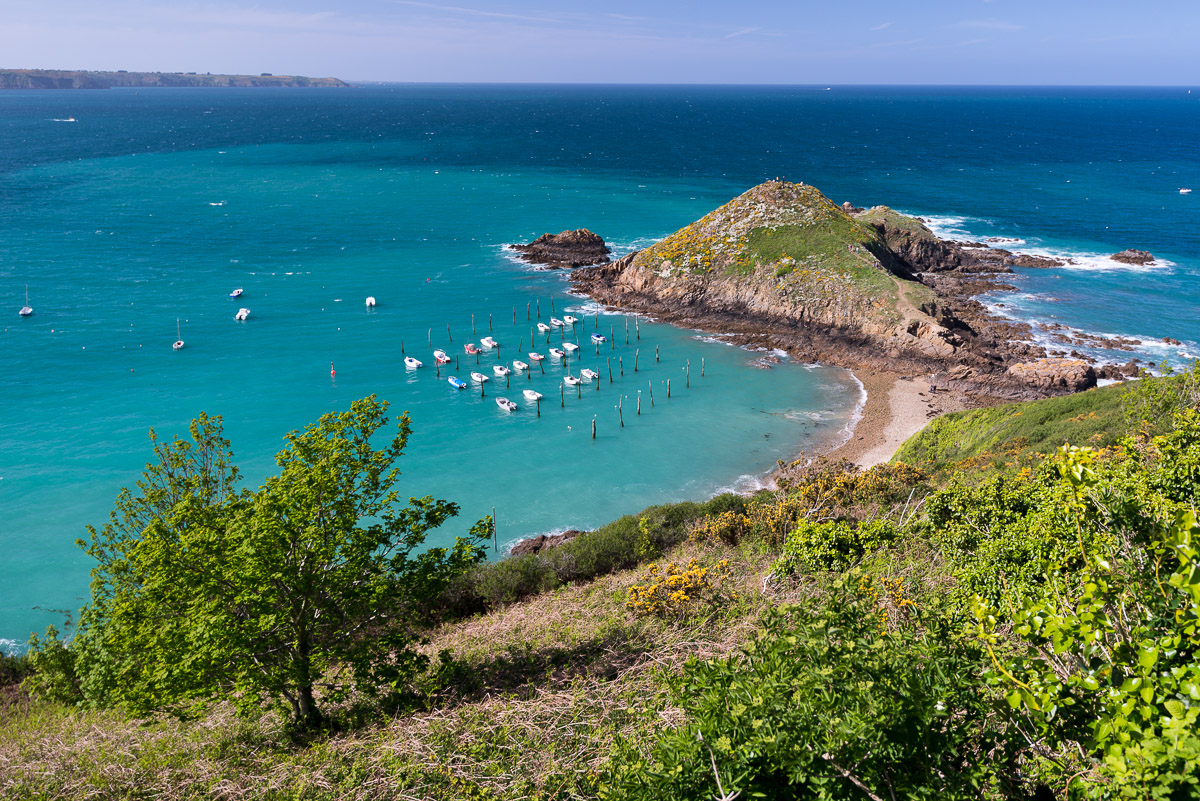
Port of Gwin Zegal, 2018, Photo: © Sebastien Desnoulez
Depending on the tide, the landscape changes dramatically. At low tide, the boats rest on the sand. At high tide, they float, animated by the movement of the water. This contrast makes it an ideal playground for long exposure photography.
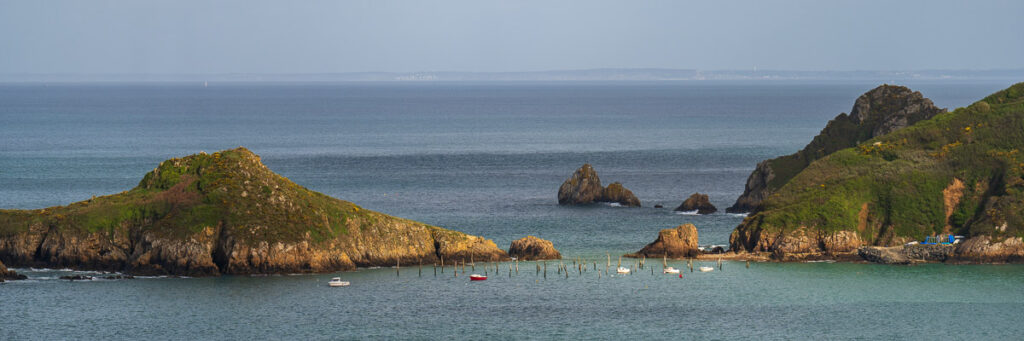
Port of Gwin Zegal 2026 - Photo: © Sebastien Desnoulez
2018: a first long exposure composition
During my first visit, the idea of a long exposure immediately emerged. The goal was to smooth the sea and create a contrast between the movement of the boats and the stillness of the wooden posts.
However, this first attempt remained a test. The framing, shot at 50mm with a visible horizon, did not yet allow for sufficient simplification of the scene. A 15-second exposure combined with a 45° backlight produced overly strong contrasts that disrupted the visual reading.
The image works partially, but remains descriptive, with a composition that feels too busy to reveal a true visual language.
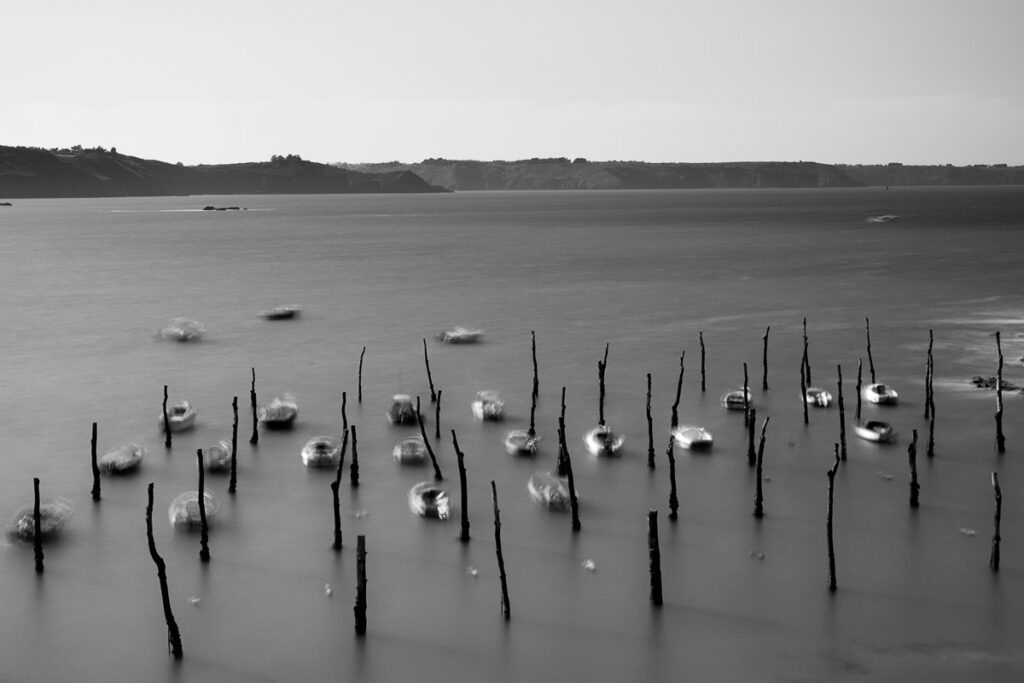
Port of Gwin Zegal, 2018, 50mm, 15s, f/8, Photo: © Sebastien Desnoulez
Long exposure: technical constraints and field choices
This first approach highlights an important point: long exposure alone is not enough. The final result depends as much on shooting conditions as on technical decisions.
Without an ND filter, or with a low ND value (<ND32000), the exposure time remains limited. In this type of scene, however, a few seconds are not enough to transform the moving elements. The boats retain too strong a presence, and the reflections become undesirable areas of contrast. To prepare this type of setting in the field, the long exposure calculator with ND filter helps quickly estimate the required exposure time from the exposure measured without the filter.
This technical constraint confirmed the initial intuition: to achieve the desired image, it would be necessary to return under different weather conditions and adopt a new point of view. This approach is part of a broader long exposure practice that I explore in this article on long exposure landscapes in Brittany.
Returning with a precise intention
Returning to a location does not mean repeating a shot. On the contrary, it is a deliberate approach, guided by a clear vision of the image to be created.
In this case, the objective remained unchanged from the beginning: to use long exposure to transform the presence of the boats and highlight the structure of the wooden posts as the main subject.
This requires waiting for specific conditions: high tide, soft light, and the ability to shoot exposures lasting several minutes.
Port of Gwin Zegal, 2019, 86mm, 2min, f/11, Photo: © Sebastien Desnoulez
2022: photographing Gwin Zegal at low tide
When returning in 2022, the port appeared at low tide. The boats were resting on the sand, motionless, at the base of the mooring posts.
This configuration offered a completely different reading. Movement disappeared, giving way to a more graphic, almost documentary scene. It was no longer the same photograph, nor the same subject.
This was not about improving the initial image, but about exploring another facet of the location. An interesting variation, but one that moved away from the original intention based on movement and its disappearance.
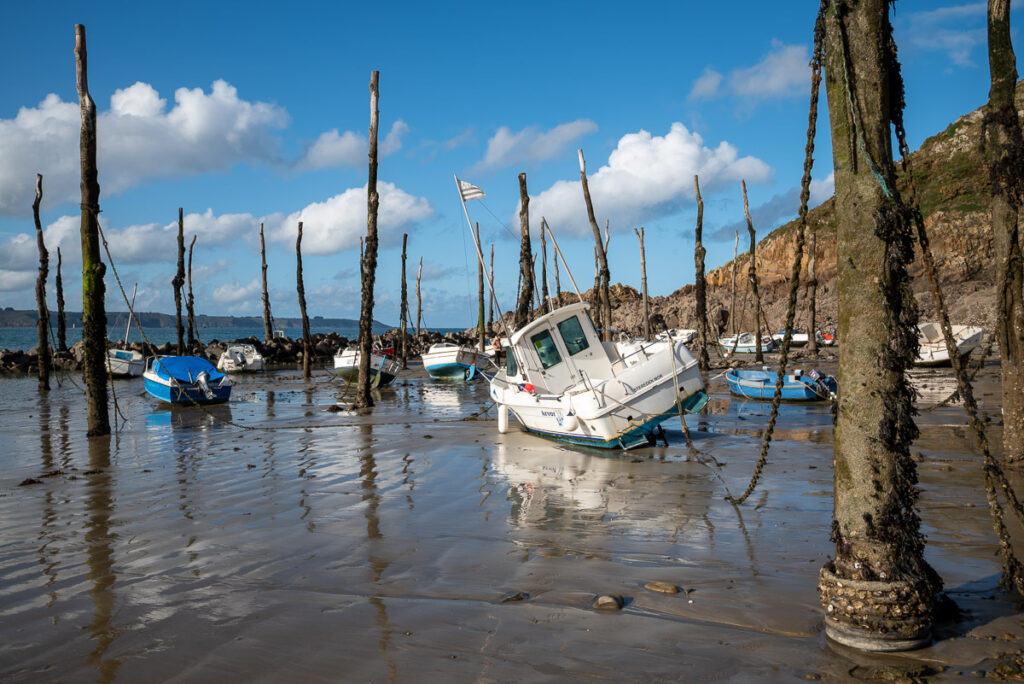
Port of Gwin Zegal, 2022, Photo: © Sebastien Desnoulez
2026: bringing together the right conditions
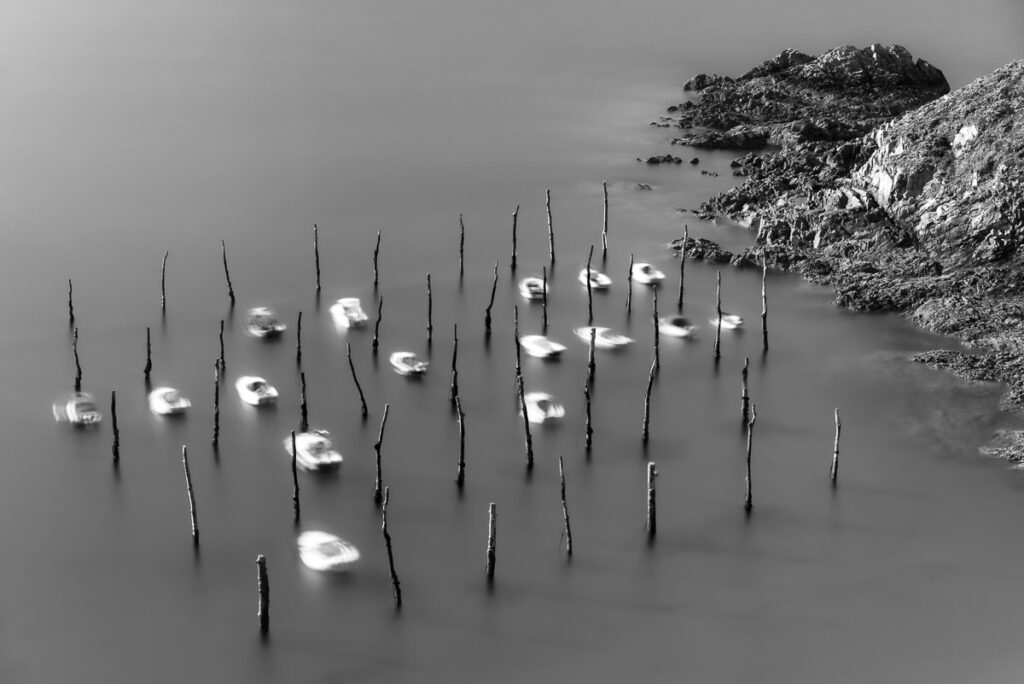
This year, the conditions finally came together. The sky was overcast, the light soft, and the tide high. My ND32000 filter allowed exposure times of up to 4 minutes.
At this duration, the transformation is radical. The boats are no longer distinct elements, but become blurred, almost ghost-like traces. The water becomes completely smooth, creating a uniform surface that clarifies the perception of the image.
The wooden posts remain perfectly sharp. They structure the composition and become the true subject. In a large-format fine art print, the richness of the bark textures contrasts with the sea, transformed into a satin-like, almost metallic surface by the 4-minute exposure, creating a visual tension between detail and abstraction.
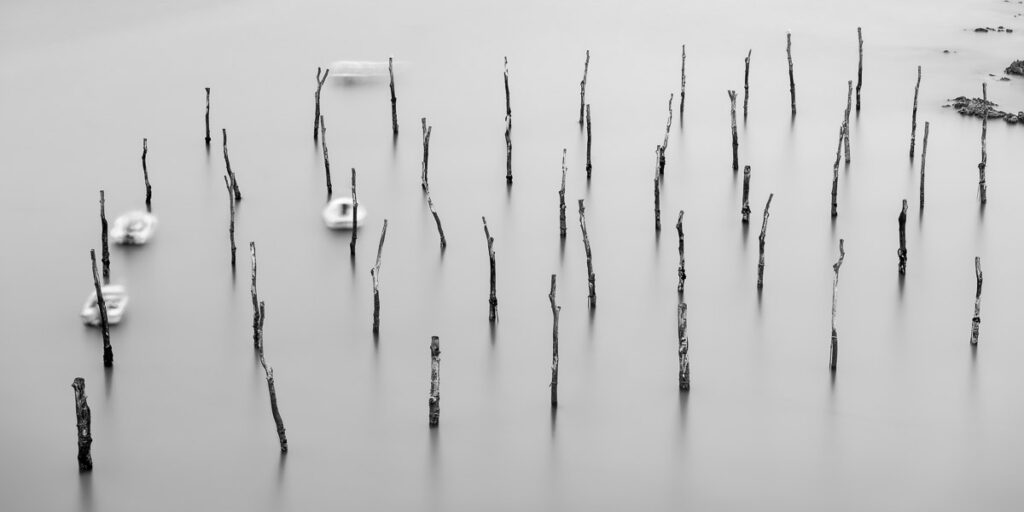
Port of Gwin Zegal, 2026, 71mm, 4min, f/5.6, Photo: © Sebastien Desnoulez
The final image: refining the composition
In the most accomplished image, the framing evolves to strengthen the composition. The posts occupy the left side, arranged in a vertical rhythm. On the right, the rocks add a dense mineral mass, contrasting with the lightness of the water.
At the center, the smooth surface of the sea creates a visual breathing space. The whole composition relies on a balance between structure and material, repetition and rupture.
The framing excludes the boats, reducing the image to three elements: water, rock, and wood. At 4 minutes of exposure, the sea becomes a perfectly smooth surface.
What was once a harbor becomes an almost abstract composition, built on lines, rhythms, and contrasts.
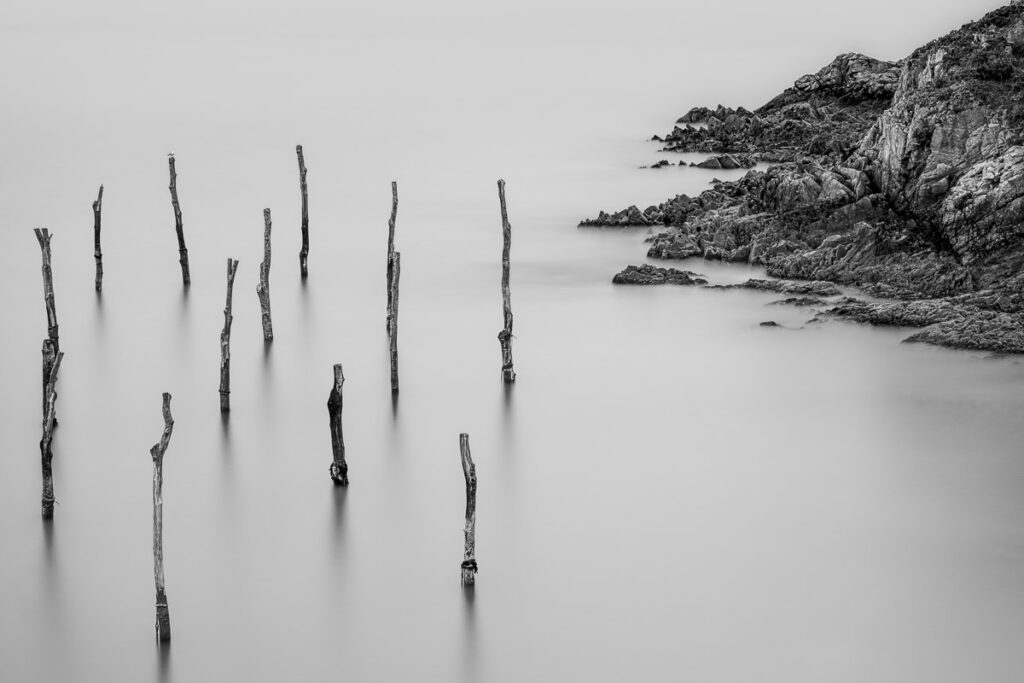
Port of Gwin Zegal, 2026, 105mm, 4min, f/5.6, Photo: © Sebastien Desnoulez
Building an image over time
This series created at Gwin Zegal illustrates a reality often overlooked in landscape photography: some images are built over time.
Not in terms of exposure duration, but as a process. Returning to a location, refining the composition, waiting for the right conditions, adjusting your approach until the image aligns with the original intention.
In the end, photography is no longer just about capturing a landscape. It becomes an interpretation, where each element finds its place, where textures interact, and where the viewer’s eye moves naturally. An image designed to be experienced over time, revealing its full richness in a large-format fine art print.
In photography, the best decision is not always to press the shutter. Sometimes, it is simply to come back.
About the Author
Sebastien Desnoulez is a professional photographer specializing in architecture, landscape and travel photography. Trained in photography in the mid-1980s, he covered Formula 1 races and reported from around the globe before devoting himself to a more demanding fine art photography practice blending composition, light and emotion. He also shares his technical expertise through hands-on articles for passionate photographers, built on a solid background in both film and digital photography.
Tags