


Leica, optical rendering and film photography: understanding a reputation

Why does Leica fascinate photographers so much? The question may seem simple, but it goes far beyond sharpness alone. For decades, Leica has held a special place in the photographic imagination. For some, the brand embodies discretion, mechanical precision and a certain form of optical elegance. For others, it also represents a myth sustained by history, collectors and the prestige of the object itself.
For a long time, I have tried to understand what really built Leica’s reputation: the rendering of its lenses, their compactness, the mechanical quality of the cameras, but also the very particular relationship between the tool, the photographer and their way of seeing.
A recent article about a contemporary replica of a Leica 35 mm f/2 lens made me want to return to this question. The lens in question is described as very sharp in the centre at full aperture, with vignetting, pronounced bokeh and more even image quality when stopped down. In other words, it is not a perfect lens in the modern sense of the term, but a lens with character. That description brought me back to an old question: what really made Leica different in the film photography era?
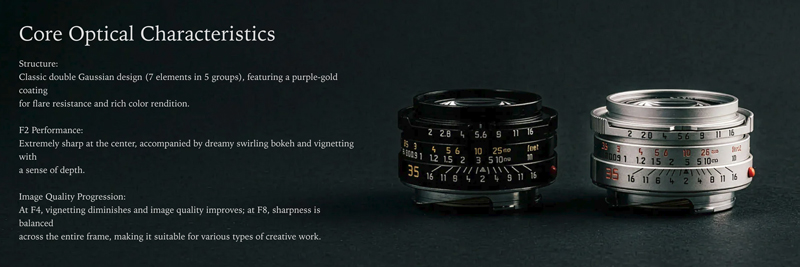
Mandler replica of the Leica Summicron-M 35 mm f/2 version IV
Summary
- Why Leica held a special place among reporters
- Leica rendering: sharpness, contrast or visual signature?
- My experience with a Leica M6
- Can a legendary lens be imperfect?
- Leica versus Nikon and Canon SLRs of the 1980s
- Choosing your equipment, developing your own vision
- Leica today: photographic tool, cultural object and luxury symbol
- Understanding the myth without blindly accepting it
Why Leica held a special place among reporters
Forty years ago, digital photography did not yet exist in everyday professional use. Reporters worked with 35 mm film cameras, often Nikon or Canon SLRs, but some also used Leica cameras for their discretion, quiet shutter release and compactness. A typical example of the equipment carried by photojournalists can be found in the article 9 photographers empty their camera bags.
Photographing in the street, in a silent place, in a theatre, during an intimate moment or in a tense social context does not create the same relationship with the subject depending on the equipment being used. A professional SLR, however excellent, can impose a physical and audible presence. A Leica M, smaller and quieter, allowed another kind of approach. Its reputation therefore did not come only from its lenses, but also from a way of photographing.
The rangefinder viewfinder allows the photographer to see what is happening around the frame. Unlike an SLR, where one looks exactly through the lens, the Leica offers a more open, almost anticipatory view. Some photographers find great fluidity in this: they can compose, wait for a person to enter the frame, then release the shutter at the right moment.
But this quality also has its downside. A rangefinder viewfinder does not show exactly what the lens sees. It imposes a different relationship to framing, edge precision, level and verticals. This is where my own experience with Leica was more nuanced.
Leica rendering: sharpness, contrast or visual signature?
When people talk about “Leica rendering”, they often talk about sharpness. Yet that is an oversimplification. A lens can be highly resolving and still produce a rather cold image. Another may be less perfect in the corners, yet create an image that feels denser, more legible and more alive.
The rendering of a lens depends on many factors: overall contrast, microcontrast, the transition between sharp and out-of-focus areas, vignetting, the handling of highlights, flare resistance, distortion, field curvature and mechanical consistency. Reducing a lens to resolution alone often means missing what gives it its identity.
Leica lenses have long been admired for their compactness, manufacturing precision and rendering. With classic focal lengths, especially 35 mm and 50 mm, the rangefinder system also allowed optical designs that differed from those used on SLRs. The absence of a mirror made it possible to design shorter, more compact lenses, sometimes simpler in construction.
So the Leica difference was not simply about measurable superiority on every level. It was more about a balance between compactness, construction, rendering and the experience of use.
My experience with a Leica M6
I briefly used a Leica M6 myself in 1995, with an Elmarit-M 28mm f/2.8 III. I came from many years of using Nikon and then Canon SLRs, and the experience mainly taught me how much the choice of a camera system depends on the way each photographer constructs an image.
I appreciated the M6 for its compactness and discretion, the absence of vibrations caused by a moving mirror, and the excellent quality of its 28mm lens. On the other hand, its rangefinder viewfinder suited me less well when it came to precisely controlling the edges of the frame and keeping vertical lines parallel. With this relatively bulky Elmarit and its lens hood, part of the image area was also obscured in the lower-right corner of the viewfinder.
I kept the M6 for about three months before selling it. More than thirty years later, digitising the films I shot in Buenos Aires has allowed me to take a much more precise look at that brief experience: the results were better than I remembered, but they also confirm that the M system suited my way of framing less naturally than an SLR.
I have described this experience in detail, together with the photographs I made at the time, in the article Buenos Aires with a Leica M6 during the 1995 Argentine F1 Grand Prix.
Can a legendary lens be imperfect?
A lens can be legendary without being perfect. In fact, this is often the case. Many cult lenses did not become famous because they corrected every flaw, but because they produced a recognisable signature.
An older 35 mm f/2 lens can be very sharp in the centre at full aperture, while showing vignetting, weaker corners, a certain softness in the periphery or a particular transition into blur. Stopped down to f/4, the image becomes more even. At f/5.6 or f/8, it can become very balanced across the frame. This behaviour is not exceptional for a lens of that generation. Many SLR lenses from the 1970s or 1980s improved in the same way.
The real question therefore lies elsewhere: why are some older Leica lenses more sought after than other technically comparable lenses? The answer lies partly in their compactness, mechanical quality and coherence with the camera body, but also in their rendering. A lens is not only a measuring instrument. It is also a tool of interpretation.
What photographers sometimes call “rendering” remains difficult to quantify. It may come from a particular contrast, a softness in transitions, a way of separating planes, a density in the blacks or a sensation of depth. These qualities can be real, but they are sometimes amplified by brand culture, user stories and the rarity of the objects.
Leica versus Nikon and Canon SLRs of the 1980s
It would be unfair to discuss Leica without acknowledging the quality of SLR systems from the same period. Nikon and Canon dominated much of photojournalism, sport, magazine photography and professional photography. Their camera bodies were robust, their lens ranges extremely complete, and their long or specialised lenses answered needs that the Leica M system did not cover in the same way.
For motorsport, stage photography, action, telephoto work, zoom lenses and later autofocus, the SLR was the natural choice. In terms of optical quality, the major Japanese manufacturers were already capable of producing remarkable lenses. On well-exposed film, at f/5.6 or f/8, the difference with Leica could become slight, even invisible, depending on the subject, development, print or digitisation.
The reality is therefore less spectacular than the myth: Leica was not necessarily the best system for everything. It was a very coherent system for certain photographers, certain gestures and certain contexts.
Choosing your equipment, developing your own vision
A photograph depends first and foremost on light, subject, timing and composition. Through composition, the photographer organises what they choose to show and expresses their point of view.
The camera, lens, film or sensor, followed by development or image processing, naturally contribute to the final result. They influence rendering, sometimes impose a particular way of working and can support a precise aesthetic intention. They are not, however, enough to create a vision.
Knowing which lens a photographer used does not make it possible to reproduce their images, any more than adopting the same camera, film or settings. Their work also depends on the way they see, choose a subject, wait for a moment and organise space within the frame.
For a given budget, manufacturers now produce increasingly capable cameras and lenses. All major brands allow photographers to create excellent images. Everyone can therefore choose the system whose ergonomics, lens range or philosophy best suits their practice and the pleasure they find in taking photographs.
Professional equipment from ten or fifteen years ago may have been surpassed in certain respects by a newer generation while remaining remarkably capable. It often provides possibilities far beyond those offered by equipment available thirty or forty years earlier. The arrival of a new range does not suddenly remove the qualities of the cameras and lenses that came before it.
There is therefore no reason to let the reputation of a brand, laboratory benchmark results or the opinion of an admired photographer devalue equipment that was carefully chosen. The tools that suit one photographer will not necessarily suit another.
Rather than searching for a recipe or following trends, it is better to build your own experience: take photographs, test, compare, learn how your equipment behaves and try to push both its capabilities and its limitations. This familiarity with your tools gradually allows you to develop your own path and concentrate on what matters most: conveying emotion.
Leica today: photographic tool, cultural object and luxury symbol
Leica occupies a particular position today. The brand continues to produce cameras and lenses used by demanding photographers who value compactness, simplicity, build quality, rangefinder viewing and the pleasure of using a refined tool.
But Leica has also become a cultural object and a symbol of luxury. High prices, limited editions, rarity, special finishes and historical prestige all contribute to this image. This does not take anything away from the quality of the equipment, but it complicates the way we look at the brand. A Leica is not always purchased solely as a tool. Sometimes it is also bought as a story, a sense of belonging, an aesthetic or a form of distinction.
This phenomenon is not unique to Leica. It exists in watchmaking, cars, hi-fi, fashion and musical instruments. Some objects go beyond their function. They become signs. The danger, in photography, is to confuse that sign with an automatic superiority of the image produced.
This cultural dimension should not make us overlook the tangible value of the user experience. A tool one enjoys using can influence the gesture, attentiveness, concentration and relationship with the subject. Perhaps this is where part of the Leica truth lies: less in the promise of absolute optical perfection than in the quality of a photographic experience.
Understanding the myth without blindly accepting it
Leica is neither a total illusion nor an absolute truth. The brand built its reputation on real foundations: discreet cameras, high mechanical quality, compact lenses, a coherent system for reportage and a major place in the history of twentieth-century photography.
But the legend has sometimes exceeded measurable reality. Not all Leica lenses are perfect. Some are even sought after today for their controlled imperfections: vignetting, softness in the corners, a more organic rendering or a particular transition between sharpness and blur. These are not necessarily the criteria of a modern lens, but they are sometimes those of an image with character.
What keeps Leica alive may be this rare balance between use, craftsmanship, rendering and imagination. It is not just a camera or a range of lenses. It is a system that still makes photographers think about their way of seeing.
About the Author
Sebastien Desnoulez is a professional photographer specializing in architecture, landscape and travel photography. Trained in photography in the mid-1980s, he covered Formula 1 races and reported from around the globe before devoting himself to a more demanding fine art photography practice blending composition, light and emotion. He also shares his technical expertise through hands-on articles for passionate photographers, built on a solid background in both film and digital photography.
Tags