


Film vs Digital Photography: Return to the Roots or Romantic Illusion?

Rediscovering old film archives, handling a Nikon F, or dreaming of a Graflex view camera, the vintage temptation draws in many photographers. But is it truly a return to the roots… or sometimes just a romantic illusion?
Choosing a camera is already laying the foundations of your visual language. Over the decades, technological evolution has granted us increasing freedom: ultra-precise autofocus, high ISO sensitivities, extended dynamic range, lenses delivering sharpness edge-to-edge at full aperture, immediacy… all tools enabling us to explore creative territories that were once out of reach.
But should we, for that reason, reject the tools of the past? And how do we know whether the right choice today lies in returning to film, or investing in a full-frame or even medium-format digital camera? Here are a few reflections shaped by experience, to help informed enthusiasts consider the question with a broader perspective.
The charm of vintage gear
I used two Nikon F bodies from the 1960s for a long time, no light meter, prism viewfinder only. One accompanied me as a third body in my early days; the second, added in 1992 as my “color” body during my first road trip through the American Southwest, embodied an almost ascetic approach, in contrast with my digital EOS-1s on racing circuits.
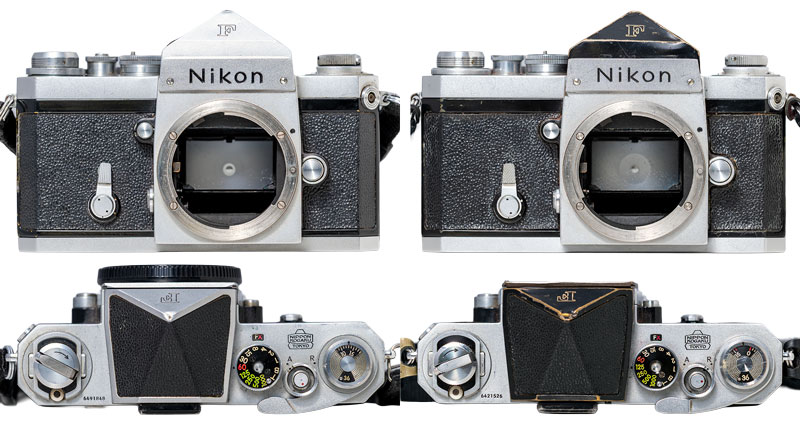
I sold both for around €200 each to fund my Nikon Z lenses. Same for my Nikon F5, the most advanced film camera I ever worked with, which I ended up selling after more than fifteen years of sleeping in my camera bag. Rational decisions… yet not without a twinge of emotion.
There’s something about these tools: functional beauty, timeless robustness, an almost lost elegance, and, with the Nikon F, the satisfaction of making the photograph “by hand”: focus, shutter speed, aperture, helped by a Minolta light meter… and a raw body so solid it felt like you could hammer nails with it.
Today, I still own a 1968 Nikon F Photomic, inherited from my father in 2018, and yet I’ve never loaded a single roll of film into it.
Archives, memory, and regrets
Since starting the digitization of my photo archives, with images taken since 1984, I feel more connection than nostalgia. Each image brings back a place, a light, a camera, a situation. It's as much a mental map as an emotional one.
My only regret, perhaps, is that I sometimes photographed with image banks in mind: perfect framing, “sellable” images, but so few photos of the surrounding context, the streets, the life. New York in 1985, Paris in the late 1980s… I brought back clean shots, but I should have captured more of the city’s atmosphere. That said, with only 36 exposures per roll, we rationed every frame.
Between the lure of a compact and a return to the roots
Recently, I too felt tempted by a partial return to film, not out of nostalgia, but to reawaken something. I thought about picking up my Nikon F again, mounting a 24 mm lens, loading a roll of HP5, and shooting a film, just like between 1985 and 2000, to find a mindset, a rhythm, an alternative creative mode.
At the same time, I considered buying a small camera I could always have with me. I explored the idea of a Canon EOS M with its 22 mm lens (35 mm equivalent), a simple and efficient setup. I also looked at high-end compacts like the Leica D-Lux 8, its twin Panasonic LX100 II, the Sony RX100 V, and the Canon PowerShot G5 X Mark II, all offering bright lenses, discreet bodies, and electronic viewfinders.
The desire was there: image quality beyond what my smartphone offers, with pro-like ergonomics in a compact body that fits in a pocket.
But very quickly, I reconsidered. Why invest in a system that, as appealing as it may be, imposes compromises? When I go out with my bag, my Z lenses, and my cameras, I know I can shoot anything, with the quality and precision I expect. Technical flexibility isn’t a luxury; it’s a condition for creative freedom. And that realization also fed the desire to write this article.
The ruined temple of film photography

Beirut, Place des Canons, October 1991 - On the left, the making-of by Fabrice de Pierrebourg; on the right, my photograph shot with a Nikon F and an 18 mm f/4 on Ilford HP5. Photo: © Sebastien Desnoulez
From time to time, I browse second-hand listings as a mental exercise, a way of imagining myself using a Nikon F, a Hasselblad 500, a Fuji 6x9, a Graflex view camera, or a Zenza Bronica. But each time, reality catches up: developing film, scanning it, archiving it… all of that takes time I no longer have.
I learned photography the hard way, shooting film in every condition, sometimes up to twenty rolls a week during my ten most intense agency years. Today, I enjoy being able to free myself from a technique I’ve mastered, so I can focus fully on the subject: how to showcase it, how to interpret it in my own way.
In parallel, I sometimes reread old issues of Photo Reporter, the magazine that first made me want to become a photojournalist, I recently bought around forty back issues. Page after page, the graveyard of vanished brands keeps growing.
That is why shortcuts can be misleading: buying a 1976 Leica R3 with a 50 mm lens today, then loading it with Kodak Portra designed in 1998, will not suddenly produce an “1980s film look.” The resulting images will belong to a blend of eras.
At best, this gear gives your images a strong aesthetic, a nostalgic “form” that can feel out of sync with the “content” of what you’re photographing. A delicious illusion, perhaps… but an illusion nonetheless.
It’s not the camera that makes the photograph
This article is not meant to retrace the technical history of the shift from film to digital to mirrorless, but rather to examine the desire for vintage gear.
Of course, in a deliberate artistic approach, constraints can boost creativity. But in everyday practice, why impose technical limits?
Trends and social media
So why this renewed popularity of film? For some, it’s a way to learn the fundamentals. For others, it’s an aesthetic shortcut.
Photography remains a language. The gear does not create emotion, the eye does.
I also understand that for some, these limitations are part of the pleasure.
I truly respect those who love vintage objects. My point is not to criticize, but to explain that if what you’re seeking is technical freedom, film may become a constraint.
Ultimately, trying to establish the superiority of film over digital, or convincing a photographer to choose one over the other, is as pointless as ranking oil painting above acrylic. It simply doesn’t make much sense, and no one really has anything to gain from that debate.
To continue exploring this topic, you might enjoy this article: 40 Years of Photography: From Film to Digital and Mirrorless.
From this perspective, film and digital photography are not opposing camps, one is the continuation of the other.
Choose film if you feel drawn to it. Choose digital if you seek freedom. In the end, what matters lies elsewhere: in the way you see.
About the Author
Sebastien Desnoulez is a professional photographer specializing in architecture, landscape and travel photography. Trained in photography in the mid-1980s, he covered Formula 1 races and reported from around the globe before devoting himself to a more demanding fine art photography practice blending composition, light and emotion. He also shares his technical expertise through hands-on articles for passionate photographers, built on a solid background in both film and digital photography.
FAQ - Film vs Digital Photography
Is film photography better than digital?
There is no absolute answer. Film and digital are simply different tools. Film can offer a slower, more deliberate process and a specific aesthetic, while digital provides flexibility, precision, and immediate feedback. The choice depends on your intent, not on a supposed hierarchy.
Can digital photography replicate the look of film?
To a large extent, yes. Contrast curves, grain simulation, and color grading can reproduce many aspects of film rendering. The main differences often come from the process itself and from unpredictable analog variations such as light leaks or chemical inconsistencies.
Is film photography a good way to learn photography?
It can be. Film forces you to slow down, anticipate exposure, and think before shooting. However, digital can also be an excellent learning tool thanks to instant feedback and the ability to experiment freely without additional cost.
Why is film photography becoming popular again?
The renewed interest in film is driven by several factors: nostalgia, the appeal of tangible processes, and a desire to slow down in a fast-paced digital world. For some, it is also a way to explore a different creative discipline.
Does using a vintage camera improve your photography?
No camera automatically improves your work. A vintage camera may influence your approach or aesthetic, but composition, light, timing, and intention remain the key factors in creating meaningful images.
Is film photography more “authentic” than digital?
Authenticity comes from the photographer’s vision, not the medium. Both film and digital are capable of producing strong, meaningful images. The difference lies in the workflow, not in the legitimacy of the result.
Can you combine film and digital workflows?
Yes, and many photographers do. Shooting on film, scanning negatives, editing digitally, and printing with modern techniques is now a common hybrid workflow that combines the strengths of both approaches.
Should beginners start with film or digital?
Both are valid starting points. Film encourages discipline, while digital allows rapid learning through experimentation. The best choice depends on your personality, budget, and preferred learning style.
Tags