


Under the Louvre Pyramid, a 1989 black and white photograph

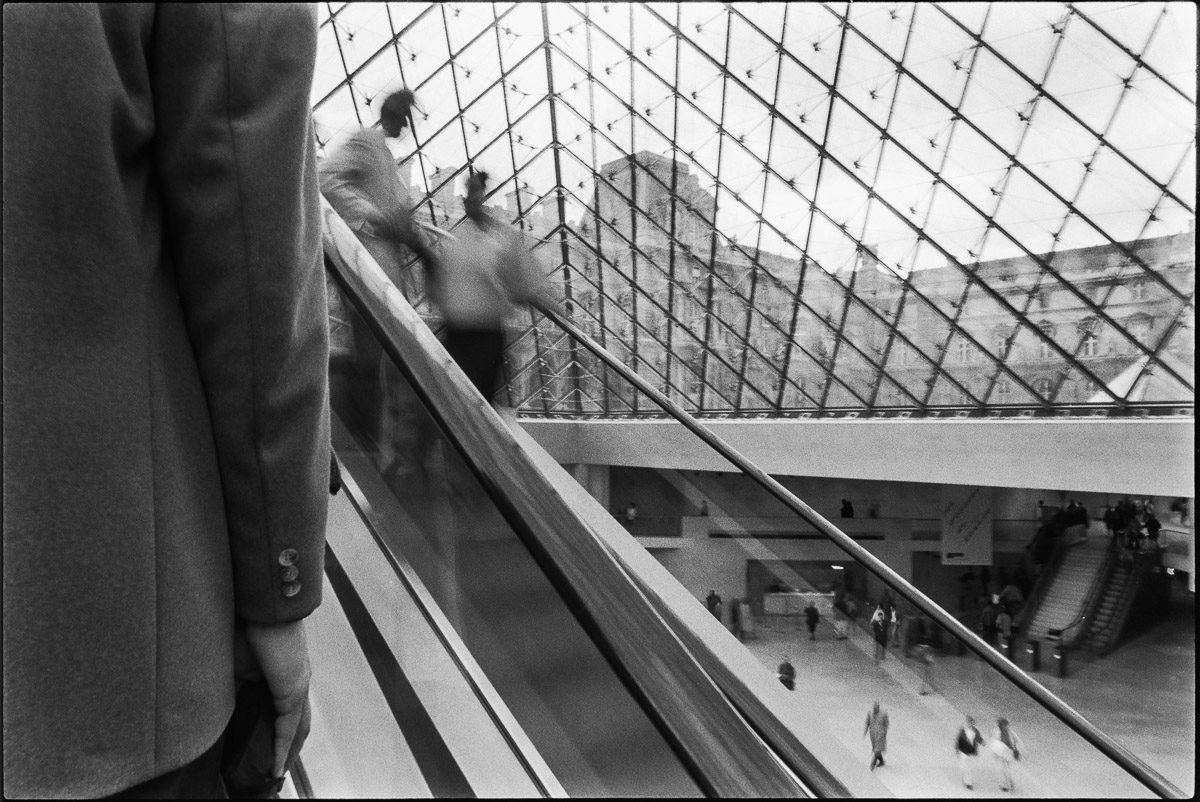 Louvre escalator under the Pyramid, 1989 – Photo © Sebastien Desnoulez
Under the Louvre Pyramid, 1989
In the late 1980s, the Louvre Museum had just opened its new entrance beneath the glass Pyramid. It is 1989. I am riding up the escalator among the visitors, a Nikon F without prism around my neck. I press the camera downwards so that the strap around my neck is pulled tight and stabilises it. With my Nikon 24 mm f/2.8 Ai-S, I choose a slow shutter speed around 1/15 s or 1/8 s, accepting that blur will be part of the image. I focus, compose and frame directly on the Nikon F’s focusing screen, with the prism removed. A single photograph, an instinctive composition, which would nonetheless become one of my favourite images from the very first development.
Composition: diagonals, sharpness and blur
The focus is deliberately set on the back and arm of the person in front of me on the escalator. They become the anchor point of the image, the only truly sharp presence in a moving world. Around them, silhouettes begin to slide: people on the opposite escalator, visitors in the hall, the architecture itself, slightly softened by the slow shutter speed.
The diagonal lines of the handrails structure the frame and lead the eye towards the top, where two blurred figures seem to emerge from behind the foreground subject. You can sense a fragment of a story that the photograph does not show explicitly but simply suggests, leaving the viewer to project themselves and imagine their own narrative.
In black and white, the scene becomes more straightforward. The tonal range emphasises the contrast between the geometric structure of the Pyramid and the fluid movement of the silhouettes. The film grain recalls the era of the shot and gives the image a particular texture. Graphic and powerful, this photograph is a good summary of the way I work: capturing an instant, offering a kind of synthesis of a place or a moment, with a strong visual dimension, without necessarily tying it to a larger assignment or series.
From darkroom print to digitisation
At the time, I made an 18×24 cm print on Ilford Multigrade paper, with a white border and the edge of the negative as a thin black line. That print was already one of my favourites, hanging in my staircase, while the 24×36 negative stayed filed away in my binders.
I brought it out again recently as part of a process of rediscovering and digitising my film archives. To learn more about my method for digitising 35 mm slides and negatives, read the dedicated articles How to scan your film photos: flatbed scanner, Nikon Coolscan or camera? and Digitising black and white negatives with a camera and developing them in Lightroom.
From film to digital, a continuity
Coming back to this Louvre image in 2025, digitising it and reworking it slightly is also a way of measuring the distance travelled since my early film years. I still frame and anticipate a scene with the reflexes I acquired in the film era, when “work fast and be perfect” was the motto of the motorsport press photographer.
Thirty-six frames per roll, waiting for development and discovering the contact sheets trained my eye and still influence my images today, whether they are made with a Nikon Z8 or other recent cameras. I talk in more detail about this evolution of my practice over nearly 40 years in the article The evolution of photography: 40 years between film, digital and mirrorless.
Why this image matters to me
Among the photographs I made in that period, this escalator scene at the Louvre has a special place. From the very first development, it stood out as one of my favourite images. It is not linked to any specific assignment and is not part of a carefully constructed series about the museum. It comes straight from instinct, from a quick gesture, from a graphic intuition in the middle of a visit.
What makes it important to me is its ability to condense into a single frame the encounter between a place, a moment and a few anonymous characters. It is a way of portraying a space and its atmosphere in one unique image, representative of my taste for strongly graphic compositions, whether I am working on architecture, landscapes or street scenes.
By digitising the negative today, I simply give this photograph a new life that remains faithful to its film origin.
About the Author
Sebastien Desnoulez is a professional photographer specializing in architecture, landscape and travel photography. Trained in photography in the mid-1980s, he covered Formula 1 races and reported from around the globe before devoting himself to a more demanding fine art photography practice blending composition, light and emotion. He also shares his technical expertise through hands-on articles for passionate photographers, built on a solid background in both film and digital photography.
Tags