

Photographing architecture is not just about recording a building. It means building an image from lines, volumes, materials, reflections and light. Between precise framing, the reading of perspectives and a more graphic interpretation of places, this page brings together my main articles devoted to architectural photography, in Paris, La Défense, while traveling, in religious heritage and in contemporary architecture.
A photographic approach to architecture
My way of looking at architecture has developed gradually, through cities, travels, contemporary buildings, monuments and places of passage. What interests me is not only the architectural subject itself, but the way a façade, a line, a shadow or a reflection can become a photographic composition.
Architectural photography requires close attention to the photographer’s position, the balance of verticals, proportions, light and distracting elements. But it can also move away from a strictly descriptive rendering and become more graphic, more abstract, more personal.
In my work, architecture is often a field of oppositions: mineral surfaces and sky, transparency and mass, shadow and light, geometric rigor and the accidents of reality. Each image seeks to organize these tensions within a readable frame, without reducing the building to a simple illustration.
Paris and Île-de-France: monuments, façades and contemporary architecture
Paris and the Île-de-France region offer an especially rich terrain for architectural photography. Historic monuments stand alongside contemporary buildings, glass façades, cultural venues, urban reconversions and more discreet architectures. This mix makes it possible to work both with the memory of places and with their transformation.
Photographing Paris does not simply mean repeating familiar viewpoints. It often means finding an angle, a reflection, a light or a particular situation that renews the way we look at a building we may already think we know.
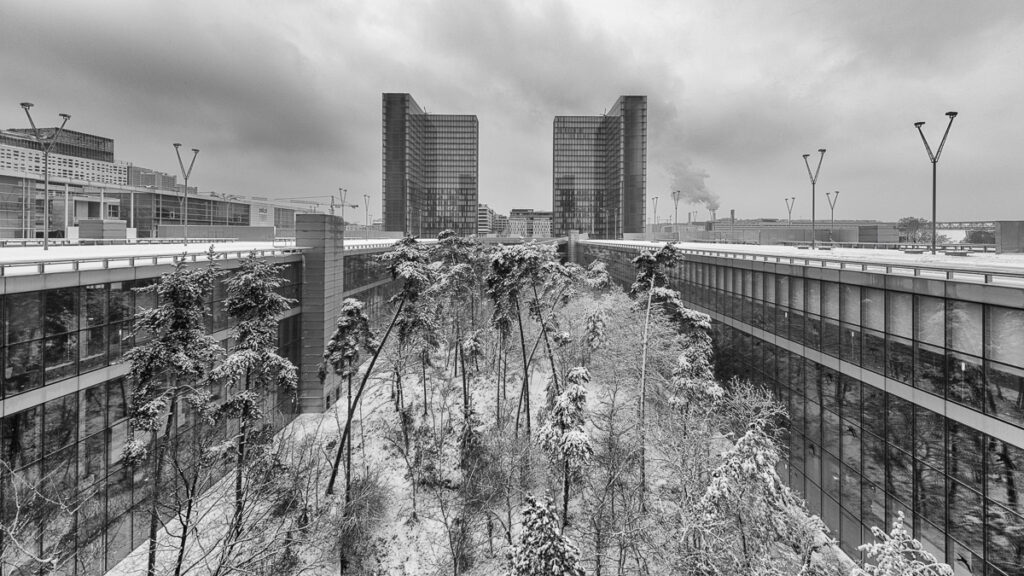
Bibliothèque François Mitterrand in Paris - Photo: © Sebastien Desnoulez
Architectural photographer in Paris: from modern buildings to heritage landmarks
This page presents my approach to architectural photography in Paris, from contemporary buildings and monuments to façades, urban lines and compositional work. It is one of the main entry points into my architectural photography.
Orion 55 in Beaugrenelle: architecture photographs of a modernist building in Paris
The series devoted to the Orion 55 building explores a modernist Parisian structure through its volumes, lines and details. It shows how a building can become a graphic subject when light reveals its structure.
Centre Pompidou, the empty forecourt, a rare architectural view
The Centre Pompidou forecourt, emptied of its usual flow of visitors, offers an unusual reading of the building. The absence of crowds changes the perception of the architecture and makes the relationship between façade, public space and urban void more visible. To extend this approach, the article devoted to the Centre Pompidou Caterpillar explores another side of the building: its tubular structure, escalators, plays of light and suspended circulation, one of its architectural signatures.
Bibliothèque François Mitterrand: photographic views of architecture in Paris
The Bibliothèque François Mitterrand is a place where lines, volumes, walkways, reflections and empty spaces form a highly photographic architecture. The article explores this relationship between contemporary monumentality and graphic framing.
Philharmonie de Paris: photographing the architecture of Jean Nouvel
The Philharmonie de Paris offers a complex, fragmented, metallic and shifting architecture. It allows the photographer to work with surfaces, reflections, cut-outs and the relationship between a cultural building and the urban landscape.
Architectural photographs of the Louis Vuitton Foundation: light, glass and Parisian reflections
The Louis Vuitton Foundation is an especially rich subject for architectural photography. Its glass sails, curves and reflections multiply viewpoints and compositional possibilities.
Reflection of the Paris Courthouse on the Maison des Avocats
This photograph plays with reflection, distortion and mise en abyme between two contemporary architectures. The building almost becomes an image within the image, between urban precision and visual abstraction.
La Défense: lines, reflections and urban geometry
La Défense holds a particular place in my architectural work. It is a territory of towers, slabs, perspectives, reflections, monumental artworks and changing light. The district allows both documentary photography and much more graphic compositions.
What interests me in La Défense is not only the verticality of its towers, but the way the buildings interact with one another: reflective façades, walkways, pools, sculptures, glass roofs, perspectives and morning or evening light.
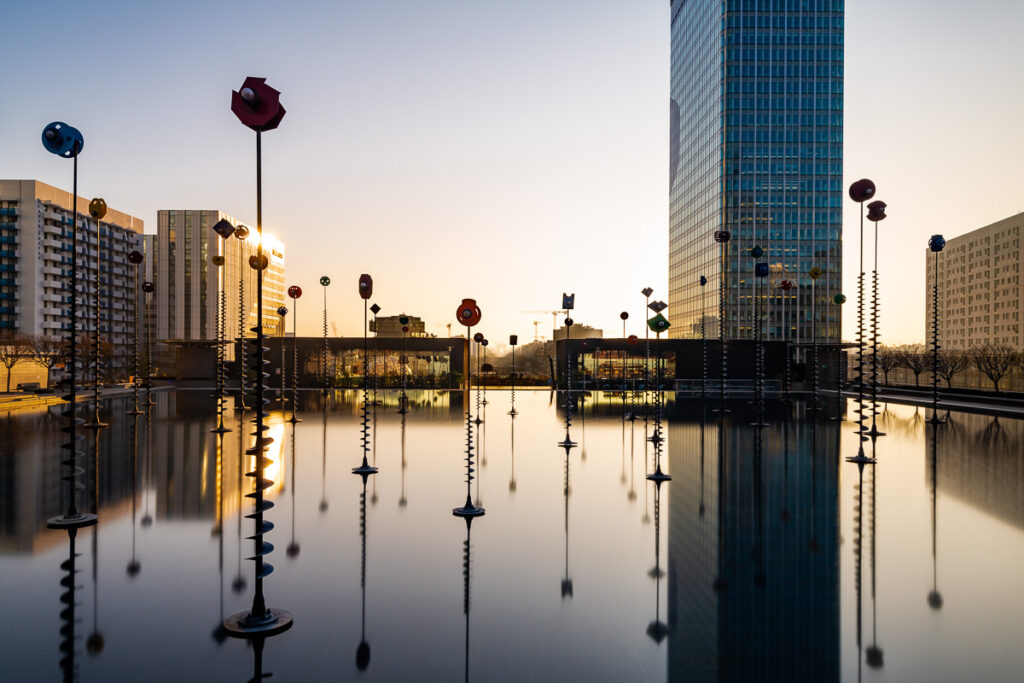
Sunrise over the Takis Pool at La Défense - Photo: © Sebastien Desnoulez
Architectural photographer at La Défense
This page brings together my approach to La Défense as an architectural subject. It highlights the district’s geometry, perspectives, reflections, iconic towers and graphic potential.
Reflections of the Grande Arche in Agam’s Monumental Fountain at La Défense
The reflection of the Grande Arche in Agam’s fountain turns architecture into a moving surface. The image plays with repetition, color, distortion and the relationship between monument, water and light.
North wall of the Grande Arche: urban geometry and light
The north wall of the Grande Arche becomes an almost abstract subject. The repetition of lines, the mass of the building and the precision of the framing allow the architecture to be read as a graphic composition.
Perspective of La Défense from Pont de Neuilly at sunset
From Pont de Neuilly, La Défense becomes an urban perspective. Lines converge, towers respond to one another and the twilight light transforms the district into a graphic scene.
Color photographs of Tour Trinity: contemporary architecture and dramatic light
Tour Trinity is a strong architectural subject, where contemporary lines interact with a heavy sky and dramatic light. The article shows how color treatment can shift the reading of a building, turning it toward a fine art photograph.
Photography of the Takis Pool at La Défense: sunrise in long exposure
Long exposure and the soft light of sunrise transform the Takis Pool into a quieter scene. In this hard, mineral urban landscape, smoothed water, reflections and monumental artworks soften the perception of La Défense.
Architecture photographs: urban geometry on Ellipse Plaza in La Défense
Ellipse Plaza reveals the urban geometry of the district. Lines, curves, volumes and circulation patterns form a space where architecture becomes almost an abstract construction.
Sacred architecture: concrete, stone, verticality and light
Churches, abbeys and cathedrals create another relationship to architecture. Here, light does not only describe forms: it takes part in the meaning of the place. Volumes, heights, stained glass, stone and concrete surfaces call for a quieter photography, more attentive to interior space.
Whether Romanesque, Gothic, Cistercian or Brutalist, these places often require a careful balance between faithful rendering, verticality, simplicity and visual emotion.
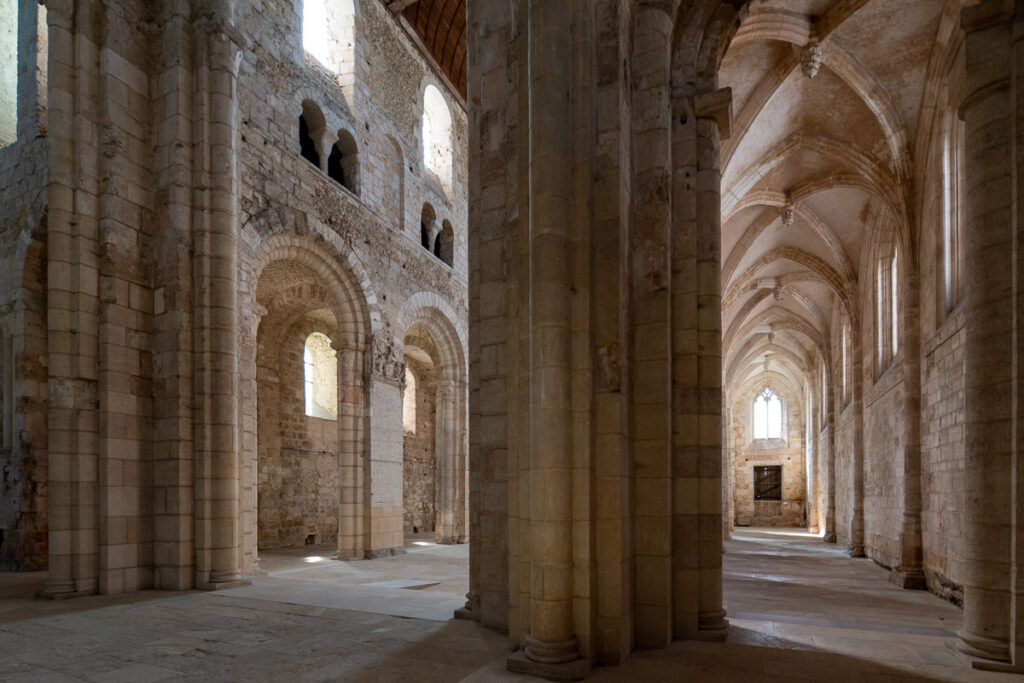
Notre-Dame Abbey Church in Bernay - Photo: © Sebastien Desnoulez
Pontigny: light and simplicity in the first Cistercian abbey
Pontigny Abbey offers an architecture of restraint, light and silence. The photography seeks to convey the sobriety of the volumes, the purity of the lines and the strength of a space without excess.
Photographs of Notre-Dame Abbey Church in Bernay: the oldest preserved Romanesque church in Normandy
The abbey church in Bernay allows one to work with Romanesque matter, ancient volumes and interior light. The article highlights an architectural heritage where photography also becomes a means of transmission.
Notre-Dame du Raincy: sacred concrete and architectural modernity
Notre-Dame du Raincy is a major milestone in concrete religious architecture. Filtered light, stained glass and modern structure create a very singular photographic space.
Saint-Joseph Church in Le Havre: a concrete tower crossed by light
At Saint-Joseph in Le Havre, concrete and verticality create an impressive spatial experience. Photography attempts to convey this rise toward light and the architectural force of the place.
Architectural photography: how to capture the dramatic height of Bourges Cathedral?
Bourges Cathedral raises an essential question in architectural photography: how can the height, verticality and power of a Gothic space be conveyed without betraying the perspectives? The article also discusses the use of a tilt-shift lens.
Notre-Dame Church in Royan: architectural photographs of Brutalist concrete
Notre-Dame de Royan shows a radical religious architecture sculpted in concrete. Its structure, light and monumentality make it a powerful subject for architectural photography that is both documentary and graphic.
Travel architecture and iconic places
Architecture encountered while traveling often carries a different value. It may be linked to a famous monument, a newly discovered city, a historic site or a transformed industrial building. The traveler’s gaze is neither that of a client nor that of a daily passer-by: it is shaped by availability, surprise and memory.
These images extend my interest in lines and volumes, but in more varied contexts: London, New York, Jordan, the United States and other places where architecture also becomes a travel memory.
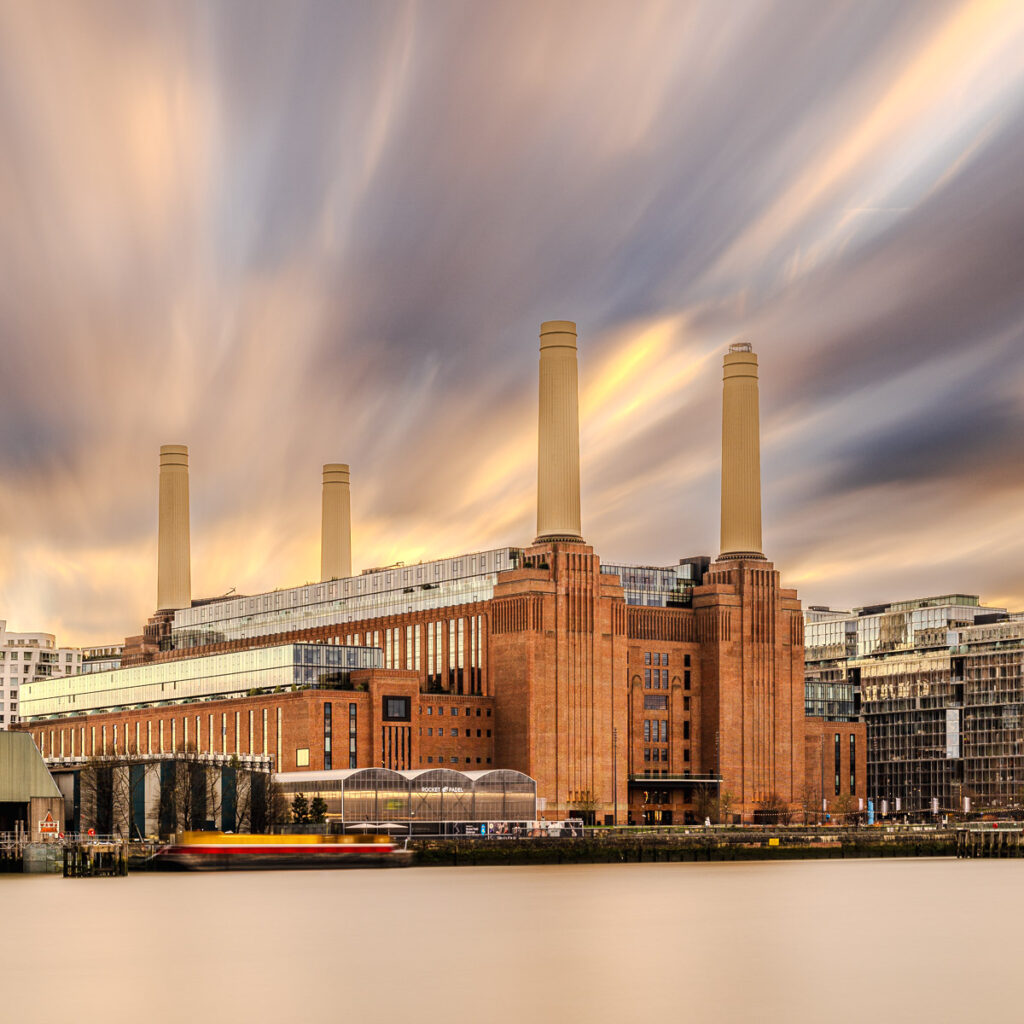
Battersea Power Station, London - Photo: © Sebastien Desnoulez
Architectural photography in London
London offers a rich mix of historic, industrial and contemporary architecture. This page brings together different views of the city, from monuments and iconic buildings to urban transformation.
Battersea Power Station: industrial architecture and renewal in London
Battersea Power Station is a strong example of architectural reconversion. The former power station becomes a living district, where industrial memory enters into dialogue with contemporary uses.
Westminster Abbey in London: light and stone
Westminster Abbey reconnects travel photography with the concerns of sacred architectural photography: stone, verticality, filtered light, heritage and historical density.
Big Ben and Westminster in London: Thames classics
Big Ben and Westminster are widely photographed subjects. The challenge is then to find a light, a frame or an atmosphere that gives personal presence to an iconic motif.
New York City World Trade Center 1985
The World Trade Center photographed in 1985 belongs both to travel architecture and to visual memory. Over time, these images have gained a particular documentary and emotional dimension.
People’s Vote Award at the reFocus Awards 2025: architectural photography in Bonifacio
The award-winning photograph of Bonifacio’s cemetery shows how an architectural place can become an image of forms, contrasts and memory. It connects architecture, landscape, light and artistic intent.
Lenses, tilt-shift and perspectives
Architectural photography often requires precise technical choices. Verticals, converging lines, large interior spaces and building height demand particular attention to framing. Equipment does not replace the eye, but it can help translate an intention more faithfully.
Depending on the situation, I use ultra-wide-angle lenses, software corrections, in-viewfinder level guides or tilt-shift lenses. Each solution has its advantages, limits and consequences for the final image.
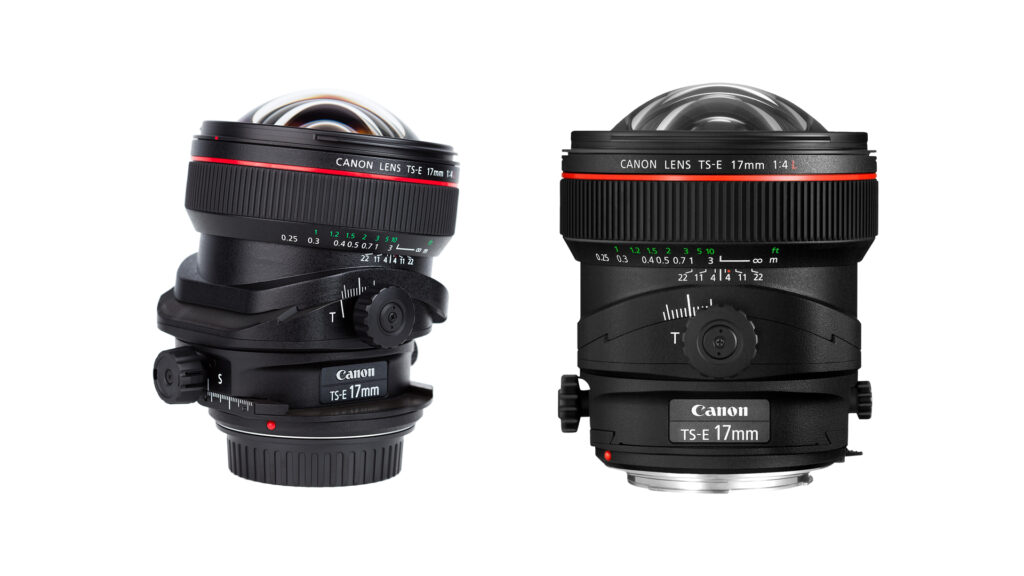
Canon TS-E 17mm f/4L
Architectural photography: why use a tilt-shift lens?
This article explains the value of a tilt-shift lens in architectural photography. It shows how shift movements can correct perspectives directly at the time of shooting and preserve verticals without relying solely on software correction.
Canon TS-E 17mm f/4L: a dedicated lens for architecture
The Canon TS-E 17mm f/4L is one of my most specialized tools for architecture. Used on Nikon Z with an adapted mount, it allows perspectives to be controlled with a precision that is difficult to achieve otherwise.
Nikon Z 14-30mm f/4 S: field review, opinion and photographs
The Nikon Z 14-30mm f/4 S is a compact ultra-wide-angle zoom, very useful for architecture, interiors and travel. Its compatibility with screw-in filters and its good optical consistency make it an effective complement to more specialized lenses.
Photographing Bourges Cathedral: conveying height and vertical lines
In Bourges, the technical question also becomes a question of vision: how can the spectacular elevation of a Gothic space be conveyed while preserving an image that remains readable, stable and faithful to the impression felt on site?
From architectural documentation to fine art photography
An architectural photograph can document a building, but it can also detach itself partly from the building and become an autonomous image. Lines, reflections, shadows, repetitions and masses can lead toward a more abstract reading of reality.
In this approach, the building is no longer merely identified: it becomes visual matter. The image can then move away from a simple architectural record and join a more personal exploration of form, light and oppositions.
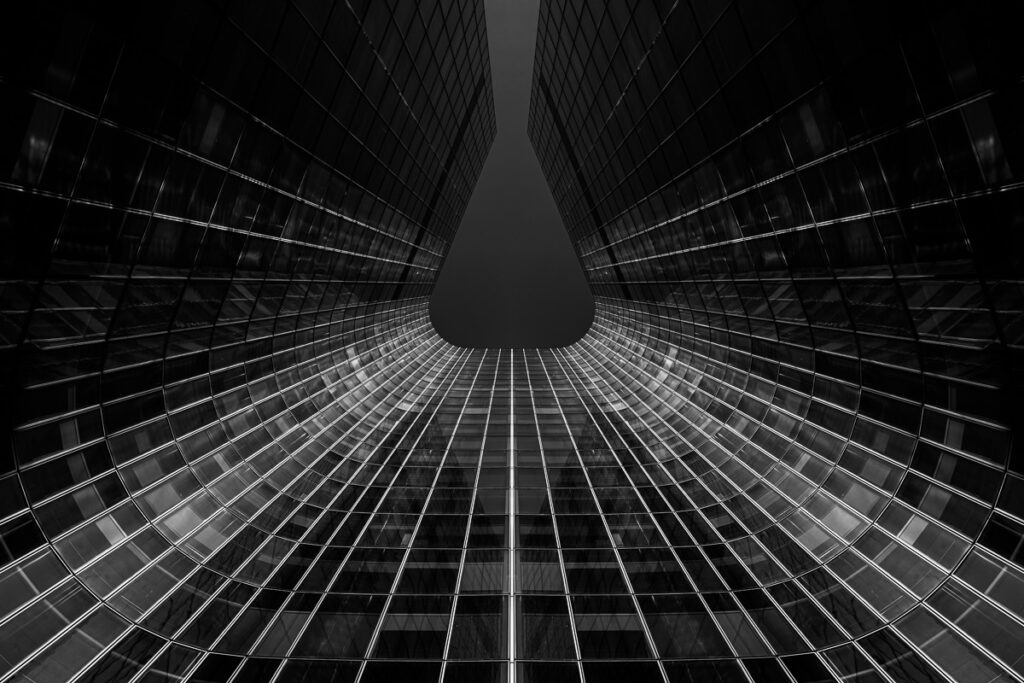
Converging Lines, Darkchitecture series - Photo: © Sebastien Desnoulez
Graphic architectural photography: Darkchitecture
Darkchitecture is a series exploring architecture in black and white, with a graphic, contrasted and sometimes abstract approach. Buildings become forms, tensions and surfaces of light.
Architectural diptych in La Défense: an urban wave in two photographs
This architectural diptych shows how two images can enter into dialogue to create a new form. Architectural photography becomes here a play of lines, curves and visual correspondences.
Parallel Worlds: a photo series blending sci-fi and architecture
With the Parallel Worlds series, real architecture becomes the starting point for a shift toward the imaginary. A Brutalist church, a skyscraper, a museum or an urban structure is transformed through framing, light and measured visual interventions to evoke parallel worlds, portals or invisible presences. The building is no longer only an architectural subject: it becomes a science-fiction setting and the material of a photographic narrative.
All articles in the Architecture category
This page offers a structured reading of my main articles devoted to architectural photography. It does not replace the full archive of the category, which brings together all publications related to buildings, monuments, urban perspectives, façades, interiors, heritage and contemporary architecture.
See all articles: Architecture.
See also: for more technical aspects related to lenses, filters, scanning and workflow, read the photo gear guide. For images made from film, archives and older reports, see also the film photography and archives guide.
About the author
Sebastien Desnoulez is a professional photographer based in Paris, specializing in architectural photography, landscape photography and travel photography. Trained in photography in the mid-1980s, he covered Formula 1 and reported from around the world before turning to demanding fine art photography, combining composition, light and emotion. He also shares his technical experience through practical articles for passionate photographers, drawing on a strong visual culture acquired in both film and digital photography.