

Choosing a lens, a camera body or a working method is not just a matter of comparing technical specifications. In photography, gear only really makes sense when it supports a practice, a way of seeing, a subject and a level of expectation. This guide brings together my main field experiences with Nikon Z lenses, adapted optics on mirrorless cameras, architectural photography, film scanning, file backup and photographic workflow.
A field-based approach to photo gear
My relationship with photo gear was shaped in the field, long before online reviews, comparison charts available in a few clicks and the endless debates on social media. I began with film cameras, prime lenses and slide films with very limited exposure latitude. I then worked in a press agency, especially in motorsport, before gradually moving to digital, professional scanning, autofocus SLRs and, later, Nikon Z mirrorless cameras.
This background still influences the way I evaluate a camera, a lens or a working method. I am not only interested in whether a lens is theoretically sharp, whether it scores well in a laboratory test or whether it matches current expectations. I am more interested in what it actually allows me to do: frame faster, travel lighter, work with precision, secure my files, render architecture without betraying its lines, or bring film archives back to life.
The articles gathered here are therefore not gear reviews in the strictly commercial sense. They are field-based experiences, grounded in a real photographic practice: architecture, travel, urban photography, landscape, archives, digitizing, long lenses, old or adapted optics. Some choices are very personal, but that is precisely what makes these reviews useful: they do not replace press reviews, they complement them with practical field experience.
Nikon Z lenses: field reviews and choosing optics
Nikon Z lenses now play a central role in my equipment. The Z mount has deeply changed the way some lenses can be approached: built-in corrections, high consistency across the frame, better management of wide angles, and strong pairing with high-resolution bodies such as the Nikon Z8 or Z7 II. But not all lenses answer the same need. Some are made for traveling light, others for working with precision, isolating a subject, covering an event or composing architectural images.
Rather than accumulating focal lengths, I try to build a coherent system. The choice of a zoom or a prime lens depends on its role in the camera bag, its weight, versatility, rendering and ability to fit into everyday practice.
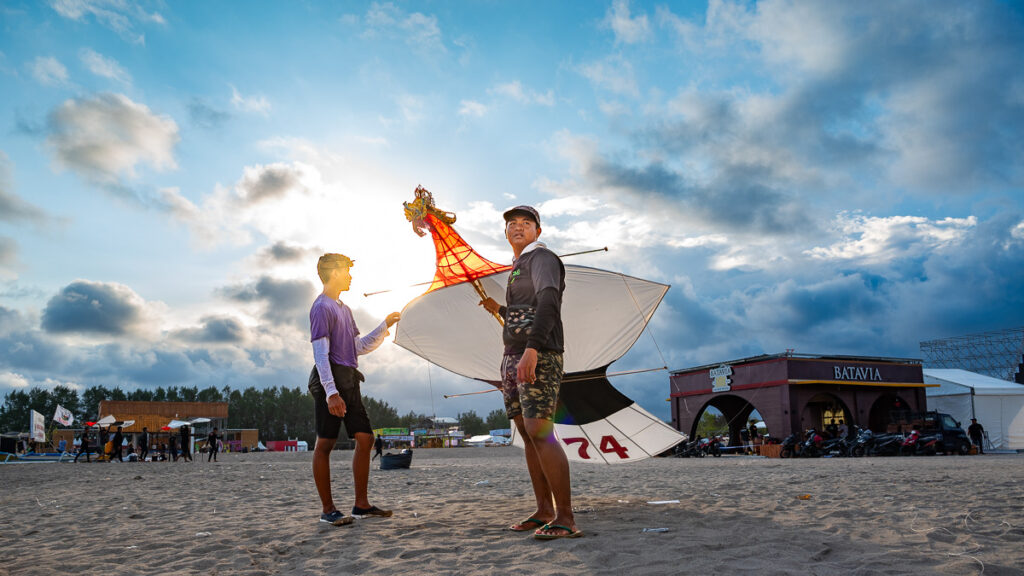
Sanur Village Kite Festival in Bali - Nikon Z 24-120mm f/4 S - Photo: © Sebastien Desnoulez
Nikon Z 24-120mm f/4 S: field review and photographer’s opinion
The Nikon Z 24-120mm f/4 S is one of the most useful zooms in my kit. It covers a very comfortable focal range, from wide angle to short telephoto, while maintaining excellent consistency. I use it for travel, urban photography, light architectural work and all situations where framing flexibility matters as much as optical quality.
Nikon Z 14-30mm f/4 S: field test, review and photos
The Nikon Z 14-30mm f/4 S is a compact ultra-wide-angle zoom, especially useful for architecture, interiors, landscapes and urban scenes. Its value lies not only in its 14mm focal length, but also in its compact size, compatibility with screw-in filters and ability to fit into a relatively light travel kit.
Nikon Nikkor Z 35mm f/1.8 S: field test, review and sample images
The 35mm remains an essential focal length for photographers working between reportage, street photography, travel and instinctive framing. In this article, I look back at the Nikon Z 35mm f/1.8 S, its rendering, precision, versatility and place in relation to modern zooms.
Nikon Z 50mm vs 24-70mm: which lens should you choose?
Should you choose a bright prime lens or a more flexible zoom? This question runs through many photographic practices. The article compares the use of a 50mm and a 24-70mm according to subject matter, shooting style, bulk and the relationship to framing.
Nikon NIKKOR Z FX and DX lenses: complete list, weight, dimensions, close focus and filters
This article works as a reference table for comparing Nikon Z lenses. It brings together FX and DX focal lengths, weights, dimensions, minimum focusing distances, filter diameters and useful characteristics for building a coherent lens system. It is one of the central technical resources on the site.
Nikon Nikkor Z 70-200mm f/2.8 VR S: review, field test and photos
The 70-200mm f/2.8 is a lens apart. Heavier than a standard zoom, but very powerful for isolating a subject, compressing perspective, working in portraiture, landscape or on architectural details. This article looks at its real-world use and what this focal range brings to a demanding practice.
Nikon Z MC 50mm f/2.8: sharpness, bokeh and creative uses
The Nikon Z MC 50mm f/2.8 is not only a compact macro lens. It also allows you to work on details, textures, small objects, flowers and close compositions. Its compact format makes it an interesting lens to enrich a camera bag without adding much weight.
Nikon F, Canon EF and adapted lenses on Nikon Z mirrorless cameras
One of the major strengths of Nikon Z mirrorless cameras is the ability to adapt lenses from other eras or other mounts. This should not be seen as mere tinkering, but as a way of extending the life of specialized lenses, some of which remain remarkable, or rediscovering renderings that modern optics sometimes tend to smooth out.
Adapting a lens does not simply mean checking that it mounts mechanically. Autofocus, aperture control, stabilization, angle of incidence, edge quality, balance on the body and the type of subject photographed all matter. Some older lenses remain highly relevant. Others show their limits more clearly on today’s high-resolution sensors.

Dew, Brittany - Canon EF 300mm f/2.8 L USM (non-IS) - Photo: © Sebastien Desnoulez
Nikon F lenses on Z mirrorless cameras: compatibility, optical design and image quality
This guide analyzes the possibilities offered by Nikon F lenses on Nikon Z bodies. Compatibility, angles, image quality, optical limitations and the real value of keeping certain lenses: the article helps determine what still works very well and what becomes less relevant with modern mirrorless cameras.
Canon EF 300mm f/2.8 L USM non-IS: review and field test of a legendary lens
The non-stabilized Canon EF 300mm f/2.8 L USM remains an impressive lens in terms of rendering, speed and construction. Adapted on Nikon Z, it brings back the power of a professional super-telephoto lens, with the constraints of an older optic but also with a character that is not always found in recent lenses.
Nikon Nikkor 500mm f/4 AI-P IF-ED: Nikon’s last professional manual super-telephoto lens
The Nikon 500mm f/4 AI-P belongs to an era when manual focusing remained central to a photographer’s work. This article looks back at the history, characteristics and value of this professional super-telephoto lens, both demanding and fascinating.
Nikon AF-S Zoom-Nikkor 80-200mm f/2.8D IF-ED: history, specifications and overlooked swirling bokeh
The Nikon AF-S 80-200mm f/2.8D IF-ED is an important lens in the history of Nikon professional zooms. Its rendering, sometimes swirling bokeh and place in the transition toward modern autofocus lenses make it interesting beyond its technical specifications alone.
Sigma Macro 105mm f/2.8 EX DG OS HSM: field test and professional review
The Sigma 105mm macro can be approached as a macro lens, a short telephoto and a precision tool. The article looks at its behavior, sharpness, rendering and relevance in a current practice, especially with a mirrorless body.
Architecture, ultra-wide-angle lenses and tilt-shift optics
Architectural photography imposes a particular discipline. Verticals, converging lines, balance of volumes, distance from the subject and respect for the structure of a building require constant attention. Gear can help, but it does not replace framing, the photographer’s position or an understanding of the place.
Depending on the situation, I use several approaches: corrected ultra-wide-angle lenses, tilt-shift lenses, software correction, the artificial horizon in the viewfinder, or freer composition when the subject does not require a strictly orthogonal rendering. The right tool depends on the visual constraint.
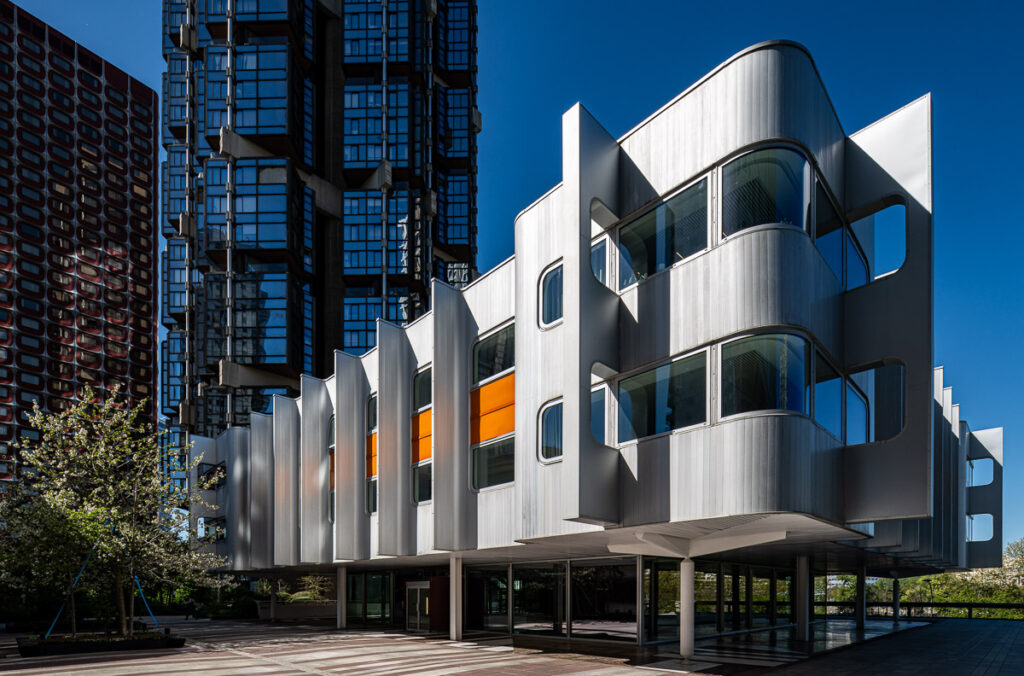
Orion 55 building in Beaugrenelle - Canon TS-E 17mm f/4L - Architectural photography: © Sebastien Desnoulez
Canon TS-E 17mm f/4L: a dedicated lens for architecture
The Canon TS-E 17mm f/4L is one of the most specialized lenses I use. Mounted on Nikon Z via an adapter, it makes it possible to correct perspectives at the time of shooting thanks to shift movements. It is a demanding tool, but almost irreplaceable when line accuracy and faithful rendering of volumes become priorities.
Nikon Z 14-30mm f/4 S: ultra-wide angle and architectural photography
The Nikon Z 14-30mm f/4 S works very well alongside a tilt-shift lens. It is faster to use, more compact, compatible with screw-in filters and optically good enough for many architectural, travel and interior situations. It does not replace a tilt-shift lens, but it offers great flexibility.
Darkchitecture: architectural photographs
The Darkchitecture series shows how technique can serve a more graphic visual language. Architecture becomes matter, contrast, lines and light. It is a less descriptive approach, but deeply connected to the compositional rigor of this subject.
Macro, telephoto lenses and specialized uses
Some lenses are not chosen for their versatility, but for a specific function: getting closer to the subject, isolating a detail, compressing planes, working at a distance or producing a particular rendering. These specialized lenses are not always the ones carried every day, but they can transform a way of photographing.
Macro lenses, long focal lengths and fast telephotos require a slower and more intentional approach. They force you to look differently: closer, farther, tighter, with particular attention to the background, successive planes and shooting stability.

Nikon Nikkor Z MC 50mm f/2.8 test - Photo: © Sebastien Desnoulez
Nikon Z MC 50mm f/2.8: compact macro and creative uses
This lightweight macro lens makes it possible to work on details without switching to heavy or highly specialized equipment. It is interesting for flowers, textures, objects, close framing and certain creative uses where distance to the subject becomes part of the composition.
Sigma 105mm macro: precision and working distance
The 105mm macro offers a more comfortable working distance than a 50mm macro, while retaining high precision. It is a particularly interesting focal length when you want to isolate a detail without being too close to the subject.
Canon EF 300mm f/2.8 L USM: long focal length and professional rendering
A fast telephoto lens is not only useful for photographing distant subjects. It also changes the relationship between planes, background and main subject. The Canon EF 300mm f/2.8 L USM retains a very strong rendering, even if it requires a slower and more attentive practice.
Film scanning, digitizing and photo archives
Digitizing film archives has become essential for anyone who worked on film or is rediscovering old negatives and slides. Scanning an image is not just about producing a digital file. It is about preserving the film’s texture, respecting density, avoiding excessive artificial sharpening, correcting dust when possible and accepting the limits of the original medium.
I experienced the transition from film to digital in a photo agency, with early production scanners, slide duplication, Photoshop workflows and physical archives. This experience still informs the way I approach camera scanning, flatbed scanners, Nikon Coolscan units and the processing of files made from black and white or color film.
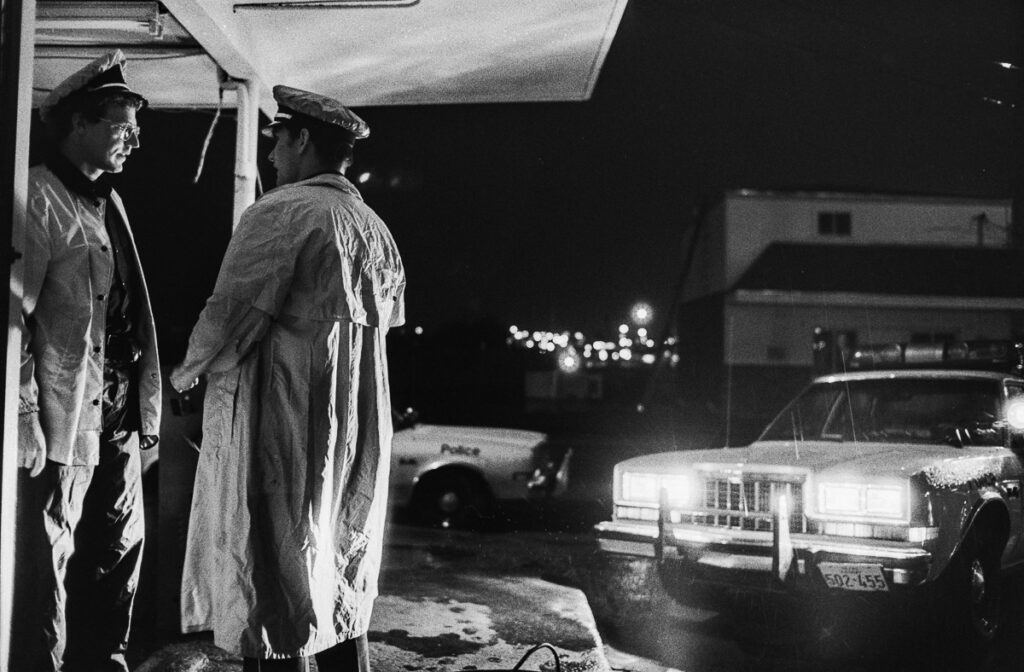
Dallas Police 1987 - Nikon F, 35mm f/1.4 Ai-S, Ilford HP5 - Photo: © Sebastien Desnoulez
How to scan your film photos: flatbed scanner, Nikon Coolscan or camera?
This article compares the main methods for digitizing film archives: flatbed scanner, dedicated scanner such as Nikon Coolscan, and camera scanning. It is intended for photographers who want to understand the advantages, limits and concrete uses of each solution.
VALOI easy35 v2: the best way to digitise 35mm negatives and slides?
After using the JJC FDA K-1 to digitise a large part of my film archives, I switched to the VALOI easy35 v2 to speed up the processing of negative strips and mounted slides. This hands-on review covers its setup with a Nikon Z8, its film holders, the preservation of the negative’s black border, the quality of its light source, and the choice between the Nikon Z MC 50mm and Sigma 105mm Macro lenses.
Digitizing black and white negatives with a camera and developing them in Lightroom
Reproducing black and white negatives with a digital camera requires method: even lighting, alignment, RAW capture, curve inversion, density correction and respect for film grain. This article details a complete workflow, from the RAW file to development in Lightroom.
Film photography today: creative revival or romantic illusion?
The return of film photography fascinates many photographers. But what are we really looking for in film today: a creative constraint, an aesthetic, slowness, nostalgia or another way of seeing? This article questions the place of film photography in a contemporary practice.
Experimental photography with a Holga: film experiments
The Holga reminds us that technique is not limited to precision. Blur, vignetting, imprecision, surprises and visual accidents can also become creative tools. This experimental approach connects with another relationship to gear, less controlled and more open to the unexpected.
Photo workflow, backup and organization
A good photographic workflow begins before returning to the computer. When traveling, on assignment or during an important shoot, file safety is as essential as lens choice. A memory card can be lost, damaged or filled. A drive can fall. A handling error can compromise an entire series.
For this reason, I am as interested in backup methods as in shooting equipment. Card readers, hubs, SSDs, smartphones, dual card slots, copy verification and folder organization may seem less appealing than a fast lens, but they protect the work made in the field.
How to back up camera photos while traveling, no laptop needed
This article explains how to back up photographs while traveling without carrying a computer. It details a method based on a smartphone, hub, card reader and SSD, with concrete precautions for securing RAW files on the road.
Understanding focal lengths, sensors and lenses
Focal length and aperture equivalence according to sensor size
A practical calculator for comparing framing, angle of view and depth of field between APS-C, full frame, medium format, large format, advanced compact cameras and smartphones.
Depth of Field Calculator for Photography
A tool for estimating the area of acceptable sharpness according to format, focal length, aperture and focusing distance. It also allows you to compare two lenses or two configurations, with display of the near limit, far limit, total depth of field and hyperfocal distance.
Technical advice for shooting
Technique only matters if it serves a visual intention. Shutter speed, aperture, ISO sensitivity, an ND filter or perspective correction are not ends in themselves. They are ways of translating an idea, a light, a texture or a composition.
The technical articles on this site follow this logic: explaining without disconnecting the method from the field. The aim is not to impose a universal recipe, but to show how certain technical choices can make shooting smoother, more reliable or more expressive.
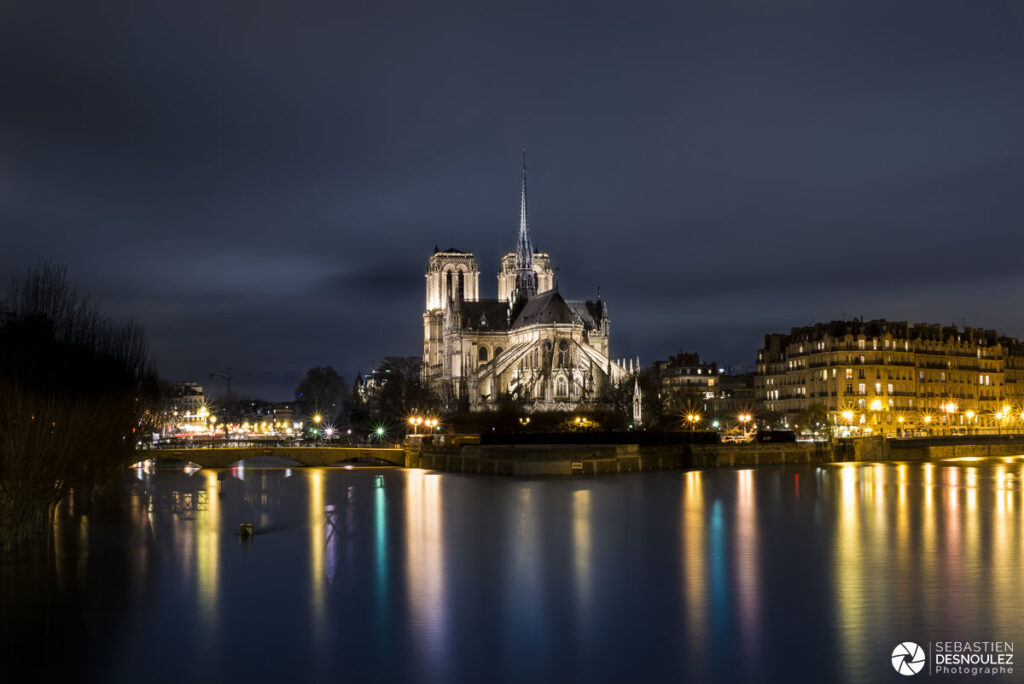
Notre-Dame de Paris during the Seine flood in January 2018 - Photo: © Sebastien Desnoulez
ND filters and long exposure photography
ND filters make it possible to extend exposure time in daylight, smooth water, transform movement or simplify a scene. Their use nevertheless requires method: focusing, exposure, stability, control of color casts and anticipation of the final result.
Long exposure calculator with ND filter
This calculator helps estimate the exposure time to use with an ND filter, taking into account the shutter speed measured without the filter, aperture, ISO, optional polarizer and target exposure time. It complements the ND filter guide by providing a practical tool that can be used directly in the field.
Articles about long exposure
Long exposure is a technique I use especially in landscape and architectural photography. It transforms the relationship between the fixed and the moving, between matter and time, between observed reality and constructed image.
Freelensing: a creative photographic alternative to tilt-shift
Freelensing diverts the normal use of a lens to create tilted planes of focus, selective blur and sometimes light leaks. At the opposite end of the spectrum from the precision of a tilt-shift lens, this practice allows for more intuitive and experimental photography.
All articles in the photo gear section
This page offers a structured reading of my main technical articles, but it does not replace the complete archive of the section. To find all articles published on lenses, cameras, digitizing, backup, filters, accessories and shooting methods, you can consult the dedicated category.
See all articles: Photo Gear and Technical Advice.
About the author
Sebastien Desnoulez is a professional photographer based in Paris, specializing in architectural photography, landscape photography and travel photography. Trained in photography in the mid-1980s, he covered Formula 1 and reported from around the world before turning to demanding fine art photography, combining composition, light and emotion. He also shares his technical experience through practical articles for passionate photographers, drawing on a strong visual culture acquired in both film and digital photography.