


Differences between Photography, Image Editing and Generative AI

Photo Editing: An Extension of the Gaze
Since the beginning, photographers have modified their negatives and prints to best represent what they saw, something film could not always faithfully reproduce. Work in the darkroom was a subtle art involving masking, multiple exposures, and contrast toning, far from a simple mechanical reproduction of reality. As early as the 19th century, retouching became a means of conveying a visual intention.
But the history of retouching also includes more controversial uses. In the 20th century, authoritarian regimes used photography as a propaganda tool. Under Stalin, political figures were erased from official images. This visible and brutal manipulation helped fuel mistrust toward any intervention on images.
In contemporary photography, editing is not necessarily falsification. It can become a form of visual writing. It allows for restoring a perception, reinforcing an atmosphere, clarifying a message. That is how I approach editing: not as an alteration, but as an extension of the gaze.
From Reversal Film to RAW: A Constant Discipline
Trained in film photography using reversal film (slides), I learned early on to compose directly at the moment of capture. With limited exposure latitude and no cropping possible, each image had to be pre-visualized and composed before pressing the shutter. My experience as an automobile sports photojournalist taught me to shoot fast, accurately and efficiently, with no second chances in that field. You had to make the most of every situation, depending on the light and context.
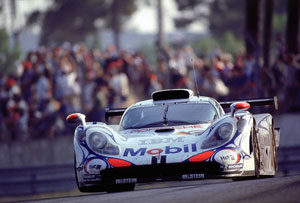
24 Hours of Le Mans 1998, Porsche 911 GTR, Photo: © Sebastien Desnoulez
Today, I shoot in RAW, a format that offers extended dynamic range, but whose initial rendering may appear flat. Digital development then becomes a natural step to reveal the image: adjusting levels, contrast and color balance, sometimes using masks to even out overly dark or bright areas.
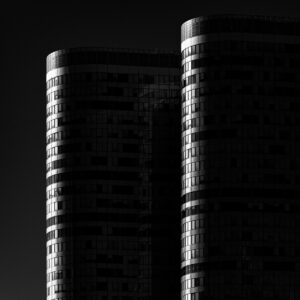
Densification in Lightroom, Twins, Darkchitecture series, Photo: © Sebastien Desnoulez
For my black and white images, I sometimes work in Silver Efex to recover a sense of density, texture and depth close to certain sensations associated with film photography. But in most cases, my photographs remain directly rooted in the original capture, with a level of intervention that stays limited and consistent with the initial intention.
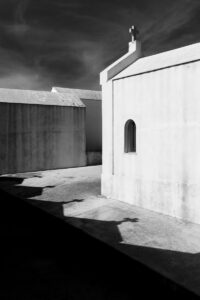
Mariners’ Cemetery, Bonifacio, Photo: © Sebastien Desnoulez
Editing is never about transforming the image, but about refining an intention. It extends a rigorous photographic practice, rooted in film and adapted to today’s tools. It is a matter of precision and balance, in service of vision, not effects.
A Technical and Aesthetic Approach
For me, photo editing is about control, technical neutrality and aesthetic commitment. Finalizing an image is like mixing audio or mastering a video. It does not negate the truth of the moment: it optimizes its visual translation.
Tools are simply extensions of the gaze. The gaze decides, the software executes. It is not a world of filters or illusions: it is a digital workshop where precision matters as much as sensitivity. I use the possibilities of digital development, including certain generative AI features when they allow me to remove or correct a distracting element, without altering the photographic nature of the image.
I also use generative AI for clearly stated creative purposes, like in my series Parallel Universes, where I compose images inspired by science fiction based on real architectural structures. These creations, although rooted in photography, belong to a different artistic process, always specified as such.
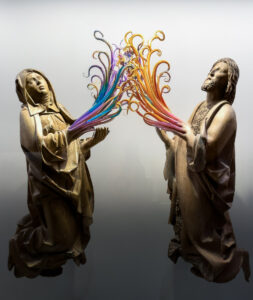
Establishing communication, Sci-Fi series, Photo: © Sebastien Desnoulez
Photography vs. Generated Images: A Critical Distinction
To photograph literally means “to write with light”, from the Greek roots phōtos (light) and graphein (to write, to draw). Any photograph therefore involves the capture of real light at a specific moment using an optical device. A generative AI image, by contrast, does not stem from light or from a moment in reality, but from algorithmic calculation. It is not a photo, but a graphic creation.
At a time when artificial intelligence can generate so-called "photographic" images from simple text prompts, it becomes essential to reinforce this fundamental distinction. A photograph is born from a light capture on a physical or digital medium. It implies a perspective, a moment, an optical device, a place and a real-world presence.
A generative AI image, however attractive, is not a photograph. It is a visual simulation derived from statistical computation based on millions of pre-existing images. It was never seen, never lived, never captured. It documents nothing. It belongs to another form of creation.
When some artists publish black and white images in a "fine art" style generated by AI, without clarifying their origin, they contribute to a problematic confusion. This is not about aesthetics, it is about visual ethics. Passing off an algorithmic result as a photograph deceives the viewer, especially when the nature of the image is not explicitly stated.
Generative AI can be a powerful tool for visual creation, provided its use is clearly acknowledged. The issue does not come from the tool itself, but from the ambiguity created when AI-generated visuals are presented, or deliberately left unexplained, as captured photographs. This confusion undermines trust, clarity of intent and, ultimately, the ethics of the image.
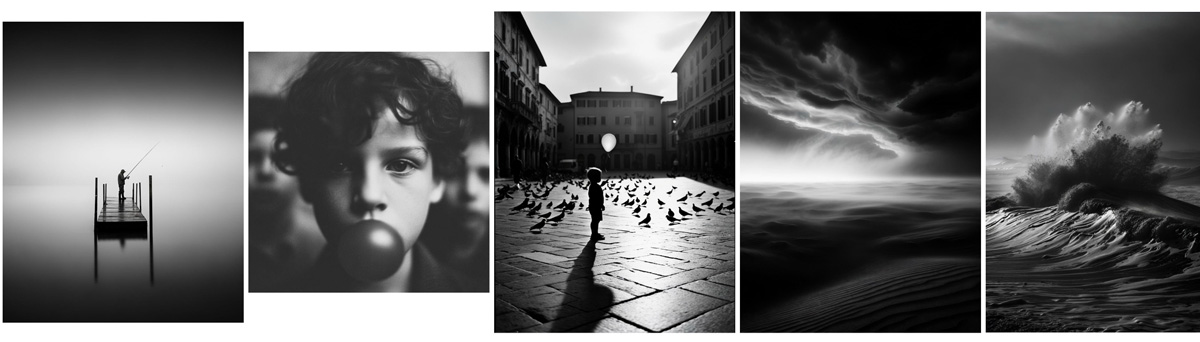
Images created using generative AI in a fine art style
The ease with which AI now replicates the aesthetic codes of fine art photography confuses non-expert audiences.
The analogy is simple: it is like comparing a mass-produced supermarket meal with a chef’s dish at a restaurant, or a standardized fast-food burger with a carefully crafted homemade burger. They share the same name, but they have neither the same origin, nor the same intention, nor the same value.
Tags