

JR’s Caverne du Pont Neuf

With La Caverne du Pont Neuf, JR temporarily transforms the oldest bridge in Paris into a monumental setting, between trompe-l’œil, urban installation and tribute to Christo and Jeanne-Claude. I chose to photograph this work from the Seine, from the quay, then at night in long exposure from the Pont au Change, before bad weather interrupted the project.
JR’s Caverne du Pont Neuf is a project that had been announced for some time. The artist wanted to pay tribute to Christo and Jeanne-Claude, forty years after The Pont Neuf Wrapped, the wrapping of the Pont-Neuf carried out in September 1985. Where Christo and Jeanne-Claude had wrapped the bridge in golden sandstone-colored fabric, JR proposes another form of metamorphosis: a printed inflatable structure, placed on the bridge deck, evoking a monumental cave in the heart of Paris.
The subject interested me on several levels. It was a matter of documenting a spectacular installation, visible from the quays or neighboring bridges, while also looking for a more personal reading. This type of temporary intervention profoundly changes the perception of a place we think we know. The Pont-Neuf is one of the most photographed bridges in Paris. Transforming it, even temporarily, invites another gaze, another axis, another distance.
Photographing the Pont-Neuf from the Seine
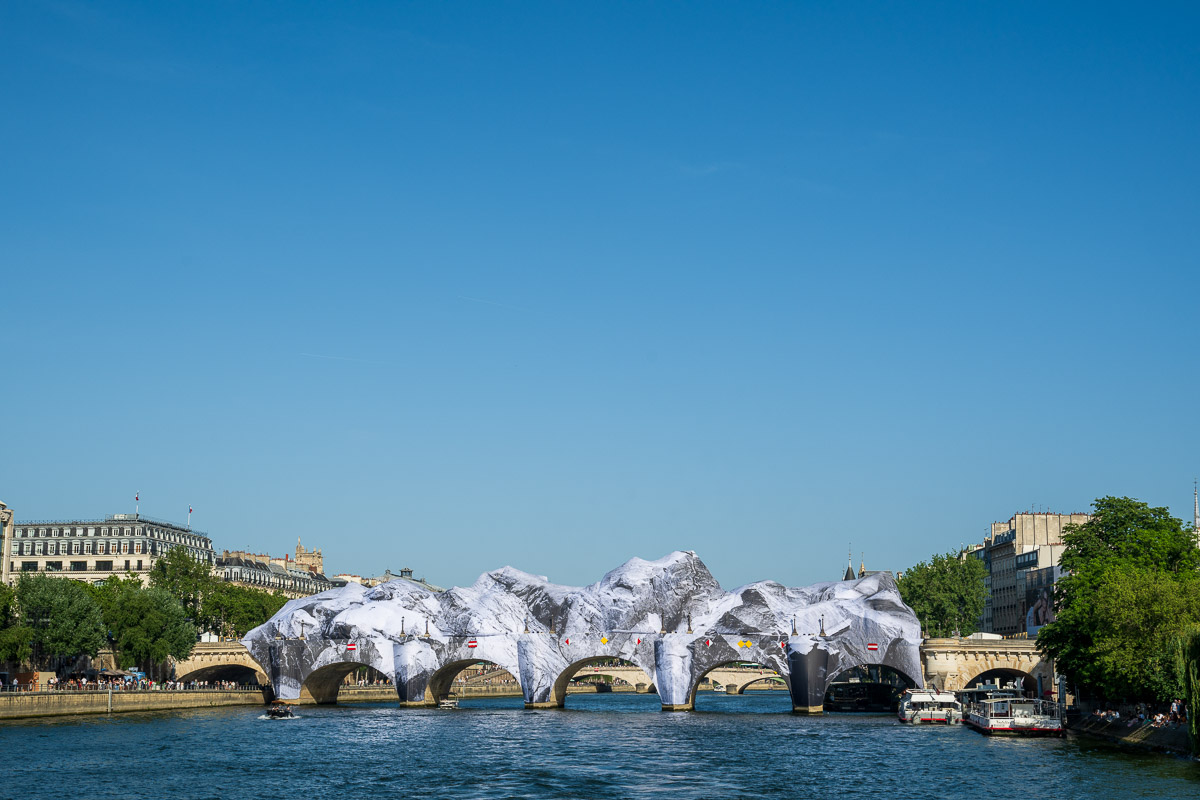
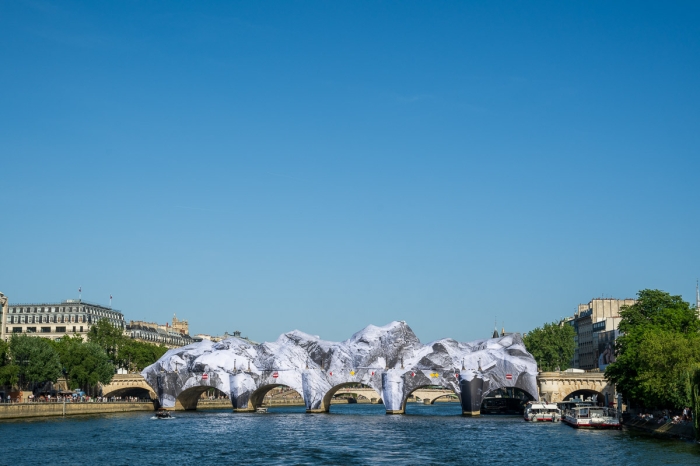
To obtain a view in line with the installation, I first chose to take a bateau-mouche. The idea was to photograph the bridge from the Seine, from a lower viewpoint than the Pont des Arts. This position made it possible to place the structure back within the architecture of the bridge, with its arches, piers and the line of the deck.
From the Seine, the work took on another dimension. The boat obviously imposed its own constraints: constant movement, quick framing, a composition more instinctive than with a tripod. It also offered a direct reading of the project, almost at water level, in the axis of river traffic. The cave then appeared as a mass placed on the bridge, both foreign to the monument and integrated into its silhouette.
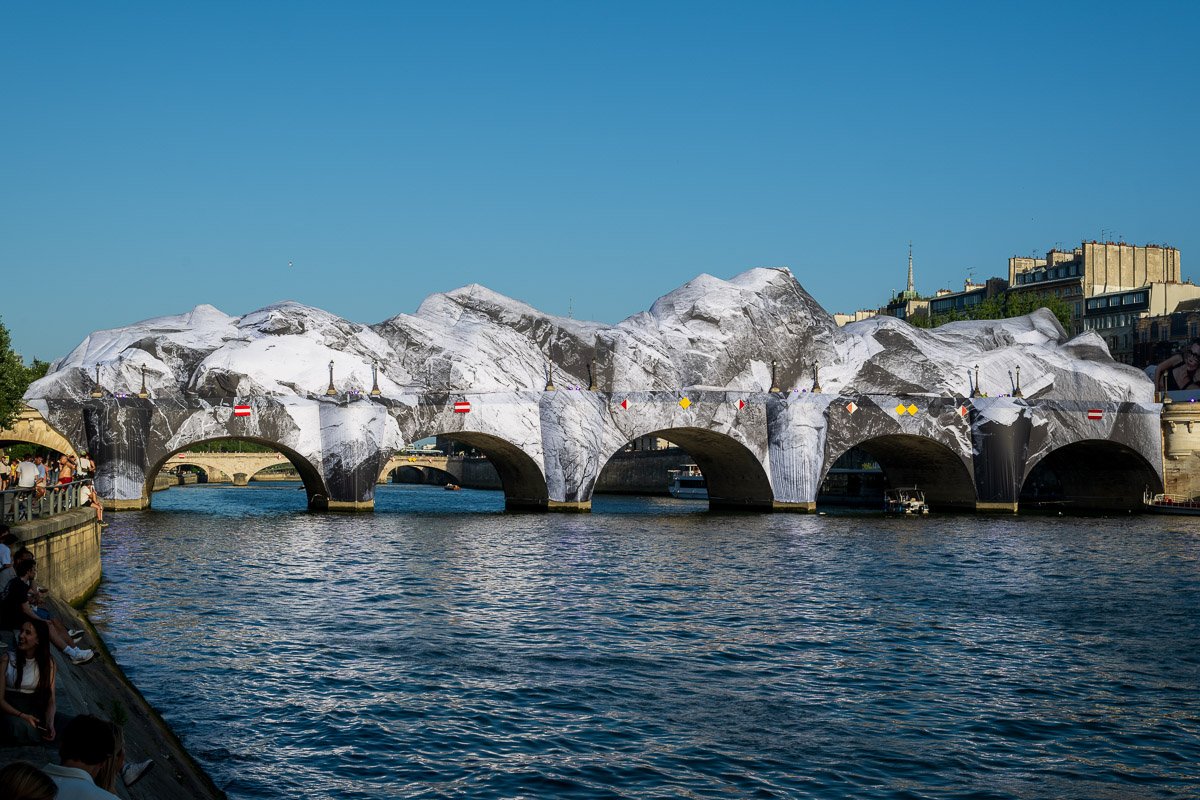
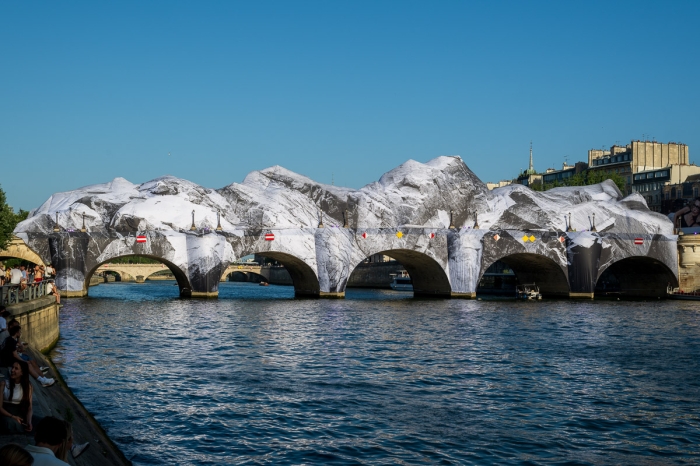
I then tried a more frontal viewpoint from the quay. This closer view shows the structure itself more clearly, its printed texture, its sense of relief and the way it covers the bridge deck. It is more descriptive, more readable, almost more documentary. This perspective, however, seemed less interesting to me for building a personal image. The viewpoint from the right bank quay showed the work clearly, without fully giving it the distance or breathing space I was looking for.
Returning to the Pont au Change to work at night
A few days later, I decided to return to work on a long exposure at night. The choice of viewpoint was essential. The Pont des Arts, despite its interesting location, seemed poorly suited to this approach. Its wooden deck transmits the vibrations of pedestrians’ footsteps, which becomes problematic when working with long exposure times. Even a perfectly stable tripod can struggle to compensate for the micro-vibrations of a moving structure.
I therefore chose the Pont au Change. Its stone structure offers much greater stability. For this type of image, this technical detail becomes decisive. A long exposure of several minutes requires a perfectly stable base. The sharpness of the structure, the regularity of the lines and the precision of the rendering depend as much on the choice of viewpoint as on the camera settings.
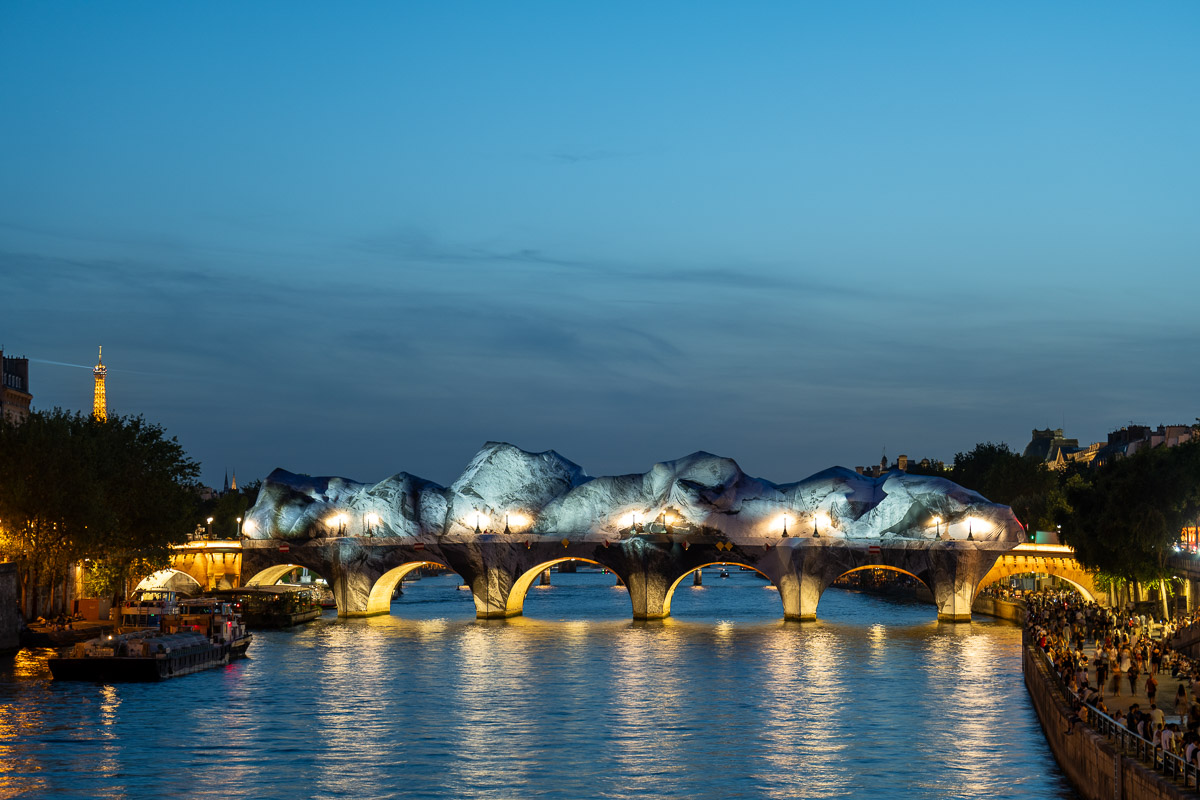
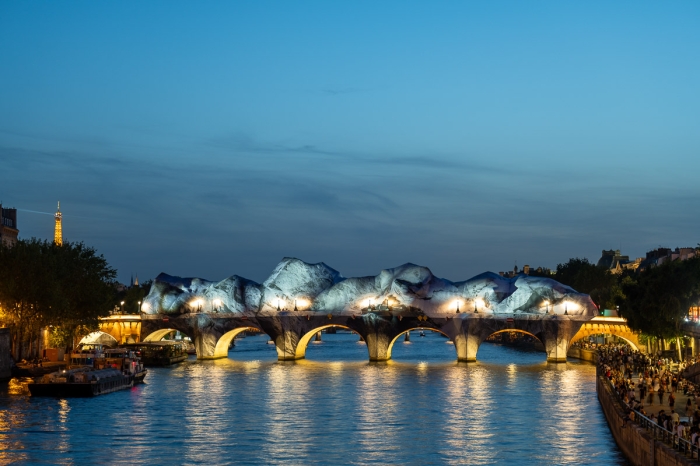
I first made an image before night had fully fallen. The sky still retained a bluish density, while the lighting was beginning to reveal the structure. This photograph keeps a transitional dimension. It still shows the city, the movement of the water, the quays, the lights and the silhouettes. It belongs to that fragile moment when the scene shifts from documentary observation to a more nocturnal reading.
A four-minute long exposure with an ND64 filter
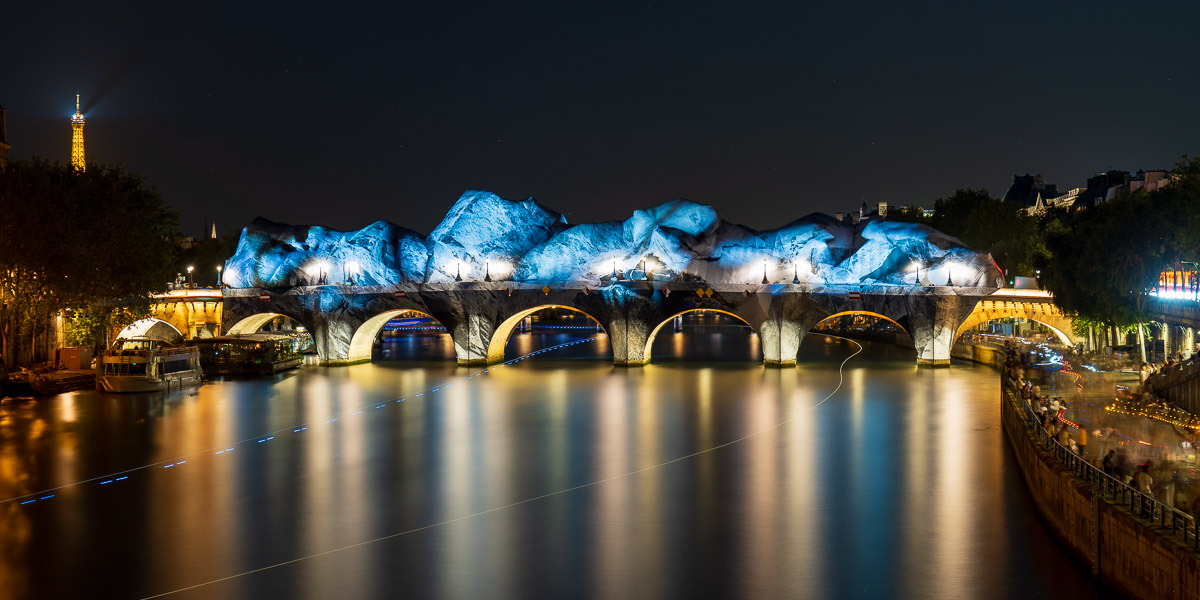
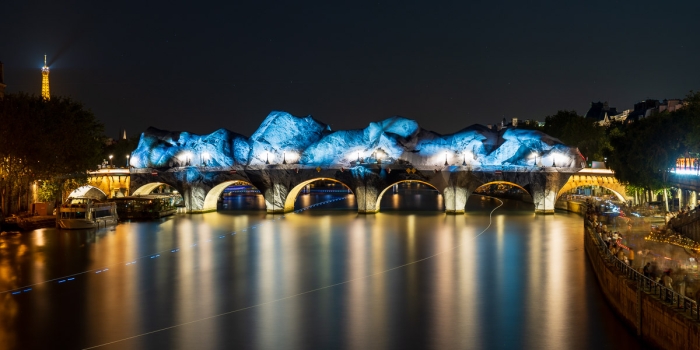
The photograph I retain most strongly was made at night, with a four-minute exposure and an ND64 filter. This exposure time made it possible to smooth the surface of the Seine, partly erase the movements of the water and reduce visual distractions. The river became a dark, continuous, almost silent mass, while the illuminated structure stood out more strongly against the black sky.
What interested me in this image went beyond the representation of JR’s work alone. Long exposure also transforms the scene. It introduces distance, a form of calm, even though the project is visually spectacular. The smoothed water, the black sky, the lights of the bridge and the pale mass of the cave create an almost theatrical contrast.
The photograph then takes on a more interpretive dimension. It goes beyond the simple view one could have from the quays. It restores a constructed visual experience, linked to the choice of moment, medium, viewpoint stability and exposure time. Here, technique directly serves the photographic intention: to isolate the installation, simplify the scene and reinforce the tension between the historic monument, the temporary work and the Parisian night.
Four approaches to the same subject
The series ultimately unfolds in four stages: a first view from the Seine, made aboard a bateau-mouche to photograph the Pont-Neuf in its axis, a more frontal view from the quay, then two images made from the Pont au Change, one at dusk, the other at night in long exposure.
Each viewpoint shifts the perception of the installation. From the Seine, the bridge regains its scale within the Parisian landscape. From the quay, the structure becomes more readable, almost scenographic. At dusk, the light accompanies the transition into night. In the nocturnal long exposure, the water, the sky and the urban lighting simplify the scene until the work takes on a quieter presence.
This progression shows how the same subject can change according to the photographer’s position, the time of day, the light and the technique used. Photographing an urban installation requires more than simply standing in front of the subject. One has to find the right distance, the right moment, and sometimes accept that a more spectacular image may be less personal than a more constructed one.
A series interrupted by bad weather
I wanted to return to the same location at daybreak to make a new long exposure. The morning light would have offered a very different atmosphere, softer, with a possible balance between the sky, stone, water and printed structure. This third sequence would have completed the series: before night, during the night, then as the city woke up.
The project was interrupted before I could make this new photograph. The fabric elements of the set were torn away and detached from the structure following bad weather. The public opening, initially scheduled for early June 2026, was postponed. As I write these lines, the available information mentions repairs in progress, with no certainty regarding the reopening date.
This interruption adds a particular dimension to the photographs already made. As often with ephemeral works, there is always an element of unpredictability. One thinks there are a few days, sometimes a few weeks, then the installation changes, disappears or becomes inaccessible. Photography then takes on the value of a trace, because it preserves a precise, fragile and temporary state of this work.
Photographing the ephemeral
La Caverne du Pont Neuf belongs to this tradition of temporary interventions that alter our perception of the city. It dialogues with the history of the place, with the memory of Christo and Jeanne-Claude, and also with photography itself. This relationship between monumental artwork, public space and photographic image already echoed my work on the Arc de Triomphe wrapped by Christo and Jeanne-Claude, another ephemeral intervention that became a photographic subject in its own right.
An installation visible for only a few days forces the photographer to react quickly, choose an angle, and work with the constraints of the moment. In this type of situation, photography also becomes a way of preserving a temporary state of reality. It fixes an apparition, a light, an urban transformation that will probably appear differently, or not at all, ever again.
These images of La Caverne du Pont Neuf therefore keep the trace of a spectacular project, interrupted by bad weather before I could complete the series at daybreak. They bear witness both to JR’s work and to the uncertainty inherent in ephemeral installations: their fragility, their dependence on time, and the need to photograph them before they change or disappear.
Click on the photos below to view them full screen.
All photographs displayed on this website are copyright protected © Sebastien Desnoulez. No use is allowed without written authorization.
Toutes les photos de ce site sont protégées par copyright © Sebastien Desnoulez, aucune utilisation n'est autorisée sans accord écrit de l'auteur.
Legal notice
About the author
Sebastien Desnoulez is a photographer, author and image-maker based in Paris. His work spans architectural photography, landscape photography and travel photography, with particular attention to composition, lines, light, blur and visual accidents. Trained in photography in the mid-1980s, he covered Formula 1 competitions and produced reports around the world, before developing a form of fine art photography based on the tension between graphic rigor and visual instability. He also shares his technical experience through practical articles for passionate photographers, drawing on a strong visual culture acquired in both film photography and digital photography.
Tags