


Berlin in June 1995: Christo’s Wrapped Reichstag

On 20 June 1995, I was in Berlin to photograph a demonstration by Michael Schumacher beneath the Brandenburg Gate. Once the event was over, I took advantage of a few free hours to walk along the Spree and see the Reichstag being wrapped by Christo and Jeanne-Claude. That evening, I returned to photograph the Brandenburg Gate and the Soviet War Memorial in Tiergarten.
A few hours in Berlin
Our hotel was just a short walk from the Brandenburg Gate. After the demonstration, I set off through the neighbourhood with my Canon EOS-1 and a Canon EF 20-35mm f/2.8 L zoom lens.
I first walked along the Spree. In the distance, the Berlin TV Tower at Alexanderplatz rose above the buildings. The riverbanks still contained large undeveloped areas, with wasteland, older buildings and a few modern constructions.
I simply photographed what I encountered during this walk through a city still marked by its recent division and already undergoing a profound transformation.
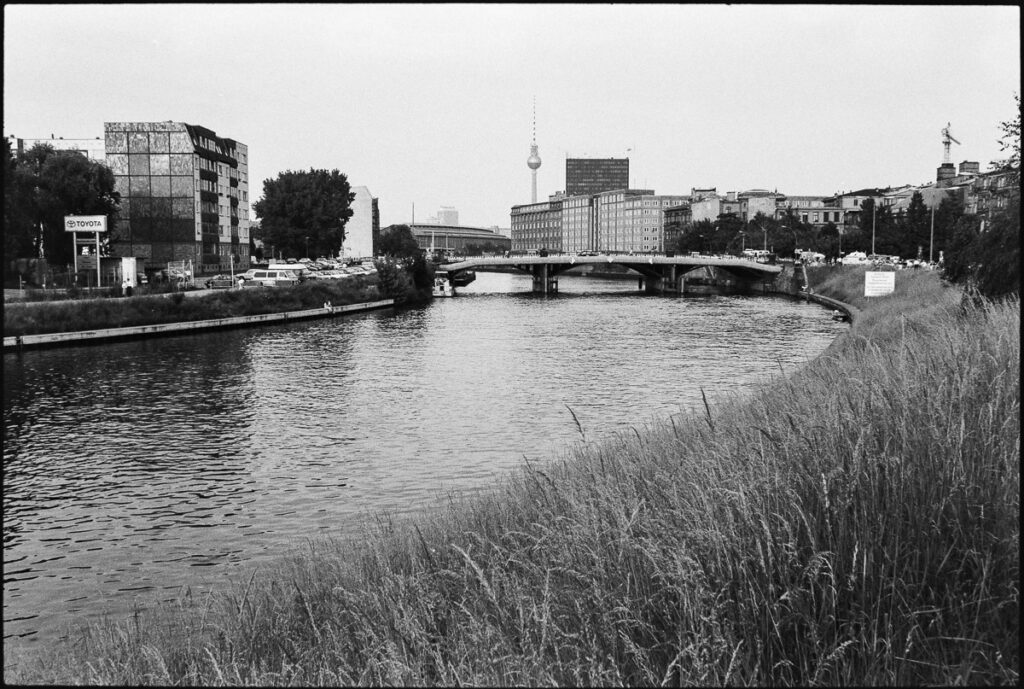 The banks of the Spree in Berlin in June 1995, with the TV Tower at Alexanderplatz visible in the background – Photo © Sebastien Desnoulez
The Reichstag being wrapped
Near the Brandenburg Gate, a large crowd had gathered in front of the Reichstag. The building was then almost entirely covered by the immense fabric designed by Christo and Jeanne-Claude. The same concept of transforming a monument by wrapping it would also be used in Paris in 2021 for the Arc de Triomphe wrapped by Christo.
The installation was not yet complete. In some of the photographs, technicians can be seen working on the upper sections of the building. Vast sheets of silvery fabric descended from the roofs and gradually concealed the façades.
The volumes of the Reichstag remained recognisable, while several architectural elements were still visible at either end. The vertical folds of the fabric completely transformed the appearance of the monument without erasing its silhouette.
Visitors arrived on foot or by bicycle. Tables had been set up to sell drinks and a few souvenirs. The atmosphere was that of a popular gathering around an artwork that was still being completed.
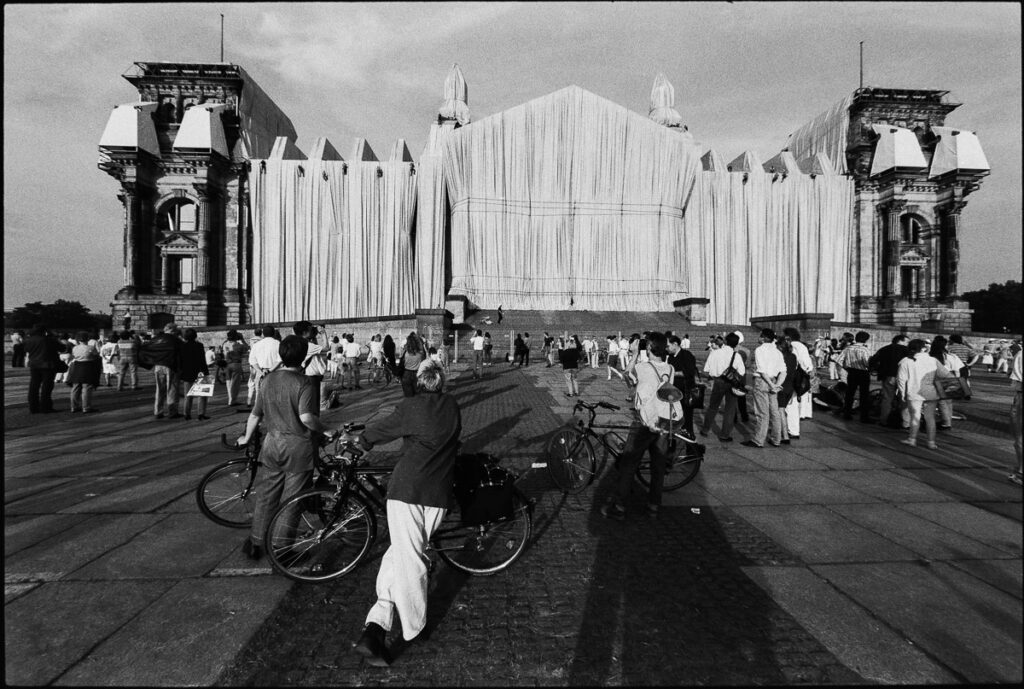 The Reichstag almost entirely covered during the final days of the installation created by Christo and Jeanne-Claude – Photo © Sebastien Desnoulez
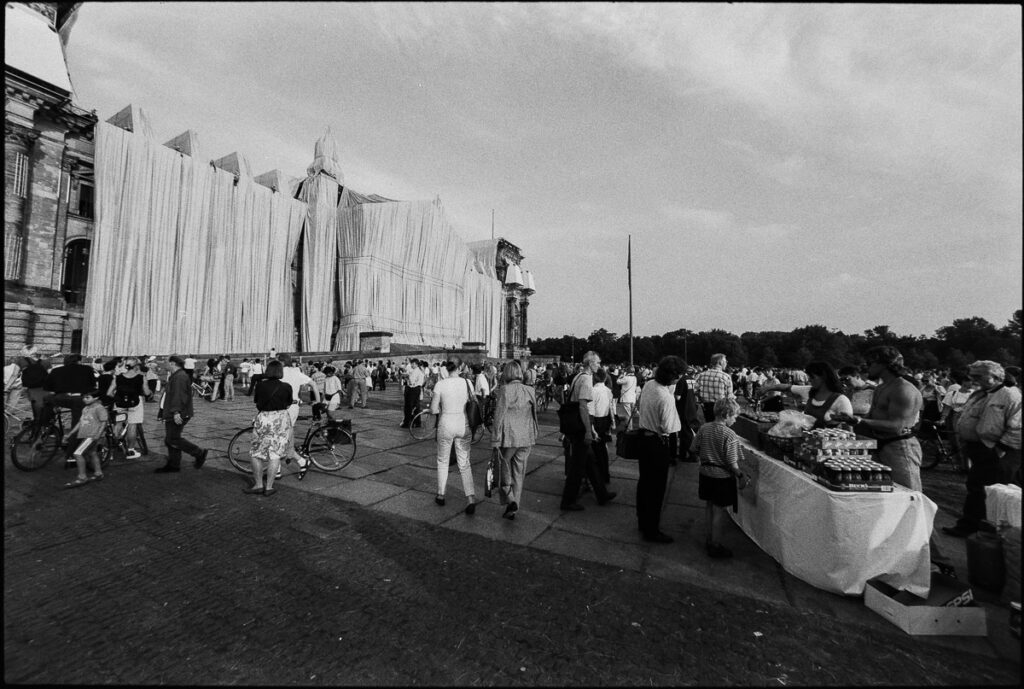 The crowd gathered in front of the Reichstag in June 1995, while technicians were still working on the upper sections of the building – Photo © Sebastien Desnoulez
The crosses commemorating victims of the Berlin Wall
Along a fence in front of the Reichstag stood several crosses bearing names and dates. They commemorated people who had died while attempting to cross the Berlin Wall.
In June 1995, only a few years had passed since the fall of the Wall. These memorials stood beside the fabric-covered building and the crowd that had come to witness its transformation.
Several periods of Berlin’s history were therefore visible within the same landscape: the division of the city, the memory of its victims and the rapid changes accompanying reunification.
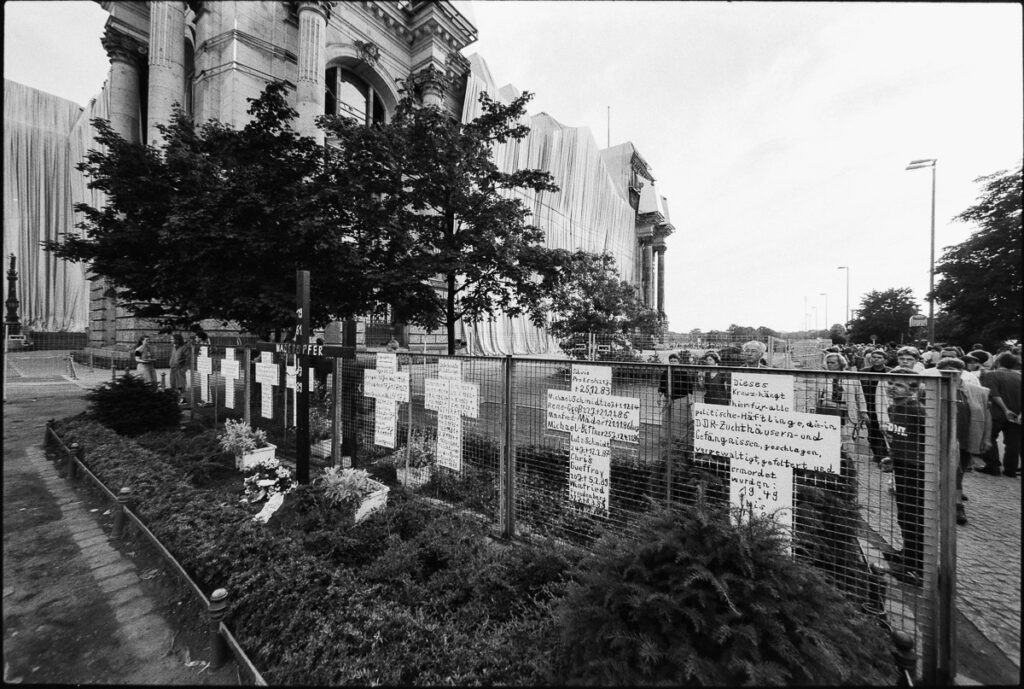 Crosses commemorating victims of the Berlin Wall in front of the Reichstag while it was being wrapped – Photo © Sebastien Desnoulez
Photographing the Brandenburg Gate at night
That evening, after dinner with Renault’s press officers, I returned to the Brandenburg Gate.
I had not brought a tripod. To make a long exposure, I therefore placed my Canon EOS-1 fitted with the 20-35mm f/2.8 L on top of a rubbish bin. The illuminated gate stood out against the black sky, while the headlights of passing cars created trails of light in the foreground.
The photograph was made with the means available, simply by finding a support stable enough to hold the camera throughout the exposure.
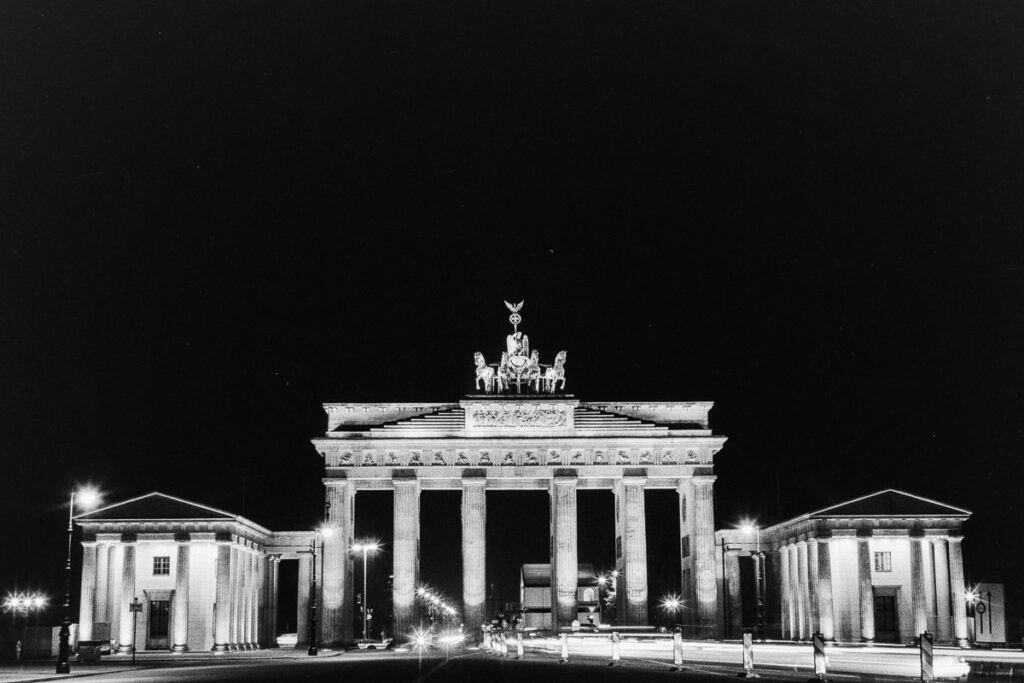 The Brandenburg Gate photographed at night on 20 June 1995, with the Canon EOS-1 resting on a rubbish bin to allow a long exposure – Photo © Sebastien Desnoulez
The Soviet War Memorial in Tiergarten
I then continued walking to the Soviet War Memorial in Tiergarten, located a few hundred metres from the Brandenburg Gate.
Built after the Second World War, the memorial is dominated by the statue of a Soviet soldier. The inscriptions and the dates “1941–1945” appear on its central section.
I also photographed it at night with the Canon EOS-1 and the 20-35mm lens. The monument’s lighting brought out its stone structure and the statue at the top, while the rest of Tiergarten almost completely disappeared into the darkness.
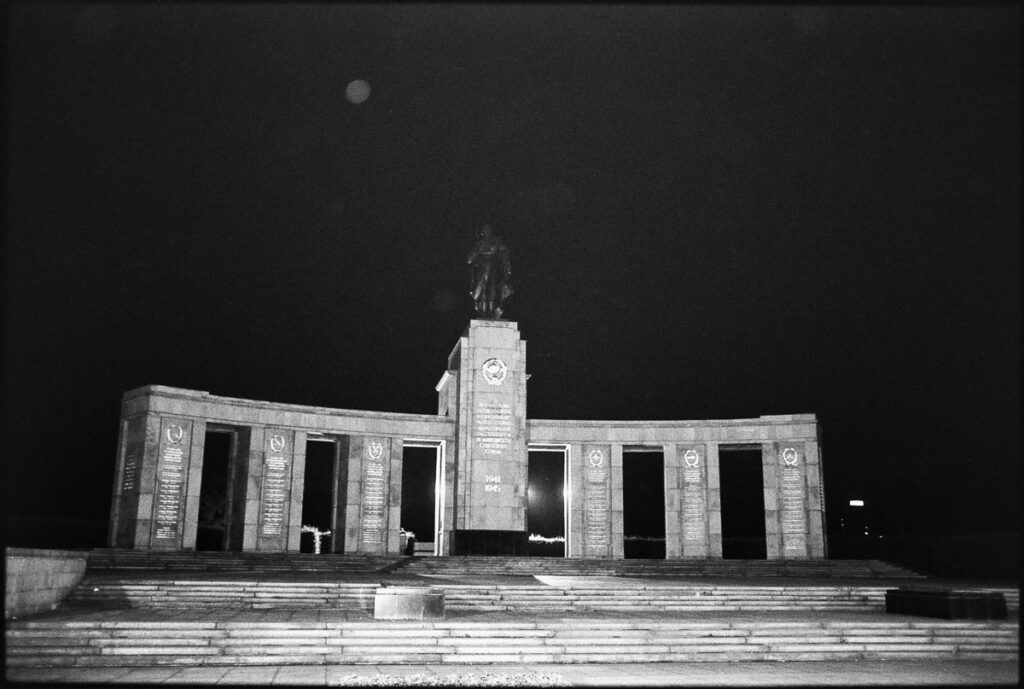 The Soviet War Memorial in Tiergarten photographed at night in Berlin in June 1995 – Photo © Sebastien Desnoulez
Berlin almost five years after reunification
The following morning, we left Berlin from Tempelhof Airport. This brief walk allowed me to preserve a few photographs of a particular moment: the Reichstag almost entirely wrapped, four days before the inauguration of the artwork, and Berlin almost five years after reunification.
During the press conference, Michael Schumacher had recalled watching the fall of the Berlin Wall live on television in November 1989. He explained how deeply the event had moved him. His demonstration beneath the Brandenburg Gate therefore held a significance for him that went beyond a Formula 1 promotional event.
About the author
Sebastien Desnoulez is a photographer, author and image maker based in Paris. His work spans architectural photography, landscape photography and travel photography, with particular attention to composition, lines, light, blur and visual accidents. Trained in photography in the mid-1980s, he covered Formula 1 and reported from around the world before developing a fine art photography practice built around the tension between graphic rigour and visual instability. He also shares his technical experience through practical articles for passionate photographers, drawing on a strong visual culture acquired in both film and digital photography.
Tags