

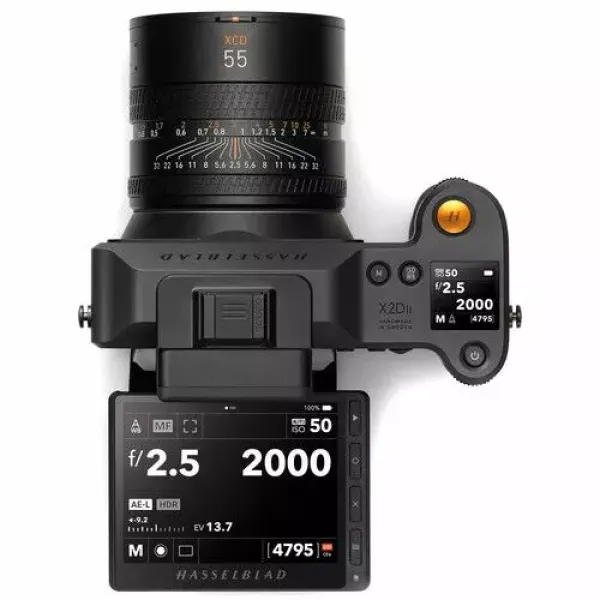
Hasselblad XCD medium format equivalence in 24x36 / Full Frame

Hasselblad X cameras and the CFV 100C digital back use a 43.8×32.9mm medium-format sensor, larger than the 24x36mm sensor found in Full Frame cameras. To compare focal lengths, framing and depth of field between the two formats, a conversion factor of approximately 0.79× must be applied.
A 50mm lens mounted on a Hasselblad medium-format camera therefore provides an angle of view comparable to that of a 40mm lens on a 24x36 camera. Similarly, a lens opened to f/2.8 produces, with identical framing, a depth of field close to that of a lens opened to f/2.2 on Full Frame.
This equivalence does not, however, alter either the actual aperture or the amount of light reaching the sensor. An XCD 55V f/2.5 remains a lens with a maximum aperture of f/2.5 for exposure purposes.
Article updated on July 28, 2026. The prices shown are the official retail prices including VAT displayed by the Hasselblad European store, excluding promotions, discounts and kit prices. When a product is discounted, the official price before the reduction is used.
Hasselblad sensor format
The Hasselblad X2D II 100C, X2D 100C and 907X & CFV 100C use a back-illuminated CMOS sensor measuring 43.8×32.9mm. Its native width-to-height ratio is 4:3, whereas the 24x36mm sensor uses a 3:2 ratio.
| Format | Dimensions | Native ratio | Surface area | Diagonal |
|---|---|---|---|---|
| Hasselblad X / CFV 100C | 43.8×32.9mm | 4:3 | 1,441mm² | 54.8mm |
| 24x36 / Full Frame | 36×24mm | 3:2 | 864mm² | 43.3mm |
The Hasselblad sensor therefore has a surface area approximately 1.67 times larger than that of a 24x36 sensor. Hasselblad generally states that its light-sensitive surface is approximately 70% larger than Full Frame.
This sensor is nevertheless smaller than the former 6×4.5cm, 6×6cm and 6×7cm film formats. It is also smaller than the 53.4×40mm sensors used in some medium-format digital backs intended for studio photography.
Hasselblad and Full Frame conversion factor
The conversion factor is calculated by comparing the diagonal of the 24x36 sensor with that of the Hasselblad sensor:
43.3 ÷ 54.8 = 0.79
To determine the 24x36 equivalent of a Hasselblad XCD focal length, simply multiply the focal length by 0.79.
Examples:
- an XCD 25mm frames like an approximately 20mm lens on 24x36;
- an XCD 38mm frames like a 30mm;
- an XCD 55mm frames like a 43mm;
- an XCD 65mm frames like a 50mm;
- an XCD 90mm frames like a 71mm;
- an XCD 135mm frames like a 105mm.
Depth-of-field equivalence
The same conversion factor can be applied to the aperture when comparing depth of field at the same framing and shooting distance.
| Actual aperture on Hasselblad | Equivalent depth of field on 24x36 |
|---|---|
| f/2.5 | approximately f/2 |
| f/2.8 | approximately f/2.2 |
| f/3.2 | approximately f/2.5 |
| f/3.4 | approximately f/2.7 |
| f/3.5 | approximately f/2.8 |
| f/4 | approximately f/3.2 |
| f/4.5 | approximately f/3.6 |
| f/4.8 | approximately f/3.8 |
This conversion only concerns the appearance of depth of field. For exposure, a lens opened to f/4 remains an f/4 lens: it transmits the amount of light associated with that aperture, regardless of sensor size.
To learn more, use our depth of field calculator for photography and read our guide to focal length and aperture equivalence by sensor size.
Hasselblad medium-format camera range
Hasselblad’s 100-megapixel range includes two X-series mirrorless cameras and a modular system combining the 907X camera body with the CFV 100C digital back.
The X2D II 100C is the most recent and most capable model. The first-generation X2D 100C remains listed by the official store despite the arrival of its successor.
| Camera | Sensor | Autofocus | Stabilisation | Storage | Viewfinder and screen | Dimensions | Weight | Official retail price |
|---|---|---|---|---|---|---|---|---|
| Hasselblad X2D II 100C | 43.8×32.9mm BSI CMOS 100MP effective 16-bit 15.3 stops 4:3 ratio |
PDAF, CDAF and LiDAR AF-S, AF-C and MF 425 PDAF zones subject detection |
5-axis IBIS up to 10 stops at the centre of the image |
1TB internal SSD CFexpress Type B |
5.76-million-dot EVF 3.6-inch tilting OLED touchscreen |
148.5×106×75mm | 840g with battery 730g without battery |
€7,500 |
| Hasselblad X2D 100C | 43.8×32.9mm BSI CMOS 100MP effective 16-bit 15 stops 4:3 ratio |
PDAF and CDAF AF-S and MF 294 PDAF zones |
5-axis IBIS up to 7 stops |
1TB internal SSD CFexpress Type B |
5.76-million-dot EVF 3.6-inch tilting touchscreen |
148.5×106×74.5mm | 895g with battery 790g without battery |
€8,699 |
| Hasselblad 907X & CFV 100C | 43.8×32.9mm BSI CMOS 100MP effective 16-bit 15 stops 4:3 ratio |
PDAF and CDAF AF-S and MF face detection |
No mechanical image stabilisation | 1TB internal SSD CFexpress Type B |
No built-in viewfinder 3.2-inch tilting touchscreen optional optical viewfinder |
102×92×84mm 907X body and digital back assembled |
620g 907X body and CFV 100C back |
€7,799 |
Current Hasselblad cameras are designed for still photography and do not offer video recording. Their continuous shooting modes remain secondary compared with the burst performance of 24x36 cameras intended for sport or wildlife photography.
Hasselblad X2D II 100C
The X2D II 100C is the most versatile camera in the range. Its 100-megapixel sensor records 16-bit colour and offers a claimed dynamic range of 15.3 stops, with a native sensitivity starting at ISO 50.
It introduces continuous AF-C autofocus to Hasselblad for the first time, combining phase detection, LiDAR measurement and recognition of people, vehicles, cats and dogs.
Its in-body stabilisation reaches up to 10 stops at the centre of the image and 8 stops at the edges, according to the manufacturer’s measurements. Storage is based on a 1TB internal SSD, supplemented by a CFexpress Type B slot.
The X2D II 100C is particularly well suited to landscape, architecture, portrait, fashion, studio, artwork reproduction and demanding travel photography.
Hasselblad X2D 100C
The X2D 100C uses a sensor with the same resolution, with a claimed dynamic range of 15 stops and an ISO sensitivity range of 64 to 25,600. It features phase-detection autofocus limited to AF-S mode and in-body stabilisation rated at up to 7 stops.
It retains the 1TB internal SSD, CFexpress Type B card slot and 5.76-million-dot electronic viewfinder. Despite its original position as the flagship model, it has now been surpassed by the lighter X2D II 100C, which offers improved stabilisation and continuous autofocus.
Hasselblad 907X & CFV 100C
The 907X & CFV 100C adopts a modular design inspired by historic Hasselblad cameras. The 907X body accepts XCD lenses, while the CFV 100C back contains the sensor, screen, storage and most of the electronics.
The CFV 100C digital back can also be mounted on most Hasselblad V-system cameras manufactured since 1957, with the exception of the original SWC. It can also be used with certain technical cameras.
This modular design is particularly attractive to architecture, landscape, still-life and studio photographers. The absence of a built-in electronic viewfinder and mechanical stabilisation makes it less suitable for fast handheld photography.
Hasselblad XCD lenses and their 24x36 equivalents
Hasselblad XCD lenses are designed to cover the 43.8×32.9mm sensor used by the X and 907X systems. The Hasselblad European store currently lists twelve lenses or optical combinations.
In the following tables:
- the focal-length equivalent refers to the angle of view obtained on 24x36;
- the aperture equivalent refers only to depth of field;
- the stated diameter is the maximum external diameter of the lens;
- the length is stated without caps or lens hood;
- the weight is stated without caps or lens hood;
- the prices are the official retail prices including VAT displayed by the Hasselblad European store, excluding discounts.
Leaf shutter and flash synchronisation
All Hasselblad XCD lenses incorporate a leaf shutter. Unlike a conventional mechanical shutter positioned in front of the sensor, this shutter is located inside the lens.
Its main advantage is that it allows flash synchronisation at every available shutter speed. Depending on the lens, the maximum speed generally reaches 1/2,000s or 1/4,000s.
This feature makes outdoor flash portraiture easier. The photographer can use a wide aperture in bright ambient light while selecting a fast shutter speed to reduce the exposure of the background.
The leaf shutter also produces less vibration than a mechanical focal-plane shutter. However, every lens must incorporate its own shutter mechanism, which contributes to the high price of XCD lenses.
Hasselblad XCD E-series zoom lenses
The E series includes Hasselblad’s two new-generation zoom lenses. They combine high-end construction, modernised autofocus and an integrated leaf shutter.
| Lens | 24x36 equivalent | Depth-of-field equivalent | Dimensions Diameter × length |
Weight | Filter | Main use | Official retail price |
|---|---|---|---|---|---|---|---|
| XCD 20-35E f/3.2-4.5 | 16-27mm | f/2.5-3.6 | 81×117mm | 805g | 77mm | Ultra-wide angle, landscape, architecture, interiors | €6,729 |
| XCD 35-100E f/2.8-4 | 28-76mm | f/2.2-3.2 | 90×138mm 178mm extended |
894g | 86mm | Standard zoom, travel, documentary, portrait | €4,800 |
The XCD 20-35E f/3.2-4.5 provides the widest angle of view in the current XCD range. Its 16-27mm equivalent makes it particularly suitable for landscape, architecture and interior photography.
The XCD 35-100E f/2.8-4 covers a range close to that of a 28-76mm lens on Full Frame. Its aperture corresponds, in depth-of-field terms, to approximately f/2.2 at the wide-angle end and f/3.2 at the longest focal length. It is the most versatile zoom in the system.
Hasselblad XCD V-series lenses
V-series lenses feature a customisable control ring and a focusing ring that allows photographers to switch quickly from autofocus to manual focus. Their autofocus motors are faster than those used in the first XCD lenses.
| Lens | 24x36 equivalent | Depth-of-field equivalent | Dimensions Diameter × length |
Weight | Filter | Main use | Official retail price |
|---|---|---|---|---|---|---|---|
| XCD 25V f/2.5 | 20mm | f/2 | 75×105mm | 592g | 72mm | Night landscapes, architecture, interiors, astrophotography | €4,199 |
| XCD 38V f/2.5 | 30mm | f/2 | 76×68mm | 350g | 72mm | Travel, landscape, street photography, environmental portraiture | €4,199 |
| XCD 55V f/2.5 | 43mm | f/2 | 76×72mm | 372g | 72mm | General photography, documentary, portrait, still life | €4,199 |
| XCD 90V f/2.5 | 71mm | f/2 | 75×95mm | 551g | 72mm | Portrait, fashion, still life, details | €4,799 |
All four V-series lenses use 72mm filters. The XCD 38V and XCD 55V are particularly compact considering their apertures and the size of the sensor they cover.
The XCD 25V f/2.5 provides framing equivalent to a 20mm f/2 lens in depth-of-field terms. The XCD 90V f/2.5 corresponds to a 71mm f/2, placing it between a standard lens and a traditional portrait lens on 24x36.
Hasselblad XCD P-series lenses
The P series prioritises compactness and low weight. These lenses also incorporate a leaf shutter, although their construction and controls are simpler than those of V-series lenses.
| Lens | 24x36 equivalent | Depth-of-field equivalent | Dimensions Diameter × length |
Weight | Filter | Main use | Official retail price |
|---|---|---|---|---|---|---|---|
| XCD 28P f/4 | 22mm | f/3.2 | 75×48mm | 245g | 72mm | Landscape, architecture, travel, street photography | €1,899 |
| XCD 45P f/4 | 36mm | f/3.2 | 80×52mm | 320g | 62mm | Travel, street photography, general photography | €1,199 |
| XCD 75P f/3.4 | 59mm | f/2.7 | 75×76mm | 398g | 72mm | Portrait, street photography, still life, details | €2,529 |
At only 245g, the XCD 28P f/4 is the lightest lens in the current range. Combined with the X2D II 100C, it creates a kit weighing approximately 1.09kg with the battery.
The XCD 45P f/4 is the least expensive XCD lens. Its 36mm equivalent makes it a versatile choice for travel and everyday photography.
The XCD 75P f/3.4 corresponds to a 59mm f/2.7 lens in depth-of-field terms. It provides a slightly longer focal length than a standard lens and is suitable for full-length, half-length and environmental portraits.
Other Hasselblad XCD lenses
Hasselblad still lists nine lenses belonging to the earlier generations of the XCD system. Some are heavier and their autofocus is generally slower than that of the more recent E, V and P series, although their optical performance remains suitable for 100-megapixel sensors.
| Lens | 24x36 equivalent | Depth-of-field equivalent | Dimensions Diameter × length |
Weight | Filter | Main use | Official retail price |
|---|---|---|---|---|---|---|---|
| XCD 21mm f/4 | 17mm | f/3.2 | 83×106mm | 600g | 77mm | Ultra-wide angle, landscape, architecture, interiors | €3,599 |
| XCD 30mm f/3.5 | 24mm | f/2.8 | 83×88mm | 550g | 77mm | Landscape, architecture, documentary, travel | €4,070 |
| XCD 45mm f/3.5 | 35mm | f/2.8 | 77×75mm | 417g | 67mm | Travel, documentary, street photography, general photography | €2,750 |
| XCD 65mm f/2.8 | 50mm | f/2.2 | 81×93mm | 727g | 67mm | Standard focal length, travel, street photography, general photography | €2,748 |
| XCD 80mm f/1.9 | 63mm | f/1.5 | 84×112mm | 1,045g | 77mm | Portrait, fashion, still life, shallow depth of field | €4,788 |
| XCD 90mm f/3.2 | 71mm | f/2.5 | 77×100mm | 619g | 67mm | Portrait, fashion, still life | €3,230 |
| XCD 120mm f/3.5 Macro | 95mm | f/2.8 | 81×150mm | 970g | 77mm | 1:2 macro, reproduction, portrait, still life | €4,680 |
| XCD 135mm f/2.8 + X Converter 1.7 | 105mm without converter 178mm with converter |
f/2.2 without converter f/3.8 with converter |
81×149mm 195mm with converter |
935g 1,372g with converter |
77mm | Tight portraits, distant landscapes, telephoto photography | €4,788 |
| XCD 35-75mm f/3.5-4.5 | 28-58mm | f/2.8-3.6 | 85×145mm | 1,115g | 77mm | Landscape, travel, general photography, portrait | €5,400 |
The XCD 21mm f/4 is the ultra-wide-angle lens from the first generation of the XCD range. Its 17mm equivalent angle of view on 24x36 makes it particularly suitable for landscape, architecture and interior photography. The XCD 30mm f/3.5 corresponds to a 24mm lens and provides a more versatile focal length for landscape, documentary and travel photography.
The XCD 45mm f/3.5 and XCD 65mm f/2.8 correspond respectively to approximately 35mm and 50mm on 24x36. The XCD 45mm is therefore a versatile general-purpose lens, while the XCD 65mm provides the traditional angle of view of a standard lens.
The XCD 80mm f/1.9 remains the XCD lens with the widest maximum aperture. It corresponds to a 63mm lens on 24x36 and, with identical framing, produces depth of field comparable to that of a Full Frame lens opened to approximately f/1.5. This high speed comes with a relatively substantial weight of 1,045g.
The XCD 90mm f/3.2 corresponds to a 71mm lens and was one of the original portrait lenses in the system. The XCD 120mm f/3.5 Macro corresponds to a 95mm lens and offers a 1:2 reproduction ratio, making it suitable for macro photography, reproduction work, still life and portraiture.
The XCD 135mm f/2.8 corresponds to a 105mm lens on 24x36. Combined with the X Converter 1.7, it becomes a 226mm f/4.8, providing an angle of view equivalent to approximately 178mm.
The XCD 35-75mm f/3.5-4.5 covers the equivalent of a 28-58mm lens. It maintains a constant overall length thanks to internal focusing, although its weight exceeds 1.1kg.
Hasselblad X Converter 1.7
The X Converter 1.7 is specifically designed for the XCD 135mm f/2.8. It multiplies the focal length by 1.7 and reduces the maximum aperture by approximately 1.5 stops.
| Configuration | Actual focal length | Actual aperture | 24x36 equivalent | Depth-of-field equivalent | Weight |
|---|---|---|---|---|---|
| XCD 135mm alone | 133mm | f/2.8 | 105mm | approximately f/2.2 | 935g |
| XCD 135mm + X Converter 1.7 | 226mm | f/4.8 | 178mm | approximately f/3.8 | 1,372g |
Unlike the Fujifilm GF 1.4× teleconverter, the X Converter 1.7 is not compatible with several telephoto lenses. It is dedicated exclusively to the XCD 135mm.
Which focal lengths should you choose for a Hasselblad?
For landscape and architecture
The XCD 20-35E f/3.2-4.5 is the most versatile option. It covers the equivalent of a 16-27mm lens on 24x36. The XCD 25V f/2.5 is faster and lighter, with framing equivalent to a 20mm lens.
The XCD 28P f/4 is a much more compact solution. Its 22mm equivalent is sufficient for many landscapes and architectural subjects, although its aperture is less suitable for night photography.
For travel
The XCD 28P f/4, XCD 38V f/2.5 and XCD 45P f/4 create the lightest kits. The 38V frames like a 30mm lens and is suitable for landscapes, documentary photography and environmental portraiture.
The XCD 45P f/4 corresponds to a 36mm lens and weighs only 320g. It is the most affordable choice for travelling with an X2D or 907X.
For general photography
The XCD 55V f/2.5 provides the framing of a 43mm lens and depth of field comparable to that of a Full Frame lens opened to f/2. It is a standard focal length that is slightly wider than a traditional 50mm.
The XCD 65mm f/2.8 corresponds exactly to a 50mm lens on 24x36. It is, however, almost twice as heavy as the XCD 55V.
For portrait photography
The XCD 75P f/3.4 corresponds to a 59mm f/2.7 lens in depth-of-field terms. It is suitable for full-length, half-length and environmental portraits.
The XCD 90V f/2.5 frames like a 71mm lens with depth of field close to that of an f/2 lens on 24x36. It allows tighter portraits while maintaining a moderate shooting distance.
The XCD 135mm f/2.8 corresponds to a 105mm f/2.2 lens. It is suitable for tight portraits and fashion photography, although its weight is considerably higher than that of V- and P-series lenses.
For telephoto photography
The Hasselblad XCD range remains limited in long focal lengths. The XCD 135mm combined with the 1.7× converter reaches the equivalent of a 178mm lens on 24x36.
The system does not currently offer a direct equivalent to a 300mm, 400mm or 500mm Full Frame lens. Wildlife and long-distance sports photography therefore remain more accessible with a 24x36 system or the Fujifilm GFX range, which includes a GF 500mm f/5.6.
Meaning of Hasselblad XCD designations
- XCD: autofocus mount designed for Hasselblad X and 907X cameras;
- E: new-generation premium zoom-lens series;
- V: recent series featuring a control ring and a mechanism that facilitates switching between autofocus and manual focus;
- P: series prioritising compactness, low weight and mobility;
- X Converter: optical converter dedicated to the XCD 135mm;
- Leaf shutter: shutter integrated into each XCD lens, allowing flash synchronisation at all available shutter speeds.
Frequently asked questions about Hasselblad equivalence
What is the conversion factor of Hasselblad X cameras and the CFV 100C?
The conversion factor between the 43.8×32.9mm Hasselblad format and the 24x36 format is approximately 0.79×. A 50mm focal length on Hasselblad therefore provides an angle of view comparable to that of a 40mm lens on Full Frame.
Is the Hasselblad sensor different from the Fujifilm GFX sensor?
Both systems use a sensor with the same dimensions, measuring 43.8×32.9mm, with a native 4:3 ratio and a conversion factor close to 0.79×. The differences concern colour processing, electronics, autofocus, stabilisation, ergonomics and lenses.
Is a Hasselblad f/2.5 lens equivalent to an f/2 lens on Full Frame?
Only in terms of depth of field, at the same framing and shooting distance. For exposure, the lens remains opened to f/2.5.
Which Hasselblad lens corresponds to a 35mm lens on Full Frame?
The XCD 45P f/4 provides framing equivalent to approximately 36mm. It is therefore the XCD lens closest to a traditional 35mm lens.
Which Hasselblad lens corresponds to a 50mm lens?
The XCD 65mm f/2.8 corresponds almost exactly to a 50mm lens on 24x36. The XCD 55V f/2.5 is slightly wider, with an equivalent focal length of approximately 43mm.
Which Hasselblad lens corresponds to an 85mm portrait lens?
The current range does not include an exact equivalent. The XCD 90V f/2.5 corresponds to a 71mm lens, while the XCD 135mm f/2.8 corresponds to a 105mm lens. The first is suitable for relatively wide portraits and the second for tighter framing.
Why do Hasselblad XCD lenses contain a shutter?
The leaf shutter built into each lens allows flash synchronisation at every available shutter speed, generally up to 1/2,000s or 1/4,000s. This solution is particularly useful in the studio and for outdoor flash portraiture.
Can the 907X & CFV 100C be used with older Hasselblad cameras?
Yes. The CFV 100C digital back can be mounted on most Hasselblad V-system cameras manufactured since 1957, with the exception of the original SWC. Adapters also make it possible to use V, H and XPan lenses on X and 907X cameras.
Can Hasselblad X2D cameras record video?
No. The X2D II 100C, X2D 100C and 907X & CFV 100C are designed exclusively for still photography.
Conclusion
The Hasselblad X and 907X systems use a conversion factor of approximately 0.79× compared with 24x36. An XCD 38mm therefore frames like a 30mm lens, an XCD 65mm like a 50mm and an XCD 135mm like a 105mm.
The same factor can be used to compare depth of field without altering the actual aperture used for exposure. An XCD 55V f/2.5, for example, produces depth of field comparable to that of a 43mm lens opened to approximately f/2 on Full Frame.
The Hasselblad system stands out for its 16-bit files, colour rendering, built-in SSD storage and the leaf shutters incorporated into XCD lenses. It is primarily suited to landscape, architecture, portrait, fashion, studio, still-life and demanding travel photography.
The X2D II 100C introduces continuous autofocus and significantly improved stabilisation, while the 907X & CFV 100C retains the modular approach that forms part of Hasselblad’s heritage. The choice of lenses remains less extensive than in the Fujifilm GFX system, particularly at long focal lengths, although the V and P series now make it possible to create relatively compact kits.
Sources: technical specifications and official retail prices published by the Hasselblad European store and the official Hasselblad website, consulted on July 28, 2026. Prices may be changed by the manufacturer. This article is not sponsored.
About the author
Sebastien Desnoulez is a photographer, author and image maker based in Paris. His work spans architectural photography, landscape photography and travel photography, with particular attention to composition, lines, light, blur and visual accidents. Trained in photography in the mid-1980s, he covered Formula 1 and reported from around the world before developing a fine art photography practice built around the tension between graphic rigour and visual instability. He also shares his technical experience through practical articles for passionate photographers, drawing on a strong visual culture acquired in both film and digital photography.
Tags