


Press photographers in 1985: what the pros’ bags revealed

In 1985, a photojournalist’s bag revealed almost everything about the way he or she worked. Motorized camera bodies, fast prime lenses, black-and-white or color films, flashes, batteries, accessories, every choice answered a specific constraint. Based on “9 photographes vident leur sac”, an article by Paul Khayat published in Photo Reporter in September 1985, this article looks back at the equipment used by French press photographers before the autofocus revolution of the 1990s, and compares it with a current professional setup.
Rereading those pages today gives us a very precise picture of field photojournalism, with its reflexes, constraints and equipment choices.
When the issue came out, I had just returned from a six-month stay at university in Texas. I was nineteen, and what had initially been a way to bring back travel memories had already turned into a real passion for photography.
I had started reading Photo Reporter after deciding to leave for the United States, in the spring of 1984. I preferred this magazine to other titles of the period because it seemed more practical, closer to the field, and more focused on the profession of photography. Part of my visual education took place in its pages.
When I returned to France, I compared the equipment choices of these professionals with those of the photographers from La Voix du Nord, AFP or Reuters whom I met while covering news in Lille, in order to imagine my own ideal camera bag. That journey would lead me, a few years later, to finally be equipped like a reporter, as I describe in Dallas Police 1987, a photo report inside the NorthWest Dallas patrols.
Three years later, after covering local political news, the 1988 presidential campaign and my first motorsport events, I joined the press agency DPPI.
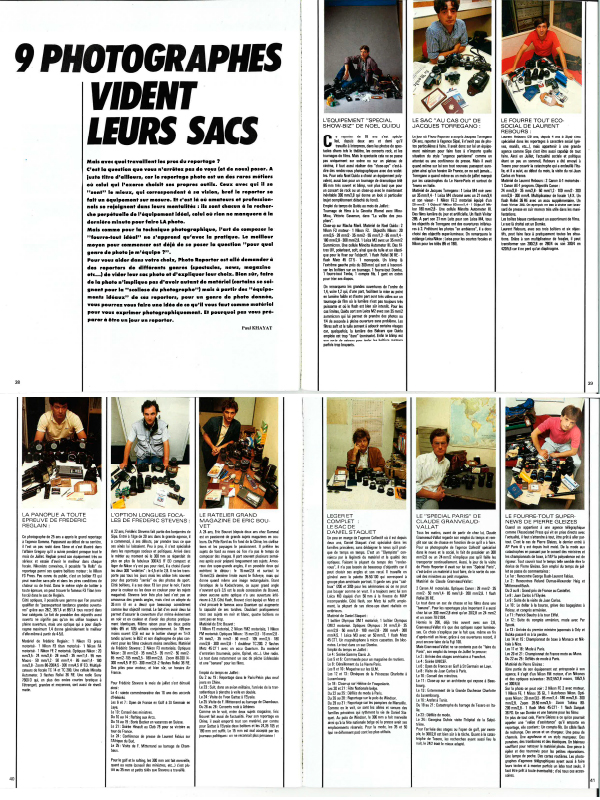
Source: Paul Khayat, “9 photographes vident leur sac”, Photo Reporter, September 1985.
Download the article as a PDF
A valuable period document
Paul Khayat’s article is far from anecdotal. With camera bags opened, it shows how photographers from agencies such as Sipa, Gamma, AP or Collectif actually worked, depending on whether they covered entertainment, news, magazines, social issues, fashion or politics. We discover equipment that was often imposing, but also highly coherent. Each bag reflects a way of photographing, a relationship with the subject, and above all an adaptation to technical constraints that today’s photographers sometimes struggle to imagine.
This document is also interesting because it captures a precise moment in the history of photojournalism. The equipment it shows would remain, in broad terms, the basis of photojournalists’ gear until the early 1990s, before the rise of Canon EOS autofocus systems profoundly transformed professional habits.
Few zooms, many prime lenses
The first thing that stands out when going through these equipment lists is the very limited place occupied by zoom lenses. They existed, of course, but remained in the minority. The heart of the camera bag was built around prime lenses, chosen one by one according to a very precise framing logic.
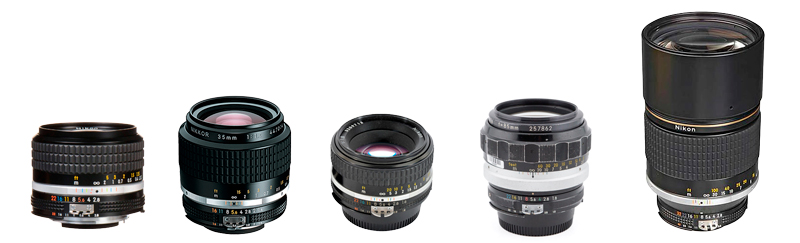
My Nikon setup in 1987:
24mm f/2.8 - 35mm f/1.4 - 50mm f/1.8 - 85mm f/1.8 - 180mm f/2.8
The same reference points appear again and again: 24mm, 35mm, 50mm, 85mm, 180mm, 300mm. This was no coincidence. This progression followed a real visual grammar, with coherent focal length gaps, often close to a factor of 1.4. In practice, each lens opened up a different way of seeing, without overlapping too much with the previous one. This logic was highly rational. It structured both the way photographers saw and the way they equipped themselves.
This breakdown also had a very concrete consequence in the field. To genuinely change perspective, one changed lenses. Today, a modern zoom allows much more precise framing adjustments. At the time, one had to anticipate more, know each focal length perfectly, and sometimes accept that a slight shift in framing meant physically moving or changing lenses.
Fast lenses, dictated by film
The second obvious point is the dominance of fast lenses. The 35mm f/1.4, 50mm f/1.2, 85mm f/1.4, 180mm f/2.8 and 300mm f/2.8 appear frequently. This was not a luxury, nor a display of power. It was a necessity.
At the time, black-and-white was still often intended for daily newspapers or fast distribution, because a film could be developed in around ten minutes, or even five minutes in the urgency of a wire agency such as AFP, Reuters or AP. Color, on the other hand, was more often destined for magazines, with much longer turnaround times, around one to two hours with an in-house agency lab, and up to twenty-four hours for Kodachrome. This time constraint partly explained the simultaneous use of several camera bodies loaded with different films.
Large apertures therefore answered several needs. They made it possible to work in low light, maintain shutter speeds compatible with action, obtain a more comfortable view through manual-focus camera bodies, and sometimes clearly separate a subject from the background. In concerts, film sets, evening events or certain indoor reportage situations, they made the difference between a possible photograph and a missed one.
Several camera bodies, not for comfort, but out of necessity
Another major characteristic of these professional bags was the number of camera bodies. Two, three, sometimes four. Seen from today, this may seem excessive. In reality, it was the bare minimum for working quickly.
The first reason was simple: one camera body could be loaded with black-and-white film, the other with color. It was impossible to change film in a few seconds without losing time, risking exposure of the film or breaking the rhythm of work.
The second reason was efficiency. Having several bodies made it possible to keep different focal lengths ready to use. Rather than constantly changing lenses, the photographer carried one body with a wide-angle lens, another with a standard lens, and another with a telephoto lens. In the heat of the action, this time saving was precious.
External motor drives, to keep the eye in the viewfinder
Another revealing detail of the period was the external motor drive. It appears frequently in the article as almost standard professional equipment. Once again, it should not be reduced to the idea of burst shooting alone.
Of course, these motor drives allowed faster sequences, useful in sport or for fleeting moments. But their main value was often elsewhere. They allowed photographers to continue shooting while keeping their eye in the viewfinder. With a manual advance lever, each frame forced a break in contact with the scene. The motor drive made the gesture smoother, maintained continuity of observation and made the work more instinctive.
It should also be remembered that in 1985, film was expensive. Photographers did not shoot without thinking. The motor drive did not encourage a flood of images. Above all, it helped them work more efficiently.
Flashes, batteries, films, accessories, a bag heavier than it seemed
When reading the equipment lists from 1985, one might think that the weight came mainly from camera bodies and lenses. In reality, the logistics surrounding the gear mattered almost as much.
Photographers had to carry films of different sensitivities, color and black-and-white, batteries for motor drives, rechargeable packs or batteries for often bulky flashes, handheld light meters, sometimes filters, cleaning equipment, and sometimes even materials for sorting, annotating or captioning. In a way, the photojournalist carried a small mobile infrastructure.
This logistical constraint also explains certain equipment choices. A bag was not designed only in terms of the ideal set of lenses. It also had to remain compatible with a working day, a journey, an assignment abroad or a news story where nothing was predictable.
Nikon everywhere, Canon still discreet in this landscape
This 1985 panorama shows Nikon’s strong dominance in general reportage. The F3, FE2, FM2 and other Nikon bodies appear constantly. Leica remained present as a complementary tool, especially for certain short focal lengths or for a more discreet approach. Olympus appears more marginally. Canon was already present, but had not yet challenged Nikon’s dominance in the world of general photojournalism.
Forty years of technical progress, but not a simplified profession
The contrast with current equipment is striking. In forty years, camera bodies have become faster, more reliable, and capable of reaching sensitivities that would have been unimaginable in 1985. Autofocus systems recognize subjects, buffers handle sustained bursts, memory cards have replaced film, images can be checked immediately, and professional zoom lenses have reached an optical level that would have seemed unimaginable at the time. I explored this transition more broadly in The evolution of photography, 40 years between film, digital and mirrorless.
But this evolution has not fundamentally simplified the profession. It has mainly shifted its demands. Today, photographers work faster, deliver faster, produce more, transmit almost in real time, and often have to handle shooting, editing and distribution at the same time. On the other hand, they no longer need to constantly choose between black-and-white and color by changing camera bodies, between 100 and 400 ISO by changing film, or between three prime lenses mounted on three different cameras.
The gain in flexibility is immense. A modern kit can cover many more situations with fewer manipulations. Zoom lenses allow more precise and faster framing, without breaking contact with the scene. Modern optics offer radically superior consistency and quality, both wide open and at the edges of the image. High ISO performance now makes it possible to shoot in low light in conditions that, in 1985, would have required much heavier compromises.
Comparing the weight of yesterday and today
This evolution also deserves to be examined from the most concrete angle of all: the weight of the equipment.
Let us take the example of Éric Bouvet’s bag as it appears in the 1985 article: one motorized Nikon F2, two motorized Nikon FM2 bodies, one motorized Nikon FM, the 15mm f/3.5, 16mm f/2.8, 24mm f/2, 35mm f/2, 50mm f/2, 105mm f/2.5, 180mm f/2.8 and 300mm f/2.8 lenses, plus a TC-200 teleconverter. If we limit the calculation to the motorized camera bodies and lenses, the set comes to around 10 kg, or around 7.5 kg if the 300mm f/2.8 is left at the agency. If we add the two Metz 45 CT-1 flashes, batteries, films and accessories, the total clearly exceeds that figure.
By comparison, a professional working today with two Nikon Z9 bodies, a NIKKOR Z 14-24mm f/2.8 S, a NIKKOR Z 24-70mm f/2.8 S II, a NIKKOR Z 70-200mm f/2.8 VR S II and a NIKKOR Z TC-2.0x has a kit weighing around 5.3 kg. In other words, with a significantly lower weight in bodies and lenses, this setup covers a more continuous focal range, allows more refined framing thanks to zooms, requires fewer lens changes, benefits from powerful autofocus, incomparable high ISO performance and immediate control of the result.
The purpose of this comparison is obviously not to dismiss the equipment of the past. It mainly shows how today’s tools concentrate, in a more compact and faster kit, possibilities that once required multiple camera bodies, prime lenses and specialized accessories.
Rereading 1985 without idealizing the constraints
Rereading today the contents of these photojournalists’ bags also helps put certain ideas into perspective. At the time, photographers closely followed every advance made by manufacturers: sharper lenses, better correction, less vignetting, finer films, greater definition, higher sensitivity. What we mainly wanted were tools that would impose fewer compromises when capturing light, framing quickly or working in difficult conditions. This does not take anything away from the value that film can have today. Discovering film, slowing down, experimenting, accepting a degree of uncertainty or seeking another relationship with photographic time can be extremely formative, and sometimes very stimulating creatively. As I wrote in Film photography today: creative revival or romantic illusion?, everyone is free to have their own experience.
But it seems useful to me to remember that current equipment does not deserve to be looked down upon in the name of a supposed superiority of the past. Today’s cameras and lenses offer exceptional qualities in precision, sensitivity, speed, optical consistency and freedom of use. They were designed precisely to answer the limitations that reportage photographers knew so well forty years ago. Using a camera or lens from the 1980s will not transport you back in time either. The context has changed, the environment too, the streets are no longer the same, nor are the cars, clothes, signage, traffic density, the presence of screens, and even the way people occupy public space. Shooting film today will not bring back the Paris of the 1960s, 1970s or 1980s. The medium can alter the texture of an image, but it cannot, by itself, recreate the vanished world it sometimes evokes. It is still the eye, the light, the framing and the intention that make the difference.
Conclusion
Paul Khayat’s article on photojournalists’ bags in 1985 shows just how much equipment shaped the practice of reportage at the time.
Forty years later, the tools have changed in nature. They have become faster, more reliable, more flexible and more powerful, but rereading these 1985 bags helps us better understand the culture of photojournalism from which they came.
This document remains precious because it shows very concretely how these photographers thought about their work, organized their equipment and faced the realities of their time.
About the author
Sebastien Desnoulez is a professional photographer based in Paris, specializing in architectural photography, landscape photography and travel photography. Trained in photography in the mid-1980s, he covered Formula 1 and reported from around the world before turning to demanding fine art photography, combining composition, light and emotion. He also shares his technical experience through practical articles for passionate photographers, drawing on a strong visual culture acquired in both film and digital photography.
Tags