


Magnetic filters in photography: choosing a universal solution

Using a very dense ND filter for long exposure photography transforms the image, but it also makes shooting more complicated. With a filter such as the NiSi HUC IR ND32000 PRO Nano, it becomes difficult to see the image clearly, adjust the framing precisely or quickly check a composition once the filter is mounted on the lens. In the field, especially when the camera is already installed on a tripod, handling filters quickly becomes a practical issue.
I mainly use three filters: an ND32000 for very long exposures, an ND64 for more moderate exposure times, and a polarizing filter. To calculate the exposure time required for each filter density, I developed a long exposure calculator for ND filters, along with a mobile version to take into the field. My practical problem was simple: how could I use these filters easily on several lenses without buying multiple sets, wasting time during setup, or risking a slight shift in framing each time I handled them?
The brands mentioned in this article are cited solely as part of my personal field experience. This content is not sponsored, does not involve any partnership, and contains no affiliate links.
Why I chose 82mm filters
My lenses do not all have the same filter thread diameter. The Nikon Z 70-200mm f/2.8 VR S and the Nikon Z 24-120mm f/4 S both use 77mm filters, while the Nikon Z 14-30mm f/4 S uses 82mm filters. Rather than buying one set of filters in 77mm and another in 82mm, I chose to standardize my system around the 82mm diameter.
The solution is to use 82mm filters, then 77 to 82mm adapter rings on lenses with a 77mm thread. Technically, these are step-up rings, since they allow a larger filter to be mounted on a lens with a smaller front thread. With wide-angle lenses, however, it remains important to pay attention to the thickness of both rings and filters in order to limit the risk of vignetting.
The limitation of screw-in filters in the field
On paper, screw-in filters are simple. In practice, especially in long exposure photography, they quickly become restrictive. When the camera is already mounted on a tripod, screwing on a filter requires care. The slightest knock can slightly alter the framing. Filter threads are fine, an adapter ring may also be required, and the whole assembly then needs to be removed at the end of the shoot in order to put the original lens cap back on.
In nature, or even in the city, this means managing the filter, its box, the lens cap, the adapter ring, the camera bag, and sometimes wind, cold or humidity. During my latest long exposure sessions in Brittany, this whole process felt unnecessarily cumbersome.
Why I did not replace my entire system with a kit
At first, I considered a universal solution based on a complete magnetic filter kit. Systems offered by Kase or NiSi seemed interesting, but they would have forced me to replace filters that I already own and that are still in excellent condition. After an exchange with NiSi customer service, I also understood that some magnetic filters had an external diameter of more than 95mm. For my use, that became too bulky.
I then remembered that, back in 2020, I had bought a Kase 82mm magnetic ring to screw onto the lens side, as well as two 82mm magnetic rings designed to receive screw-in filters. The Kase system has evolved since then, as have their filter and adapter ranges, but that older base allowed me to rethink my setup without starting from scratch.
My current solution: a fully magnetic 82mm system
I finally chose to simplify everything around a single diameter, 82mm, and a fully magnetic workflow for my main zoom lenses. A magnetic ring now stays permanently mounted on each lens.
- On the Nikon Z 14-30mm f/4 S, I use an 82mm magnetic ring directly.
- On the Nikon Z 70-200mm f/2.8 VR S, I mounted a K&F Concept 77 to 82mm adapter ring.
- On the Nikon Z 24-120mm f/4 S, I mounted an Urth 77 to 82mm adapter ring.
- I replaced the original front lens caps with 82mm Kase magnetic caps.
- Each filter also has its own 82mm magnetic ring.
I used this configuration with a magnetic ND64 filter on my Nikon Z 70-200mm f/2.8 VR S to create my long exposure photographs of JR’s Caverne du Pont-Neuf. In this situation, being able to remove the filter quickly to check the framing, then put it back without touching the camera installed on the tripod, proved particularly effective.
The result is very simple: the lenses remain ready to receive the filters, the caps attach magnetically, and the ND filters or polarizer can be mounted or removed almost instantly.
Compatibility observations
A pleasant surprise was that the Kase, K&F Concept and Urth magnetic rings and caps I use proved to be compatible with one another in my configuration. This makes it possible to mix brands depending on availability, price or design, without necessarily being locked into a single manufacturer.
Another good point: on the Nikon Z 70-200mm f/2.8 VR S, it is possible to mount and remove the lens hood without taking off the 77 to 82mm adapter ring. This is an important practical detail, as it allows the lens to remain ready for use.
Another positive point is that the filters equipped with their magnetic rings are still stored in semi-soft Nikon plastic boxes that I already owned, rather than in the often bulky cases supplied by filter manufacturers. In a compact camera bag, this detail really matters: you do not have to sacrifice the space of a lens just to carry three filters.
The downside concerns the Nikon Z 24-120mm f/4 S. Its original lens hood cannot be used with the 77 to 82mm adapter ring and the 82mm magnetic cap. To work around this limitation, I ordered an 82mm rubber lens hood.
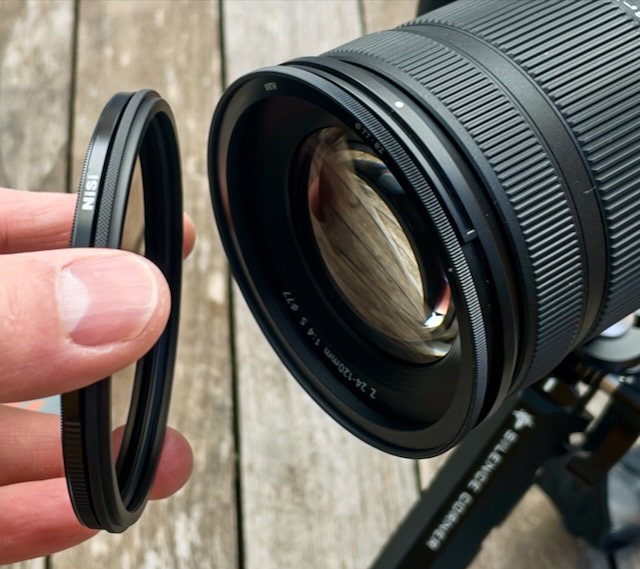
Nikon Z 24-120mm f/4 S + Urth 77 to 82mm adapter ring + 82mm Nisi ND32000 filter with Kase magnetic adapter
In the field: a real gain in comfort
In use, the comfort gain is considerable. Being able to instantly remove an ND32000 filter to check the framing, refocus or adjust the composition genuinely changes the way I work.
Another unexpected advantage is that magnetic caps seem less electrostatic than their plastic equivalents. They appear to attract less dust and, in my camera bag, they have not moved around. For field use, that is reassuring. I even wondered why I had not adopted magnetic caps earlier.
Compared with my latest long exposure sessions in Brittany two weeks ago, the difference is obvious. Setup is faster, handling is smoother, and I spend less time managing accessories. I can focus more on the light, the framing and the exposure time.
Conclusion: keeping good filters while gaining efficiency
This solution may not be the most spectacular one, but it answers my need perfectly: simplifying the use of ND filters in long exposure photography without buying a complete new kit. I kept my high-quality filters, limited my investment to rings and magnetic caps, reduced the bulk in my camera bag, and gained real comfort in the field.
For photographers who already use good screw-in filters, especially in 82mm, this approach can be an interesting alternative to complete magnetic kits. It makes it possible to standardize equipment, save time during setup, and reduce delicate handling when the camera is already mounted on a tripod.
In long exposure photography, filter quality matters, but ease of handling matters almost as much. The less you struggle with your gear, the more available you remain for the image.
FAQ about magnetic filters in photography
Why use magnetic filters in photography?
Magnetic filters allow an ND filter or polarizer to be mounted and removed quickly, without screwing the accessory on and off for each shot. This is particularly useful in long exposure photography, when the camera is already installed on a tripod.
Can a single filter diameter be used on several lenses?
Yes, it is possible to choose the largest diameter you need, for example 82mm, then use adapter rings on lenses with a smaller filter thread. This avoids buying several sets of filters.
Are magnetic filters useful for long exposure photography?
Yes, especially with very dense ND filters. They make it possible to remove the filter quickly to check the framing, adjust the composition or refocus, then put it back without moving the camera.
Are magnetic rings and caps from different brands compatible?
In my configuration, Kase, K&F Concept and Urth magnetic rings and caps proved to be compatible with one another. This makes it possible to mix brands depending on availability, price or design, provided you remain cautious and test the assembly before relying on it for an important field session.
About the author
Sebastien Desnoulez is a professional photographer based in Paris, specializing in architectural photography, landscape photography and travel photography. Trained in photography in the mid-1980s, he covered Formula 1 and reported from around the world before turning to demanding fine art photography, combining composition, light and emotion. He also shares his technical experience through practical articles for passionate photographers, drawing on a strong visual culture acquired in both film and digital photography.
Tags