

Photographing while traveling is not just about bringing back images of famous places. It means working with available light, tourist flows, weather, expectations shaped by images already seen, and the sometimes less ideal reality of the field. This page brings together my main travel photography articles, from London to Cuba, from Lisbon to Venice, from Bali to Vietnam, from the United States to Brittany, with one idea in mind: looking differently at places photographed by everyone.
A personal approach to travel photography
We often choose a destination after seeing a magazine feature, a book, a series of images or social media posts. But we easily forget that those images are often the result of accumulation: several seasons, different lights, repeated visits, sometimes the work of photographers who live there. During a weekend trip, or a journey lasting one or two weeks, trying to recreate that ideal image can quickly become a dead end.
Another phenomenon adds to this: everyone wants to photograph the same viewpoint, the same light, the same postcard, while sometimes also wanting to be inside that postcard. The traveling photographer must therefore deal with tourist flows, schedules, access, weather constraints, crowds and distracting elements.
My way of photographing while traveling is therefore based on adaptation. When the expected light is not there, when a site is too crowded or when a viewpoint has become too obvious, I look for a detail, a tighter framing, a line, a texture, a reflection, a secondary scene or another distance from the subject. A zoom can help quickly eliminate a distracting element. A long exposure can smooth water, soften the presence of a crowd and transform the atmosphere of a place. The goal is not only to bring back a recognizable image, but to capture the feeling of a city, a landscape or a moment.
Ultimately, my approach remains the same as in my other photographic series: observe, simplify, choose, then offer a personal visual synthesis. Travel then becomes less a collection of postcards than a way of reading a place through its light, forms, rhythms and contrasts.
Photographed cities: urban atmospheres, contrasts and street scenes
Cities are often among the most photographed places, but also among the hardest to summarize. They change according to time of day, weather, traffic density, season, districts and the way we look at them. A city is not always best understood through its most famous monuments. It also reveals itself in side streets, ordinary façades, reflections, details, silhouettes and contrasts between old and modern.
When traveling, I approach cities as spaces to walk through and interpret. Some images belong to architecture, others to atmosphere, reportage or personal memory. The challenge is often to find the right distance: close enough to feel the place, constructed enough for the image to exist on its own.
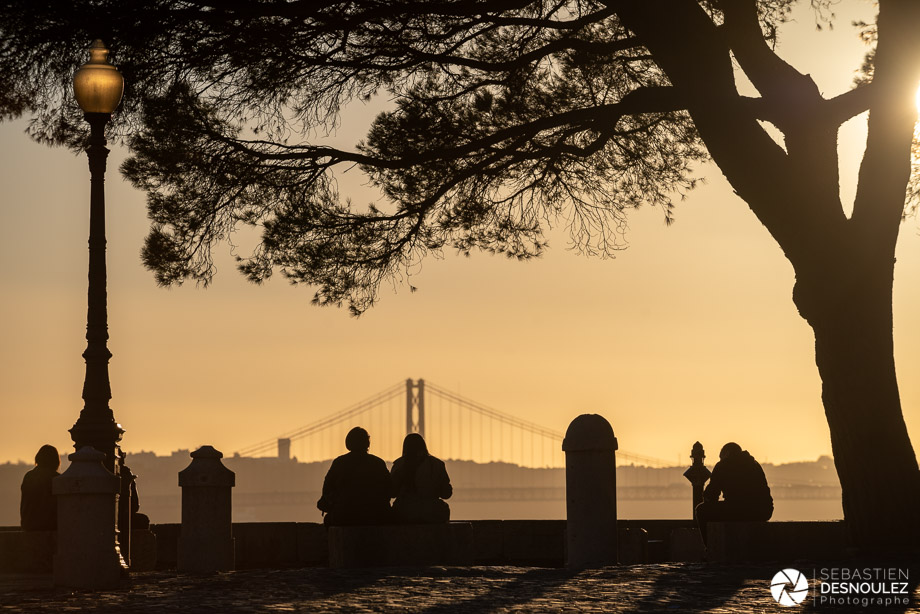
25 de Abril Bridge from São Jorge Castle, Lisbon, Photo: © Sebastien Desnoulez
Lisbon in Photographs: trams, light and urban poetry
Lisbon lends itself particularly well to a photography of light and gradients. The trams, the streets of Alfama, the colorful façades, the viewpoints and the contrasts between old city and modernity create a rich visual material, especially in winter when the light remains soft.
Photographic Journey in New York: architecture, street scenes and urban contrast
New York allows one to work with architecture, perspectives, urban density and street scenes at the same time. Between skyscrapers, silhouettes, façades, traffic and visual memory, the city imposes a rhythm that requires fast framing while remaining attentive to details.
San Francisco photography: Golden Gate, tramways and urban skyline
San Francisco is a city of relief, fog, urban lines and very strong visual symbols. The Golden Gate, tramways, steep streets and skyline create a terrain where photography moves between iconic image and urban observation.
Hanoi in Photos: monsoon atmosphere and colonial echoes
Hanoi offers a dense, humid and contrasting atmosphere. The monsoon, colonial heritage, traffic and street scenes give the city a particular presence, very different from the idealized images sometimes associated with travel.
Photos of Saigon: urban contrasts and frenzied streets in Ho Chi Minh City
Saigon is photographed through movement, contrasts and energy. Traffic, signs, façades, temples and street scenes create a more nervous reading of the city, where the image often has to deal with apparent disorder.
Photographing London: districts, architecture and contrasts
London is a very large city, made up of districts with completely different atmospheres. The City, a financial district where contemporary towers stand next to centuries-old churches, offers a striking contrast with Greenwich, Notting Hill, Westminster or Battersea. It is a city where old architecture, industrial reconversions, modern structures and street scenes constantly coexist.
Rather than looking for a single image of London, one must accept this diversity. The city is photographed in fragments: height, reflections, façades, colors, details, monuments and transitions between districts.
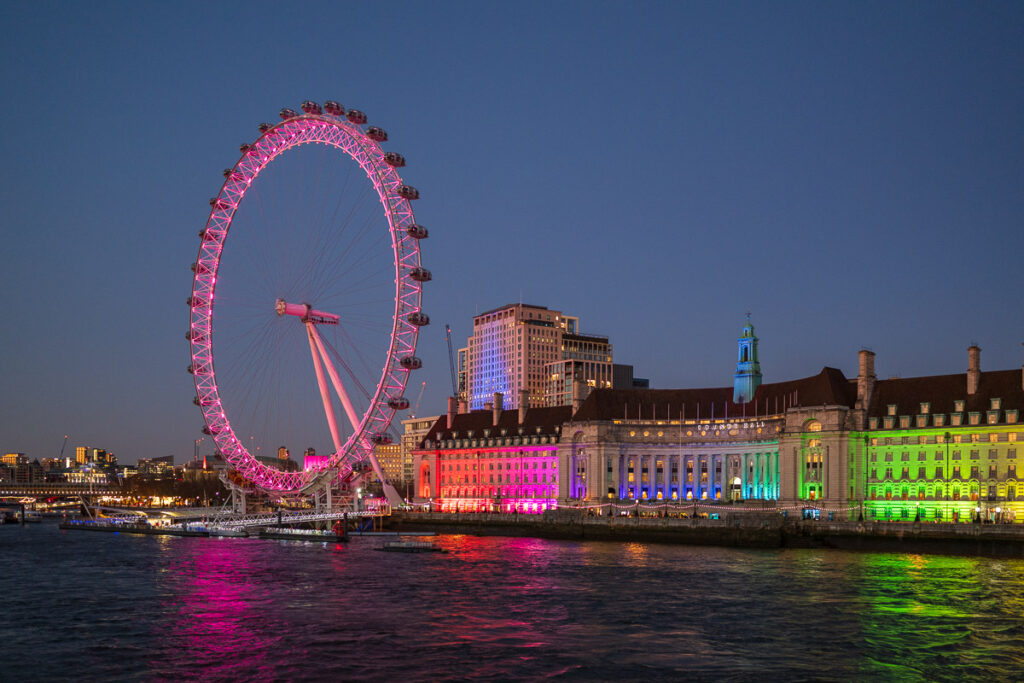
The Eye, London, Photo: © Sebastien Desnoulez
London City Architecture: reflections, steel and urban drama
This page brings together different views of London architecture, between reflections, steel, contemporary buildings and urban contrasts. It makes it possible to approach London as a city of layered architectures.
Notting Hill and Portobello Road: colors, curiosities and urban contrast
Notting Hill and Portobello Road offer another image of London, more colorful, more decorative and more connected to façades, details and street scenes. The district invites a more intuitive photography, based on colors and visual curiosities.
London from Above: London Eye and Cityscape
Photographing London from above makes it possible to read the city differently. Monuments, rooftops, the Thames and urban perspectives create a dense landscape, where the scale of the city becomes more perceptible.
Big Ben and Westminster: Thames classics
Big Ben and Westminster are among the best-known images of London. The challenge is then to move beyond the simple tourist motif by looking for light, atmosphere, framing or a more personal distance.
Battersea Power Station: industrial architecture and urban renewal in London
Battersea Power Station reveals another side of London, that of industrial reconversion and new districts. The former power station becomes a subject where memory, architecture and urban transformation come together.
Westminster Abbey: light and stone in London
Westminster Abbey approaches London through heritage, stone, verticality and interior light. Photography becomes more attentive to silence, volumes and historical density.
Cuba: colors, memory and scenes of life
Cuba is a very particular journey for a photographer. Old cars, colorful façades, colonial streets and a retro atmosphere immediately catch the eye, but the country cannot be reduced to this picturesque surface. Light, visible shortages, scenes of life, rural landscapes and inland towns tell a more complex story.
The photographic itinerary follows several stages: Havana, Viñales, the Bay of Pigs, Cienfuegos, Trinidad, Sancti Spíritus, Santa Clara and Varadero. Each place brings a different tone, between revolutionary memory, colonial architecture, beaches, rural life and traces of everyday reality.

Ford Fairlane 1957 in Varadero, Cuba, Photo: © Sebastien Desnoulez
Havana: classic American cars and nightlife in Cuba
Havana concentrates many of the images associated with Cuba: American cars, weathered façades, lively streets and night atmosphere. But the city also requires looking beyond the cliché, into details and ordinary scenes.
Viñales, rural heart of Cuba between mogotes and tobacco drying barns
Viñales offers a rural breathing space, between limestone hills, tobacco fields, drying barns and open landscapes. It is a stage where photography leaves colorful streets behind to return to a more direct relationship with landscape and agricultural activity.
Bay of Pigs, Cuba: Caribbean colors and retro atmosphere
The Bay of Pigs brings together Caribbean colors, sea, historical memory and retro atmosphere. Photography plays with contrasts between seaside imagery, traces of the past and the reality of travel.
Cienfuegos, Cuba: colonial architecture and vintage cars
Cienfuegos offers a more architectural reading of Cuba, between colonial buildings, luminous streets and old cars. The city provides ideal material for working with color and urban compositions.
Trinidad, Cuba: colonial streets, scorching heat and pastel sunsets
Trinidad is a heavily photographed city, but its heat, cobbled streets, pastel façades and evening light make it possible to seek a more personal atmosphere than the simple colonial postcard.
Sancti Spíritus and Santa Clara: daily life and revolutionary legacy
Sancti Spíritus and Santa Clara open up a more documentary approach to Cuba. Scenes of life, places of memory and urban atmosphere complete the visual story of the journey.
Varadero, Cuba: dream beaches, turquoise sea and urban shortages
Varadero confronts the ideal image of the Caribbean beach with a more contrasted reality. Between turquoise sea, fish, beach resorts and visible shortages, the destination takes on a more ambiguous dimension.
Mediterranean light: Venice, Malta, Corsica, Sardinia and southern atmospheres
Mediterranean destinations often offer strong light, intense colors and architecture marked by history. But this visual richness can also become a trap: too much sun, too many people, too many images already seen. One then has to look for shadows, reflections, narrow streets, façades, details and moments when the place escapes its expected image.

Young divers, Cala Napoletana, Isola Caprera, Sardinia, Photo: © Sebastien Desnoulez
Venice: fine art photography, reflections, light and poetry
Venice is a city where one could spend months walking through streets, canals, bridges and passageways. Its photographic strength comes as much from its reflections as from its façades, changing lights and the feeling of permanent wandering between reality and theater.
Burano near Venice: vibrant colors and poetic façades
Burano immediately attracts the eye with its colorful houses. The risk is to remake the same images as everyone else. The interest lies in working with color relationships, façades, shadows and details to give the place a personal presence.
Malta: a journey through fortresses and blue horizons
Malta combines fortifications, religious architecture, steep streets and marine horizons. Valletta, with its slopes, perspectives and stone façades, has nothing to envy San Francisco for its play of gradients, lines and light.
A suspended detail in Gozo’s Cathedral: photography of sacred atmosphere
In a cathedral, travel photography can sometimes be reduced to a detail. A suspended form, interior light or isolated element may better summarize the atmosphere of a place than a general view.
Bonifacio: photographic journey through light, shadows and limestone cliffs
Bonifacio is a place of cliffs, shadows, limestone and harsh light. Photography works there with the relationship between architecture, landscape and Mediterranean memory.
Calanques de Piana: photographs of Corsican landscapes in light and shadow
The Calanques de Piana offer spectacular mineral material. The difficulty is to go beyond the obvious beauty of the landscape and look for light, form or a more personal composition.
Sardinia Photography: light, contrast and Mediterranean atmospheres
Sardinia makes it possible to approach the Mediterranean through landscapes, contrasts and luminous atmospheres. The relationship between sea, rocks, vegetation and heat becomes the main subject.
Photo Journey in Greece: ancient ruins, coastal towns and dramatic landscapes
Greece combines ancient sites, villages, coastlines and contrasted landscapes. It is a destination where history and light require close attention to materials, shadows and horizons.
Faraway journeys: Bali, Vietnam, Sri Lanka, Jordan and the United States
Faraway journeys confront the photographer with other rhythms, other lights and other visual signs. The point is not simply to bring back the exoticism of a place, but to understand how an atmosphere is built: temples, streets, landscapes, markets, rice fields, roads, seas, mountains or architecture.
Photographs Around Ubud, Bali: temples, nature and local life
Around Ubud, Bali combines temples, nature, local life, rice fields and tropical atmospheres. It is a destination where vegetation, traditions and light require attention to details as much as to wider scenes.
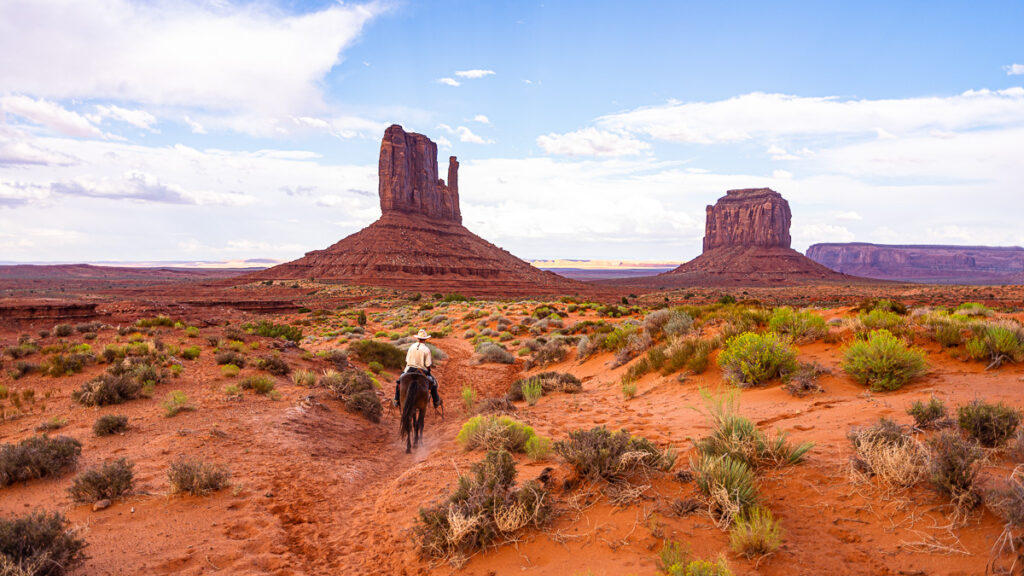
Monument Valley, USA, Photo: © Sebastien Desnoulez
Photographs of rice fields around Ubud, Bali: light, nature and rural harmony
The rice fields around Ubud offer strong graphic and luminous material. The lines of the crops, water, reflections and vegetation form a landscape where agricultural order becomes almost abstract.
Ubud Monkey Forest: sacred jungle photography in Bali
The Ubud Monkey Forest adds an animal dimension to the journey. The macaques, dense vegetation and temples create an atmosphere that is at once touristic, wild and sacred.
Sanur Village Kite Festival in Bali: colorful skies and cultural traditions
The Sanur Village Kite Festival shows another side of Bali, more festive, more graphic, carried by colors, kites and local traditions.
Sri Lanka Photography Journey: nature, culture and sacred sites
Sri Lanka combines nature, culture, temples, tropical landscapes and scenes of life. It is a destination where photography moves between heritage, spirituality, vegetation and observation of everyday life.
Petra in Pictures: photographic memories of an unforgettable visit in 1992
Petra belongs to those places whose image often precedes the journey. The challenge is to go beyond the icon and recover a personal sensation: rock, passageways, light, scale and the memory of a striking visit.
Photographic Road Trip Through the American West: Grand Canyon, Death Valley, Yosemite
The American West imposes a photography of space, distance and light. Grand Canyon, Death Valley, Yosemite and the great desert landscapes require close attention to scale, shadows and the density of horizons.
White Sands, New Mexico: sunset on the gypsum dunes
White Sands offers an almost abstract experience of landscape. The whiteness of gypsum, sunset and dune lines make it possible to build an image between reality, silence and minimalism.
New York City: World Trade Center 1985
The photographs of the World Trade Center in 1985 belong at once to travel, architecture and memory. Over time, they have acquired a documentary dimension that the moment of capture could not yet contain.
Landscapes, coastlines and natural light
Travel photography is not limited to cities and monuments. Coastlines, forests, ports, storms, beaches and changing light offer another way of telling the story of a place. In these situations, time often becomes an essential element: time of day, season, weather, wind, mist, rain or long exposure.
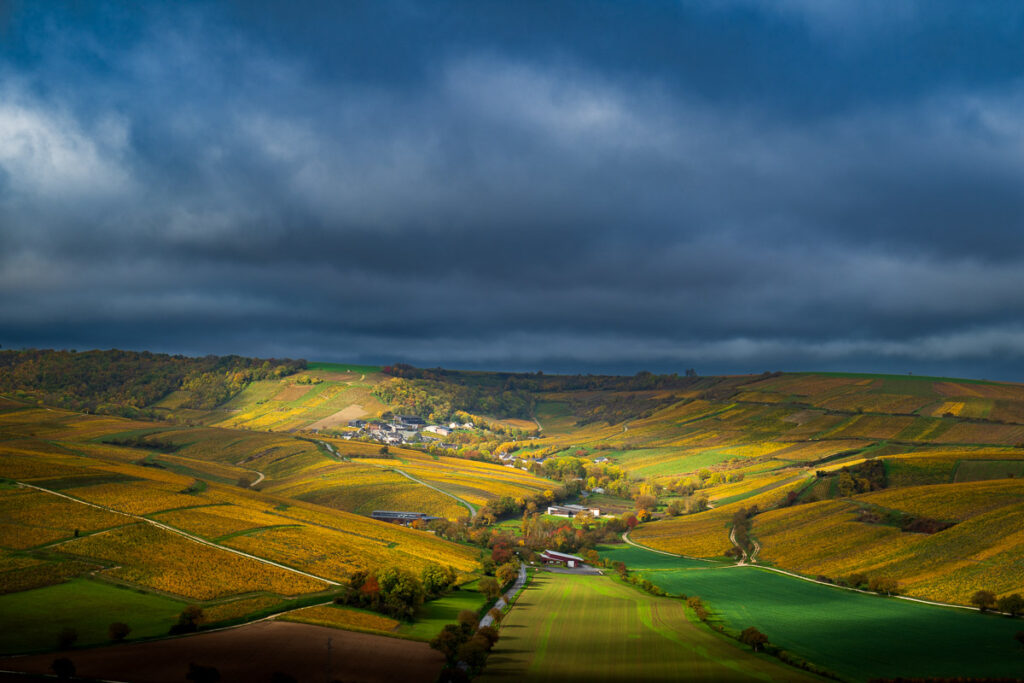
Autumn colors, vineyards of Sancerre, Burgundy, Photo: © Sebastien Desnoulez
Autumn Colors in Burgundy, Sancerre, Pouilly-sur-Loire and Briare
Between Sancerre, Pouilly-sur-Loire and Briare, autumn turns the landscapes of Burgundy and the banks of the Loire into photographic material made of warm colors, mist, low light and reflections. This article shows how a nearby journey can become a sensitive field of observation, where the seasons give the landscape particular depth.
Autumn Light in Brittany: reflections, dew and coastal landscapes
Brittany offers changing light, reflections, backlight, textures and compositions in which vegetation, mineral forms and water constantly interact.
Spring Photographs of Côtes d’Armor: changing light and wild landscapes
In spring, the Côtes d’Armor offer another reading of the Breton landscape, brighter, more vegetal, but still dependent on variations in light.
Long Exposure Photographs of Brittany: between stillness and motion
Long exposure makes it possible to transform the seascape, smooth the water, erase part of the movement and shift the scene toward a more silent atmosphere.
Port of Gwin Zegal: a unique mooring site in Brittany
The port of Gwin Zegal is a place that can be revisited several times, with different lights and intentions. Tree trunks, water and tide form a scene where time transforms the image.
Storm Ciara in Charente-Maritime: photography of a wild coastal tempest
Storm Ciara shows how weather can turn a coastline into a dramatic scene. Travel photography then becomes a confrontation with the elements.
Dominican Republic Mood Photography: palms, beaches and tropical light
The Dominican Republic may evoke the simple image of a tropical beach, but palm trees, light, skies and contrasts also make it possible to build a more nuanced atmosphere.
Architecture, heritage and iconic places
Some journeys are built around iconic places: monuments, churches, abbeys, castles, historic cities, archaeological sites or modern architecture. These places are often heavily photographed, sometimes saturated with images. The challenge is therefore not simply to record their presence, but to find a personal way of looking at them.
Malta, with its religious architecture, fortresses and steep streets in Valletta, offers especially rich terrain. Venice, for its part, seems inexhaustible: one could spend months walking through its streets and canals, as the city changes with light, reflections, seasons and detours.
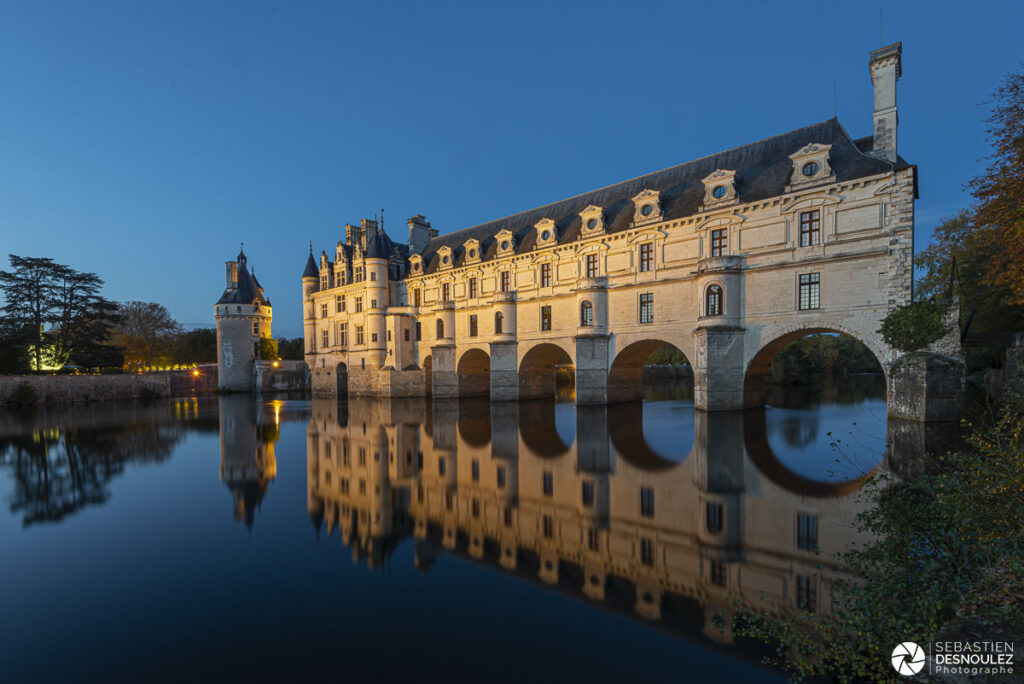
Chenonceau Castle at nightfall, Photo: © Sebastien Desnoulez
Chenonceau Castle at Nightfall: tranquil reflections and golden light
Chenonceau makes it possible to combine heritage, reflection, evening light and architectural presence. At nightfall, the castle leaves the classic tourist image behind and becomes a quieter scene.
Night Photography in Montrichard: illuminated castle keep and bridge over the Cher
Montrichard offers a nocturnal approach to heritage, where reflection, lighting and water build an image that is more graphic than descriptive.
Pontigny: light and simplicity in the first Cistercian abbey
Pontigny Abbey shows how a heritage site can be photographed through light and simplicity, without seeking spectacular effects.
Rembrandt’s Night Watch at the Rijksmuseum: photos of art and digital rituals
Travel can also pass through museums and through our contemporary way of looking at artworks. In front of The Night Watch, smartphones, screens and visitors’ gestures become a photographic subject in themselves.
All articles related to travel photography
This page offers a structured reading of my main travel photography stories and series. It does not replace the page listing the destinations and countries visited, but it serves as an entry point for understanding the way I approach places: observing, simplifying, composing, moving around expected images and looking for a personal interpretation.
See the photographed destinations: travel photography.
See also: for aspects related to lenses, filters, backup and workflow while traveling, read the photo gear guide. For images made from film, archives and older reports, see also the film photography and archives guide.
About the author
Sebastien Desnoulez is a professional photographer based in Paris, specializing in architectural photography, landscape photography and travel photography. Trained in photography in the mid-1980s, he covered Formula 1 and reported from around the world before turning to demanding fine art photography, combining composition, light and emotion. He also shares his technical experience through practical articles for passionate photographers, drawing on a strong visual culture acquired in both film and digital photography.