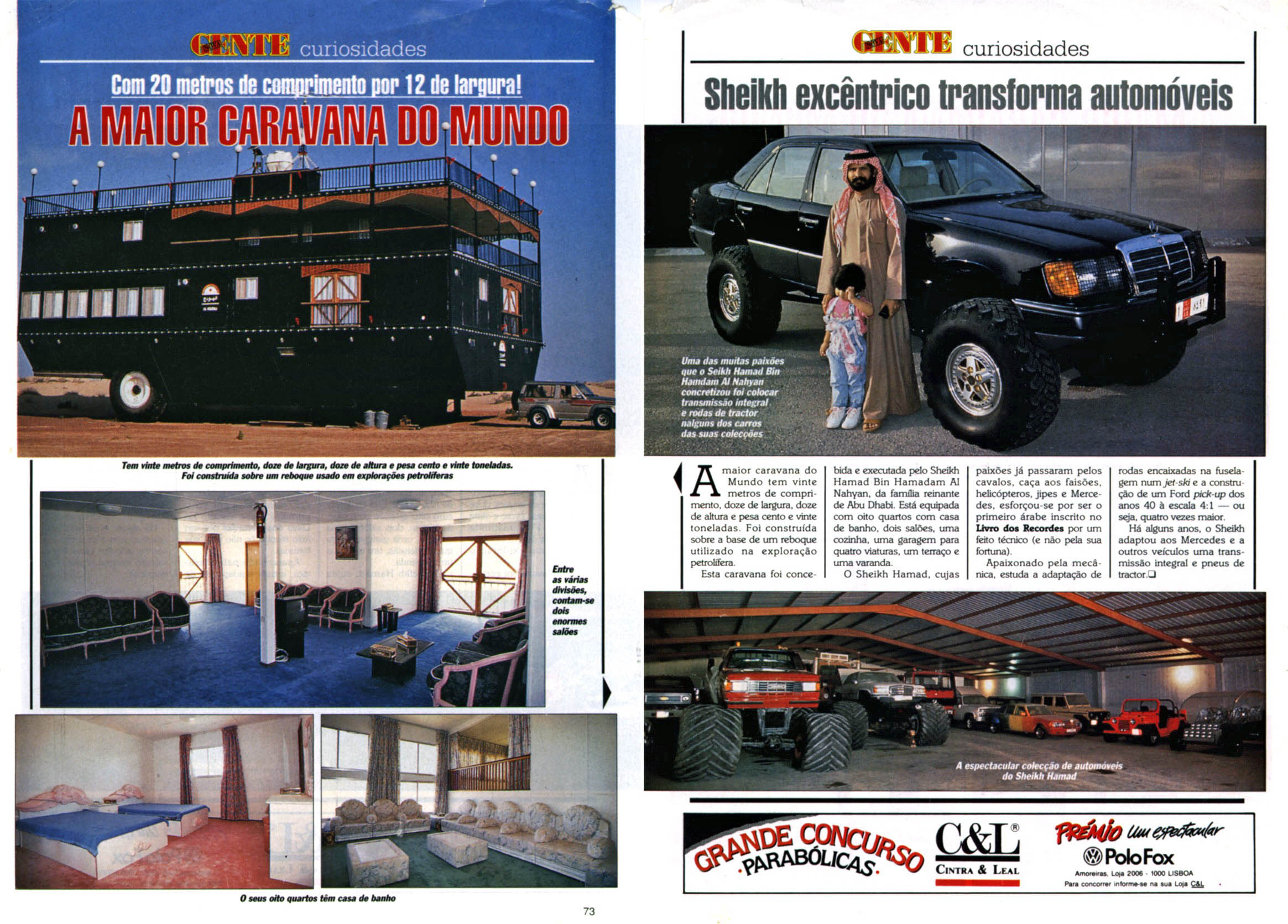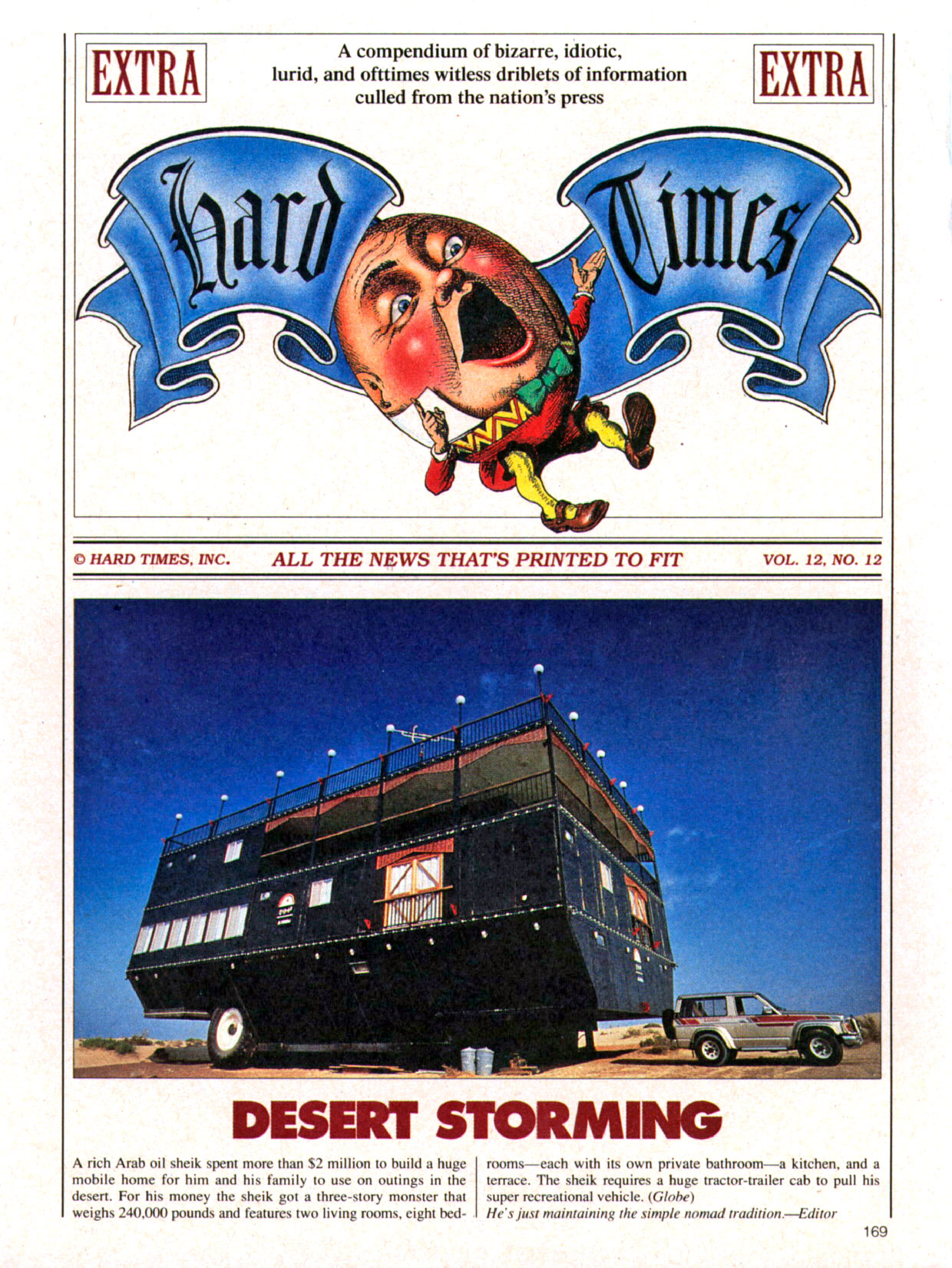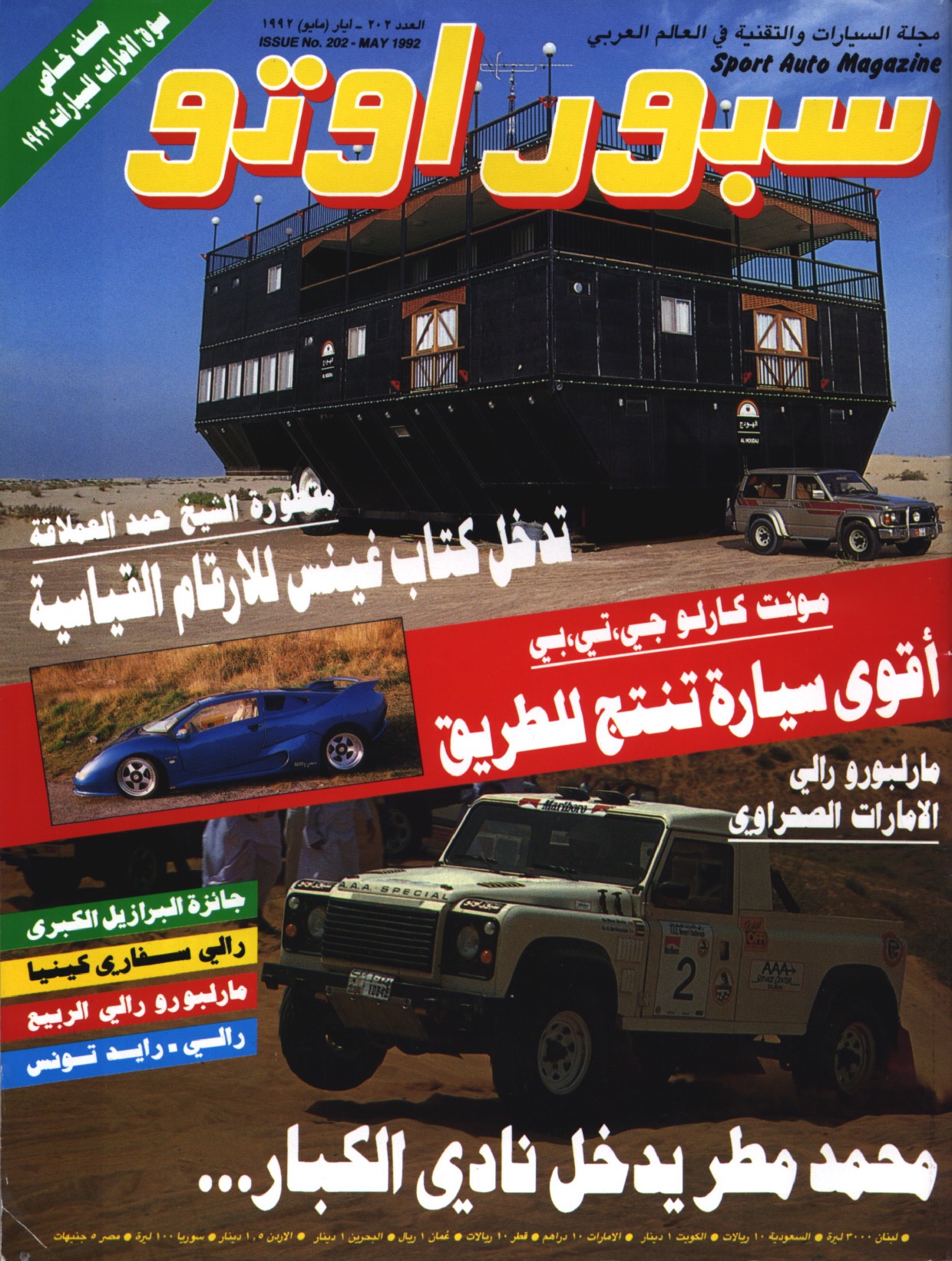


Photographs of the world’s largest caravan in the desert of the United Arab Emirates in 1991

In 1991, during a six-week stay in Dubai for the DPPI agency and the Lebanese magazine Sport Auto, I photographed one of the most remarkable mobile constructions of my career in the Abu Dhabi desert: the world’s largest caravan. This subject, born from a meeting around a collection of modified Mercedes cars, would become one of my most widely published reports in the international press.
In the early 1990s, I was working as a photojournalist for the press agency DPPI, which specialized in motorsport. At that time, Dubai was still a little-known destination in Europe. The city had not yet acquired the international image it has today. People spoke more about Abu Dhabi, oil, the desert and regional trade, and much less about Dubai as a global destination.
In 1990, on the eve of the First Gulf War, Dubai invited several European journalists to attend the final round of the Middle East Rally Championship. The objective was sporting, but also economic: to show that life was going on, that the infrastructure was operating, and that the coming conflict did not call the emirate’s commercial activity into question. The visit to the Jebel Ali Free Zone was part of this desire to reassure international partners.
The Lebanese magazine Sport Auto, one of DPPI’s clients, had an office in Dubai. The contact established during this first trip led to a new assignment in 1991. The two partners of the Sport Auto Lebanon office hired my services through DPPI to join a media team supporting the promotion of a Saudi rally driver, Mamdouh Khayat.
This assignment took me to several events: the Halkidiki Rally in Greece, Cyprus, the Algarve Rally in Portugal, the Rally of Lebanon, then the rallies of Jordan, Oman and Dubai. At the end of this period, I stayed in Dubai for around six weeks. In addition to the rallies, I produced illustration photographs and several magazine features, including the traditional rowing race in Abu Dhabi and images devoted to Dubai in the 1990s.
A collection of Mercedes cars in the colors of the rainbow
During this stay, my contacts put me in touch with Sheikh Hamad Bin Hamadan Al Nahyan, known for his passion for modified vehicles and spectacular mechanical creations. He owned, in particular, a collection of Mercedes cars painted in the colors of the rainbow, which earned him the local nickname Sheikh Rainbow.
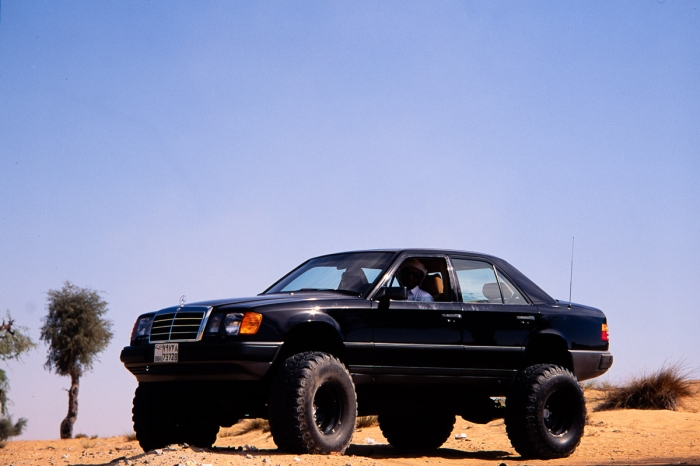
The photo session first took place around this collection. Several cars had been extensively modified. Some Mercedes models were fitted with a 4x4 drivetrain, off-road tires, a much higher ground clearance and transformed bodywork details. The chrome elements were replaced with gold. Inside, there were also two mobile phones, large devices typical of the early 1990s.
In one of the published pages I have kept, a Mercedes W124 converted into a 4x4 can be seen. The body line, rectangular headlights, grille and proportions correspond to this generation of Mercedes sedan, modified here in spectacular fashion. The result is immediately recognizable as a Mercedes, shifted into the world of off-road driving, one-off objects and mechanical transformation.
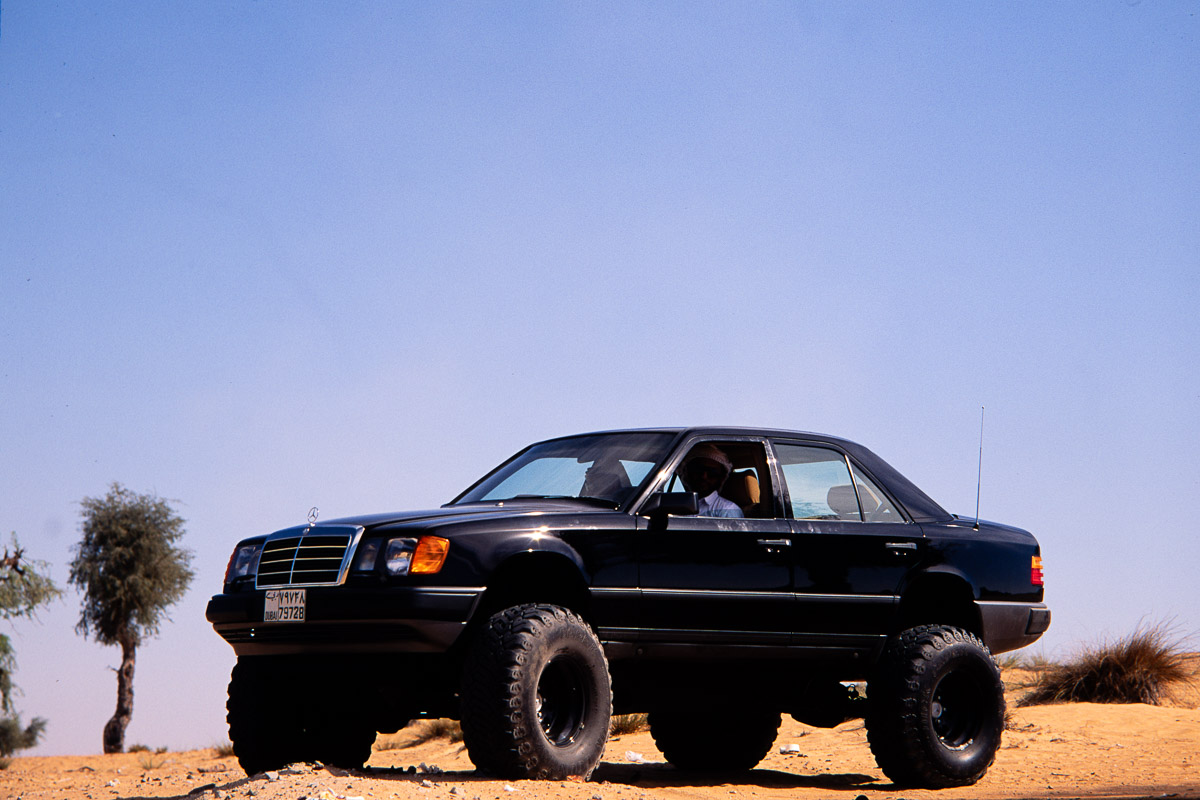 Mercedes W124 converted into a 4x4 in the desert of the United Arab Emirates, 1991 - Photo: © Sebastien Desnoulez
This Mercedes W124 converted into a 4x4 gives an idea of the mechanical world I was discovering around Sheikh Hamad at the time. The photo session in the garage was already a subject in itself. It revealed a very personal passion for automobiles, marked by a taste for experimentation, color and scale. The conversation that followed, however, opened the door to another, even more unexpected report.
A caravan built on an industrial trailer
After the photographs of the Mercedes cars, Sheikh Hamad mentioned several of his other creations. He spoke in particular about an enormous metal sphere assembled in the desert, presented at the time as one of the largest in the world. Then he mentioned a giant caravan, built from an industrial trailer used in the oil industry.
This trailer was designed to carry four generators on drilling sites. From this technical base, he had built a true mobile residence, capable of being moved through the desert. The idea seemed almost unreal. This was not a caravan in the usual sense of the word, but a mobile construction on the scale of a small house.
I asked him whether it would be possible to see and photograph it. The caravan was located about an hour to an hour and a half away in the desert. He then offered me a night in a Hilton hotel and sent two people the next morning to take me there.
The next day, I left Dubai to reach this construction installed in the desert of the emirate of Abu Dhabi. The trip was one of those reporting moments when you do not yet know exactly what you are going to discover, but you feel that the subject could be strong. In magazine photography, some reports are born in this way, from a meeting, from a question asked at the right moment, and from photographic curiosity.
Facing the world’s largest caravan
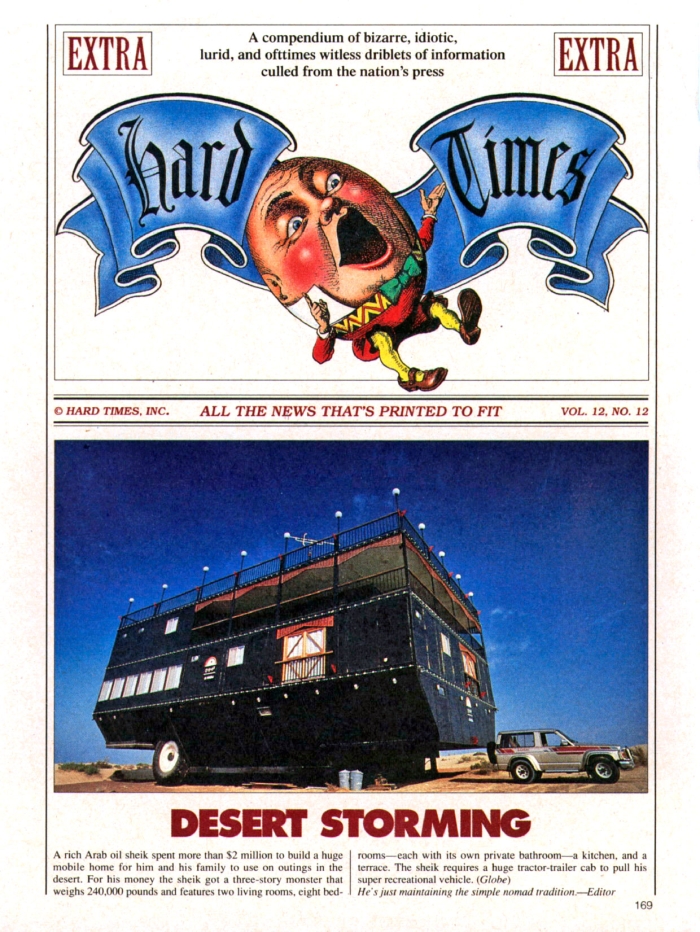
When the caravan appeared in the landscape, its size was immediately striking. It was black, massive, resting on the sand like a mobile building. Next to it, the 4x4 used as a reference point looked almost tiny. This comparison gave the full measure of the subject.
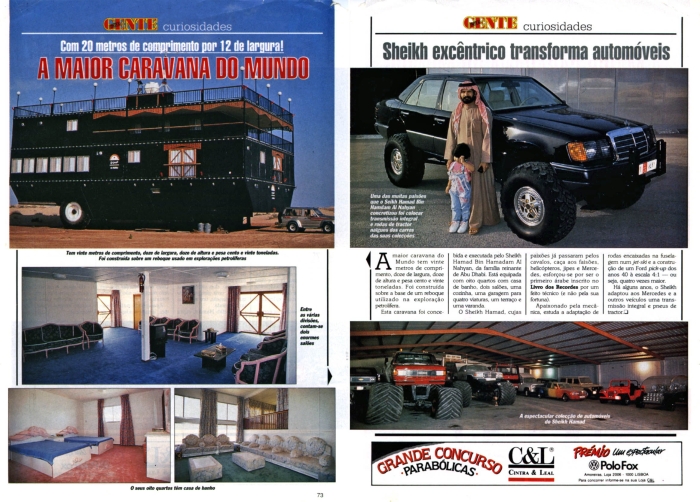
The publications that followed gave impressive dimensions: around 20 meters long, 12 meters wide, 12 meters high, with a weight of around 120 tons. The interior was described as a true home, with several bedrooms, each with its own bathroom, two living rooms, a kitchen, a terrace and an area capable of sheltering vehicles.
On site, before even thinking about the figures, it was the visual presence of the object that dominated. The caravan brought together several worlds: the desert, heavy mechanics, travel and mobile architecture. Its black mass, isolated in the landscape, gave the subject immediate graphic strength.
To photograph it, I had to find the right distance. If I moved too close, the object became almost abstract. If I moved too far away, it lost its presence. Fortunately, the desert offered great freedom of framing. The blue sky, the sand, the dark mass of the caravan and the vehicle placed beside it made it possible to build a clear, spectacular image that remained faithful to what I was actually seeing.
A magazine subject published in several countries
Among the magazine features produced during these six weeks in Dubai, the giant caravan was the one that received the widest international press coverage.
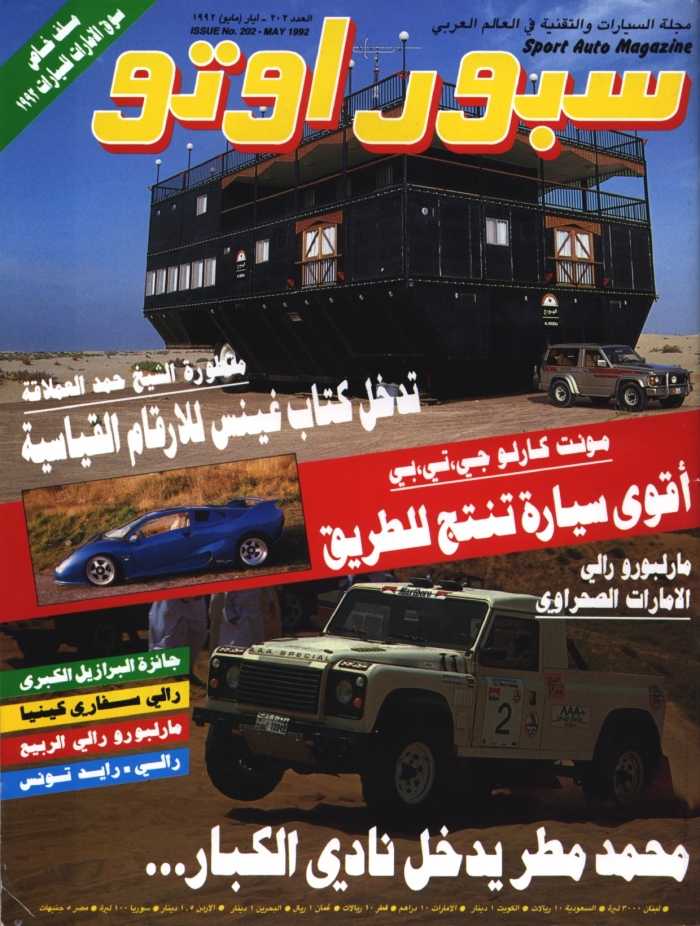
The photographs were published in Penthouse Magazine, in the Portuguese magazine Gente, and then in Sport Auto Magazine, the Lebanese magazine with which my contacts in Dubai had been established since 1990. Each publication highlighted a different facet of the subject: the caravan’s exceptional scale, its interior layout, its record status and Sheikh Hamad’s very personal automotive world.
The foreign press naturally focused on the exceptional character of the construction. The articles referred to the world’s largest caravan, its place in the world of the Guinness World Records, its dimensions, its weight, and Sheikh Hamad’s passion for unique vehicles.
What interests me today, beyond the spectacular nature of the subject, is the way these images also tell the story of a period. In the early 1990s, a photo report could circulate through agencies, magazines, duplicate slides and printed publications. The same series could be published in several countries, with different titles, languages and layouts.
These publications have become precious archives. They show how a subject discovered through local contacts could become an international image. They also recall the role of magazine publishing, capable of giving a report a second life by placing it in very different editorial contexts.
An image that anticipated the Dubai to come
This report is also a photograph of a particular moment in the history of Dubai and the United Arab Emirates. At the time, the region was already asserting its dynamism, but it had not yet experienced the architectural, tourist and media expansion that would later make it famous around the world.
Looking back, this giant caravan seems to me both representative of that period and a sign of the scale that would later shape the reputation of Dubai and the United Arab Emirates. It already brings together several elements that would later be associated with the region: the relationship with the desert, mobility, technology, the oil industry, the taste for records and the ability to turn an improbable idea into a concrete achievement.
In my memory, that day remains closely linked to a sense of space. The road, the sand, the light, then this black mass emerging in the landscape. For a photographer, the subject was easy to understand, but difficult to summarize in a single image. I had to show the size, the environment and the strangeness of the construction, without caricaturing what I was photographing.
A report born from photographic curiosity
Looking back, this report reminds me how important it is to remain curious. I had initially come to photograph a collection of modified Mercedes cars. A conversation after the session led me to another subject, far more unexpected. Without that simple question, “can we see it?”, I would never have made these images.
This way of working was very much in keeping with the press of the 1990s. You often started with a main assignment, then built other subjects through encounters along the way. You had to listen, observe, ask questions, and sense what could become a strong image or a full report.
The world’s largest caravan in the Abu Dhabi desert remains, for me, one of those improbable, impossible-to-predict yet immediately photographic subjects. It sums up a period when Dubai was still little known, when magazines were looking for strong images, and when reports were also built through trust established on the ground.
This final article in my series on Dubai and the United Arab Emirates closes a chapter that began with the camel race in Dubai in 1991, continued with falconry in Dubai in 1991, the photographs of Dubai before its expansion, the dunes, mountains and desert landscapes of the United Arab Emirates in 1991, and the traditional rowing race in Abu Dhabi in 1991. It tells another facet of that stay: a unique subject, discovered in the desert and published in several countries.
Click on the photos below to view them full screen.
All the photos displayed on this website are protected by copyright © Sebastien Desnoulez. No use is allowed without the author’s written permission. Legal notice
About the author
Sebastien Desnoulez is a photographer, author and image maker based in Paris. His work spans architectural photography, landscape photography and travel photography, with particular attention to composition, lines, light, blur and visual accidents. Trained in photography in the mid-1980s, he covered Formula 1 and reported from around the world before developing a fine art photography practice built around the tension between graphic rigour and visual instability. He also shares his technical experience through practical articles for passionate photographers, drawing on a strong visual culture acquired in both film and digital photography.
Tags