


Phase One XT IQ4 150MP: medium format, 24x36 equivalents and alternatives

The Phase One XT IQ4 150MP is one of those cameras I would love to use and own, while knowing that its price puts it far beyond my budget. Yet the system remains fascinating to examine: with its 53.4×40mm sensor, 151 million pixels, Rodenstock lenses and camera movements, it provides an opportunity to reflect on what “medium format” really means in the digital era.
After comparing the focal-length and aperture equivalents in 24x36 terms of the Fujifilm GFX and Hasselblad XCD systems, the Phase One XT represents another step. Its sensor is significantly larger than their 43.8×32.9mm sensors and comes close to the dimensions of the 645 film format.
It also raises another question: why has digital medium format stopped at roughly these dimensions, when film photography routinely allowed photographers to move from 24x36 to 6x6, 6x7 and 6x9, and then to 4x5 and 8x10 inch view cameras?
Article updated September 17, 2026. As Phase One primarily targets professional customers, prices are often quoted excluding VAT or on request. Where a French retail price is publicly available, both excluding-VAT and including-VAT amounts are shown for comparison. Prices are indicative and may change. This article is not sponsored.
From film to digital medium format: much smaller steps between formats
In film photography, changing format really meant changing scale. 135 film produced a 24x36mm image. Depending on the camera, 120 film could produce 6x4.5, 6x6, 6x7, 6x8 or 6x9 images. Beyond these came 4x5, 5x7 and 8x10 inch sheet film.
With comparable emulsions, increasing the film area allowed more information to be recorded and, just as importantly, required less enlargement to obtain a print of the same final size.
| Format | Approximate dimensions | Surface area | Surface area vs 24x36 |
|---|---|---|---|
| 24x36 | 36×24mm | 864mm² | 1× |
| Fujifilm GFX / Hasselblad X | 43.8×32.9mm | 1,441mm² | 1.67× |
| Phase One IQ4 | 53.4×40mm | 2,136mm² | 2.47× |
| 645 film | approx. 56×41.5mm | approx. 2,324mm² | 2.69× |
| 6x6 | approx. 56×56mm | approx. 3,136mm² | 3.63× |
| 6x7 | approx. 56×70mm | approx. 3,920mm² | 4.54× |
| 6x9 | approx. 56×84mm | approx. 4,704mm² | 5.44× |
| 4x5 inch | approx. 95×120mm usable area | approx. 11,400mm² | approx. 13.2× |
Moving from 24x36 to GFX or Hasselblad X therefore increases the sensitive area by only 1.67 times. The Phase One reaches 2.47 times the area of Full Frame. With film, a 6x9 image exceeds five times the area of 24x36, while 4x5 reaches roughly thirteen times that area.
With its 53.4×40mm dimensions, however, the Phase One IQ4 occupies a particular position: its 2,136mm² surface area is around 48% larger than the 43.8×32.9mm sensors used by Fujifilm GFX and Hasselblad X, while its dimensions are close to those of 645 film. It remains substantially smaller than a 6x6, 6x7 or 6x9 negative.
For a more detailed comparison of angles of view, apertures and depth of field across these formats, see my guide to focal length and aperture equivalence according to sensor size.
Phase One XT IQ4 150MP: a digital technical camera
The Phase One XT system combines two distinct components: the IQ4 150MP digital back and the compact XT technical camera body, which accepts Rodenstock lenses mounted specifically for the system.
The IQ4 150MP digital back
The IQ4 150MP uses a 53.4×40mm BSI CMOS sensor with a native 4:3 aspect ratio. Its resolution is 14204×10652 pixels, or slightly more than 151 million pixels.
| Specification | Phase One IQ4 150MP |
|---|---|
| Sensor | BSI CMOS |
| Dimensions | 53.4×40mm |
| Native aspect ratio | 4:3 |
| Image dimensions | 14204×10652 pixels |
| Resolution | 151MP |
| Pixel pitch | 3.76µm |
| Color depth | 16-bit |
| Claimed dynamic range | 15 stops |
| ISO range | 50 to 25,600ISO |
| Long exposures | Up to 60minutes |
| Storage | XQD / CFexpress + SD |
| Connections | USB-C, Gigabit Ethernet, Wi-Fi |
| Print dimensions at 300ppi | approx. 120×90cm without interpolation |
The XT technical camera
The XT body is essentially a compact technical camera connecting the IQ4 digital back to Rodenstock lenses. Composition and focusing are carried out using the digital back’s Live View.
| Specification | Phase One XT |
|---|---|
| Compatible backs | Phase One IQ4 |
| Mount | XT, physical interface compatible with Cambo WDS |
| Focusing | Ultra-fine manual focusing on Rodenstock XT lenses |
| Horizontal shift | ±12mm |
| Vertical shift | ±12mm |
| Total travel per axis | 24mm |
| Rotation | Quick change between landscape and portrait orientation |
| Tripod interface | Arca-Swiss compatible |
| Dimensions | 148×160mm |
| Weight | 700g |
| XT body-only price observed in France | €4,990 excl. VAT / €5,988 incl. VAT |
| IQ4 150MP + XT + Rodenstock 32mm f/4 kit observed in France | €50,490 excl. VAT / €60,588 incl. VAT |
| IQ4 150MP + XT + Rodenstock 23mm f/5.6 kit observed in France | €55,990 excl. VAT / €67,188 incl. VAT |
This is therefore very different from using a conventional Full Frame mirrorless camera, or even a Fujifilm GFX. The system adopts part of the logic of a technical camera and integrates it around an extremely high-resolution digital back.
Is digital medium format really equivalent to film medium format?
The answer first depends on which film format we are referring to. The IQ4 comes close to 645, but no current photographic digital medium-format system reaches the surface area of a 6x6, 6x7 or 6x9 negative.
The aspect ratio also changes the way you photograph
Phase One, Fujifilm GFX and Hasselblad X sensors all use a native 4:3 aspect ratio. This is close to 645 film, but differs from the 1:1 square of a Hasselblad 6x6, as well as from the proportions of 6x7 and 6x9.
Choosing another aspect ratio means using only part of the sensor. On the IQ4, the native file measures 14204×10652 pixels, or about 151MP.
| Aspect ratio | Approximate image dimensions | Pixels retained |
|---|---|---|
| Native 4:3 | 14204×10652 | 151MP |
| 3:2 | approx. 14204×9469 | approx. 134.5MP |
| 1:1 | 10652×10652 | approx. 113.5MP |
A square crop therefore uses only 75% of the sensor area. Even then, the file still contains around 113.5MP. The difference compared with a Hasselblad 6x6 remains fundamental: on the latter, the square is the native format and uses the entire film area.
The rendering also depends on the focal lengths used
To obtain the same angle of view, focal lengths increase as the format becomes larger.
| Format | Approximate focal length |
|---|---|
| 24x36 | 28mm |
| Fujifilm GFX / Hasselblad X | 35mm |
| Phase One IQ4 | 43mm |
| 645 film | approx. 45mm |
| 6x6 | approx. 50mm |
| 6x9 | approx. 65mm |
| 4x5 inch | approx. 100mm |
The 4x5 example is particularly revealing. A 90mm lens, a classic wide-angle focal length on this format, corresponds to approximately 25.5mm on 24x36 when the comparison is based on the diagonals of the two formats. At f/5.6, with comparable framing, it produces depth of field close to that of a 25.5mm lens opened to approximately f/1.6 on Full Frame.
A 90mm f/5.6 lens on 4x5 large format therefore corresponds approximately to a 25.5mm f/1.6 lens on 24x36 in terms of angle of view and depth of field with comparable framing.
This does not mean that the format has some unique “look” that is impossible to reproduce by other means. With equivalent angle of view, perspective, framing and depth of field, many geometric characteristics can be brought very close together. What remains different is the lens design, its aberrations, its image circle, the transition between sharp and unsharp areas, the structure of film or sensor, and the way the system itself influences how the photographer composes an image.
Why aren’t digital sensors as large as 4x5 sheet film?
Digital photography has profoundly changed the relationship between the size of the light-sensitive surface and the resolution required for the final image.
A 4K screen displays around 8 million pixels. An 8K screen displays around 33 million. Even a 45MP photograph therefore generally has to be reduced to be displayed in full on a screen.
Printing requires greater resolution, but the amount required depends on print size and, above all, viewing distance. A photograph intended to be viewed from 30cm does not have the same requirements as an image several metres wide viewed from farther away.
The “dpi” specification of a printer should also not be confused with the pixels in the image. Printing processes use several ink dots or a halftone pattern to reproduce the values and colors of a single image pixel.
In this context, the Phase One file measuring 14204×10652 pixels already allows an approximately 120×90cm print at 300ppi without interpolation. For many applications, 151MP is therefore an enormous amount of resolution.
Manufacturing a sensor approaching the roughly 95×120mm usable area of 4x5 sheet film would also create considerable economic and industrial difficulties. The larger a silicon component becomes, the fewer can be produced on a single wafer and the greater the probability that a defect will make one unusable. Added to this are the constraints of data readout, power consumption, processing, heat dissipation and optical design.
Digital photography has therefore followed a different path: recording a very large amount of information with sensors that remain significantly smaller than the largest film formats.
Why consider the XT rather than the Phase One XF?
The XF is the Phase One system that most closely resembles a modern medium-format SLR, with a viewfinder, autofocus and Schneider Kreuznach lenses. It is particularly suited to studio work, portraiture, fashion and commercial photography.
The XT follows a different logic. Focusing is manual, camera movements are an integral part of the shooting process, and Phase One describes it as a “digital field camera”, particularly aimed at landscape photography.
For landscape and architecture, this architecture seems more interesting to compare with a film technical camera. The XT does not simply attempt to reproduce the ergonomics of an enlarged 24x36 camera: it transfers some of the principles of a technical camera into an integrated digital system.
XT shift and tilt lenses
The XT body allows the digital back to move ±12mm horizontally and vertically, giving a total travel of 24mm along each axis.
This movement can notably be used to control perspective in architectural photography without tilting the camera. By keeping the sensor plane vertical, the vertical lines of the building remain parallel at the time of capture.
Shift can also be used to make several images for stitching. The lens remains in the same position while the sensor moves within its image circle, a method particularly well suited to panoramas and extremely high-resolution stitched images.
The shift position is automatically recorded in the file metadata and can subsequently be used in Capture One.
Tilt
Some XT lenses offer ±3° or ±5° of tilt. Tilt does not create more depth of field: it changes the orientation of the plane of focus.
In landscape photography, this makes it possible to angle the plane of focus toward the ground so that a nearby foreground and a distant background both fall within the sharp area without having to stop the lens down as far.
Here, the XT recovers one of the fundamental principles of the view camera while combining it with a 151MP digital sensor.
Frame Averaging: long exposures without an ND filter
The IQ4 back includes a particularly unusual feature called Automated Frame Averaging. It can reproduce some of the effects of a long exposure without reducing the amount of light reaching the sensor with an ND filter.
The principle differs from a traditional long exposure. The camera automatically makes a sequence of short exposures and averages them to produce a single IIQ RAW file.
The photographer can therefore separate two parameters that are normally linked: the amount of light required for correct exposure and the length of time over which movement in the scene is recorded.
Imagine that the correct daylight exposure is 1/100s at f/11 and 50ISO. To make a single 10s exposure while retaining f/11 and 50ISO, the light would have to be reduced by approximately 10 stops using an ND filter.
With Frame Averaging, the individual captures remain correctly exposed while the system continues the sequence for 10s, 30s or several minutes. Their average maintains normal brightness while integrating the movement of mobile elements throughout the selected duration.
Reference exposure: 1/100s
Frame Averaging duration: 30s
Final brightness: normal exposure
Time effect: movement integrated for approx. 30s
Water in a waterfall can therefore become fluid, the sea can be smoothed and clouds can stretch across the sky without the very strong ND filter that a single exposure of the same duration would require.
The process also provides a noise benefit: random variations present in the individual images are reduced when the average is calculated.
The result is not, however, strictly identical to a continuous exposure. The sequence of captures must be sufficiently regular to prevent any gaps between frames from becoming visible in certain types of movement. Highlights must also remain properly exposed in the individual images forming the sequence.
Frame Averaging therefore does not make every filter unnecessary. A graduated filter, for example, modifies the distribution of light within the image, while a polarizing filter performs a completely different function. But when an ND filter is used only to obtain a much longer exposure in bright light, Frame Averaging can replace that function.
To me, this is one of the most interesting aspects of the IQ4: on one side, the XT adopts the movements and operating principles of a technical camera, while on the other it exploits possibilities that exist only because of digital technology.
Phase One XT / Rodenstock lenses and 24x36 equivalents
With its 53.4×40mm sensor, the Phase One IQ4 has a conversion factor of approximately 0.65× compared with 24x36. An XT focal length can therefore be multiplied by approximately 0.65 to obtain a comparable angle of view on Full Frame. Applying the same factor to the aperture gives an approximate depth-of-field equivalent at comparable framing, without changing the actual exposure.
XT lenses are derived from the Rodenstock HR range and use ultra-fine manual focusing. They incorporate the X-Shutter, an electromechanical shutter controlled by the Phase One system.
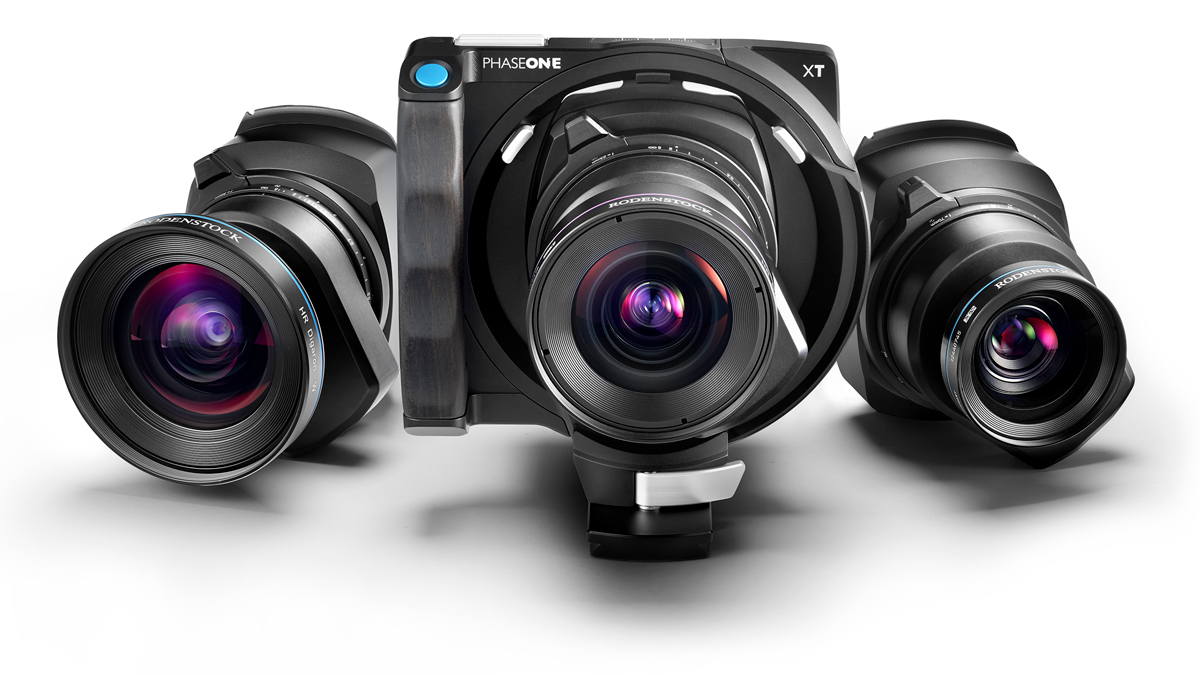 Phase One XT IQ4 150MP + lenses
The image circle is particularly important here: its size determines how far the sensor can be shifted before it reaches the limits of the area covered by the lens.
| Lens | 24x36 equivalent | DoF equivalent | Image circle | Tilt | Dimensions | Weight | Filter | Observed price excl. VAT |
|---|---|---|---|---|---|---|---|---|
| XT HR Digaron-S 23mm f/5.6 | 15mm | f/3.6 | 70mm | No | 95×107×95mm | 850g | 72mm | €9,990 excl. VAT |
| XT HR Digaron-W 32mm f/4 Tilt | 21mm | f/2.6 | 90mm | ±3° | 118×107×98mm | 1,160g | 86mm | €12,490 excl. VAT |
| XT HR Digaron-W 40mm f/4 Tilt | 26mm | f/2.6 | 90mm | ±3° | 105×107×95mm | 995g | 67mm | €10,990 excl. VAT |
| XT HR Digaron-W 50mm f/4 Tilt | 32mm | f/2.6 | 90mm | ±3° | 116×107×90mm | 1,010g | 67mm | approx. €11,490 excl. VAT |
| XT HR Digaron-W 70mm f/5.6 | 45mm | f/3.6 | 100mm | No | 109×107×89mm | 700g | 58mm | €7,990 excl. VAT |
| XT HR Digaron-W 70mm f/5.6 Tilt | 45mm | f/3.6 | 100mm | ±5° | 107×107×80mm | 750g | 58mm | €9,490 excl. VAT |
| XT HR Digaron-SW 90mm f/5.6 | 58mm | f/3.6 | 120mm | No | 160×107×90mm | 1,200g | 72mm | €11,990 excl. VAT |
| XT HR Digaron-SW 90mm f/5.6 Tilt | 58mm | f/3.6 | 120mm | ±5° | 110×107×90mm | 1,090g | 72mm | price on request |
Prices observed in September 2026 from French and European professional dealers. Excluding-VAT prices are used here to make comparison easier regardless of the VAT rate applied in the country of sale.
The 23mm is spectacular for its approximately 15mm-equivalent angle of view, but its 70mm image circle severely limits camera movements. Phase One recommends no more than around 2mm of shift with this lens.
The 32mm Tilt corresponds to approximately 21mm on 24x36. Its 90mm image circle allows the XT’s movements to be used much more extensively and makes it particularly suitable for landscape and architectural photography.
The 40 and 50mm Tilt lenses correspond to approximately 26 and 32mm on 24x36. The 70mm provides almost the angle of view of a standard lens, while the 90mm corresponds to approximately 58mm.
With an image circle reaching 120mm, the 90mm is particularly well suited to substantial shifts and multi-image stitching.
For further comparisons, use the depth of field calculator and read the guide to focal length and aperture equivalence according to sensor size.
Why a digital back on a 4x5 camera does not produce “digital 4x5”
It might seem logical to mount an IQ4 on the back of a 4x5 camera and expect to recover the rendering of large format with a digital sensor. Geometrically, that is not what happens.
A usable 4x5 image measures approximately 95×120mm. The Phase One back records only a 53.4×40mm area located in the centre of the lens image circle.
Take a 90mm lens again:
90mm on 4x5 ≈ 25.5mm on 24x36Place the same 90mm lens in front of an IQ4 sensor:
90mm on IQ4 ≈ 58mm on 24x36The same lens therefore changes from a wide-angle lens on 4x5 sheet film to a focal length slightly longer than a standard lens on the IQ4.
This is precisely why digital technical cameras use 23, 32 or 40mm lenses. They must provide a very wide angle of view while maintaining a sufficiently large image circle to permit camera movements.
Optical design also creates particular constraints. With some older large-format wide-angle lenses, light rays may strike the edges of a digital sensor at very oblique angles, producing color casts or other artifacts. Phase One particularly recommends Rodenstock HR lenses for large sensors and substantial shifts.
Why still shoot film and then digitize it?
This question becomes especially relevant when considering the price and dimensions of the largest digital sensors.
Film deals with the cost of a very large sensitive area in a different way: each 4x5 sheet provides its own photosensitive area of approximately 95×120mm for one exposure, without requiring a permanent sensor of that size.
The photograph can therefore benefit from the focal lengths, large image circles and movements specific to large-format photography. The negative can then be digitized at whatever resolution is actually required.
A 4x5 sheet can, for example, be reproduced in several sections with a high-resolution digital camera and the resulting files stitched together. The final file can become extremely large, although its useful resolution will still be limited by the resolving power of the emulsion, the taking lens, the aperture, focusing accuracy, development and the quality of the digitization.
How much resolution can a current film record?
For someone considering a 6x9 or 4x5 camera today, negative film provides a more representative reference than the transparency films historically used in medium and large formats.
In color, Kodak Ektar 100 remains available in 120 film and 4x5 sheet film; Kodak describes it as its finest-grain color negative film and as particularly well suited to scanning. Portra 160, also available in these formats, favors softer rendering and greater exposure flexibility.
In black and white, Ilford Delta 100 Professional, still available in 120 and 4x5 sheet film, is an example of a modern 100ISO film offering very fine grain and high definition.
There is, however, no exact equivalence between film grain and the pixels of a digital sensor. Resolving power depends in particular on the emulsion, subject contrast, development and the entire image-making chain.
If, simply to establish an order of magnitude, we deliberately use a conservative figure of approximately 60 lines/mm for a fine-grain film at low contrast, the theoretical result is around 68MP for a 6x9 negative and 164MP for a 4x5 sheet.
These figures do not mean that 6x9 film “equals 68MP” or that a 4x5 sheet “is worth 164MP”. They simply help place the information potential of a large film area in context. The amount of detail actually usable depends on the lens, aperture, focusing accuracy, stability, emulsion, development and digitization quality.
The comparison nevertheless helps explain why 6x9, and even more so 4x5, remain relevant alongside very high-resolution digital sensors. For a detailed discussion of lp/mm, MTF and the conversion of film resolution into megapixels, see Digital sensor vs film resolution comparison.
Despite the use of film, the workflow ultimately remains very contemporary:
camera → film → development → digitization → digital fileIt preserves the surface area, geometry and movements of large-format film photography while producing a file that can ultimately be used in a modern digital workflow.
A much more affordable alternative: a 6x9 camera and 120 film
The Phase One XT is an exceptionally sophisticated digital technical camera, but a price exceeding €60,000 including VAT for the IQ4 150MP and one lens restricts it to a very small professional market.
For photographers who want to explore a comparable way of working, including manual focus, shift, tilt, ground-glass composition and a large image area, a used 6x9 technical camera fitted with a 120 roll-film back provides an interesting alternative.
It obviously does not replace the XT in a professional production environment. The film workflow is slower, the result cannot be checked immediately, and the film must be developed and digitized. It does, however, reproduce several of the working principles of a technical camera for a fraction of the cost.
Linhof Super Technika 6x9
The Linhof Super Technika 6x9 combines a transportable folding camera with genuine camera movements. A set consisting of a wide-angle lens around 65mm and a standard lens of 100 or 105mm forms a particularly coherent landscape and architecture kit.
| Equipment | 24x36 equivalent | Main use |
|---|---|---|
| 65mm lens | approx. 28mm | Landscape, architecture |
| 100-105mm lens | approx. 43-45mm | Standard focal length, landscape, general photography |
At the time this article was written, a Super Technika IV 6x9 equipped with a Zeiss 105mm and Schneider 65mm was, for example, offered in France for around €1,200. A specialist European dealer was also offering a kit with 65, 105 and 180mm lenses for around €1,500. These examples should not be regarded as a market valuation: the condition of the bellows, shutters, optional rangefinder, backs and lenses can make the value of a kit vary considerably.
Horseman VH / VH-R
The Horseman VH and VH-R follow a similar philosophy in a compact Japanese system. A combination of 65mm and 105mm lenses is particularly well suited to landscape and architecture.
The used market is less regular than for more common cameras. Prices vary considerably depending on the number of backs, lenses, lens boards and the mechanical condition of the equipment. A complete system nevertheless remains in a completely different financial category from an XT fitted with an IQ4 and two Rodenstock lenses.
Eight frames per roll, then digitization
The 6x9 format generally provides eight photographs from a roll of 120 film. Its aspect ratio is also very close to the 3:2 ratio of 24x36.
At first sight, shooting 6x9 to benefit from a much larger sensitive area and then digitizing the negative with a 45 to 61MP 24x36 camera may seem paradoxical. The point of using a 6x9 technical camera, however, is not simply to obtain more megapixels.
Above all, it provides access to camera movements: shift to control perspective, tilt to orient the plane of focus, large image circles and composition on a ground glass. On a 24x36 camera, these possibilities require dedicated tilt or shift lenses and remain limited to the focal lengths and movement ranges offered by lens manufacturers. This subject is discussed in more detail in my article on architectural photography with a shift lens.
Digitization is then a separate step. With a 45 to 61MP 24x36 camera, a 6x9 negative can be reproduced in a single capture using a macro lens and a suitable 120 film holder. This solution is already sufficient for many purposes, although it does not necessarily extract all the potential resolution of a fine-grain film.
To go further, the negative can be digitized in several sections with the same camera and the files stitched together. A high-end dedicated scanner provides another possibility: the Hasselblad/Imacon Flextight X1 and X5, for example, reach an optical resolution of 3,200ppi on 120 film. Applied to a 6x9 image of approximately 56×84mm, this produces a file close to 75MP. A flatbed scanner accepting medium-format film can also produce highly defined files, although its nominal resolution does not necessarily correspond to the amount of real image detail extracted from the film.
The appropriate method therefore depends on the final use. Reproducing the negative in a single capture favors speed and simplicity; stitching several captures or using a specialist scanner can extract more detail when the film, taking lens and quality of the negative justify it. For a comparison of these methods, see also Scanning film photographs: flatbed scanner, dedicated scanner or digital camera.
A system such as the VALOI easy120 accepts 120 film up to the 6x9 format and makes it easier to reproduce negatives with a digital camera and macro lens.
Frequently asked questions about the Phase One XT IQ4 150MP
What is the crop factor of the Phase One IQ4 150MP?
The conversion factor from the 53.4×40mm sensor to 24x36 is approximately 0.65×. A 70mm lens therefore provides an angle of view close to that of a 45mm lens on Full Frame.
Is the Phase One IQ4 a true digital medium-format system?
Yes. Its sensor area is approximately 2.47 times larger than a 24x36 sensor and its dimensions are very close to those of 645 film. It nevertheless remains significantly smaller than a 6x6, 6x7 or 6x9 negative.
Is the Phase One IQ4 sensor larger than a Fujifilm GFX or Hasselblad X sensor?
Yes. The IQ4 measures 53.4×40mm compared with 43.8×32.9mm for GFX and Hasselblad X. Its surface area is approximately 48% larger.
The equivalents for these two other systems are detailed in my articles on Fujifilm GFX medium format / Full Frame and Hasselblad medium format / Full Frame.
Which Phase One XT lens corresponds to a 24mm lens on Full Frame?
The 32mm corresponds to approximately 21mm and the 40mm to approximately 26mm using the conversion factor calculated from the sensor diagonals. No lens in the range therefore corresponds exactly to 24mm on 24x36; the 40mm is the closest.
Why is a 70mm lens almost a standard focal length on the Phase One?
The larger sensor produces a wider angle of view from a given focal length. With the approximately 0.65× conversion factor, the 70mm produces framing comparable to a 45mm lens on 24x36.
How many megapixels remain when the IQ4 is cropped to 3:2 or square?
Keeping the full width of the file, a 3:2 crop leaves approximately 134.5MP from the original 151MP. A square crop retains approximately 113.5MP.
Can Frame Averaging replace an ND filter?
In many situations where an ND filter is used solely to extend exposure time, yes. The IQ4 automatically captures and averages multiple frames to produce a single RAW file with a time effect close to that of a long exposure. The feature does not, however, replace a graduated filter or a polarizer, and its rendering is not strictly identical to that of one continuous exposure.
Can the IQ4 back be mounted on a 4x5 camera?
Yes, with a suitable camera and adapter. The sensor, however, uses only the central portion of the image circle. Focal lengths therefore behave according to the 53.4×40mm sensor format rather than the 4x5 format.
Does a 90mm lens on a Phase One digital back give the same angle of view as on 4x5?
No. A 90mm lens covers approximately the angle of view of a 25.5mm lens on 24x36 when used with 4x5 sheet film. In front of the 53.4×40mm IQ4 sensor, it corresponds instead to approximately 58mm.
Why continue using 6x9 or 4x5 film and then scan it?
Film makes it possible to use a much larger sensitive area than current photographic sensors, together with the movements and lenses specific to these formats. The negative or sheet film can then be digitized at the resolution appropriate for the final use.
What affordable alternative offers an introduction to technical-camera photography?
A Linhof Super Technika 6x9 or Horseman VH/VH-R with a 120 back and two lenses, for example around 65mm and 105mm, provides a large film area and genuine camera movements for a budget far below that of a Phase One XT.
Conclusion
The Phase One XT IQ4 150MP fascinates me precisely because it pushes a particular conception of digital photography very far: 151 million pixels on a 53.4×40mm sensor, specialized Rodenstock lenses, back shift, tilt on selected lenses and original digital functions such as Frame Averaging.
Its price puts it beyond the reach of most photographers, myself included. That does not make it any less interesting to understand what it offers.
More than anything, this reflection shows how many different realities the words “medium format” cover today. A GFX or Hasselblad X, a Phase One IQ4, a Hasselblad 6x6, a 6x9 negative and a 4x5 sheet belong to systems whose surface areas, aspect ratios and optics differ considerably.
Digital photography has made it possible to obtain enormous resolution without reproducing the dimensions of the largest film formats. Film offers a different answer: a very large photosensitive area can be used for each individual exposure, then digitized at whatever resolution is required after development.
The Phase One XT sits almost at the meeting point of these two approaches. Its sensor is close to 645 film, but it is mounted behind a compact technical camera and lenses designed to exploit camera movements. Beyond that, 6x9 and 4x5 still offer much larger image areas, at the cost of returning to film, development and digitization.
Main sources: official Phase One photos and documentation for the XT Camera System, IQ4 Digital Backs and XT Rodenstock Lenses; prices observed in September 2026 from Prophot and European professional dealers; Kodak Professional, Ilford Photo, Linhof and VALOI documentation. Prices may change and should not be regarded as an equipment valuation. This article is not sponsored.
About the author
Sebastien Desnoulez is a photographer, author and image maker based in Paris. His work spans architectural photography, landscape photography and travel photography, with particular attention to composition, lines, light, blur and visual accidents. Trained in photography in the mid-1980s, he covered Formula 1 and reported from around the world before developing a fine art photography practice built around the tension between graphic rigour and visual instability. He also shares his technical experience through practical articles for passionate photographers, drawing on a strong visual culture acquired in both film and digital photography.
Tags