


VALOI easy35 v2: the best way to digitise 35mm negatives and slides?

I had previously been using a JJC FDA K-1 to digitise my 35mm film archives. I described this process in my article about the different solutions available for scanning film photographs, after comparing an Epson flatbed scanner, several Nikon Coolscan models and camera scanning with a digital camera.
The JJC FDA K-1 delivers excellent results. A large proportion of the photographs published in the Film Photography category were digitised using this accessory, a Nikon Z8 and a macro lens.
However, it has two limitations when large quantities of film need to be digitised: its relatively slow workflow and the fact that it cannot reproduce the entire negative with its black border. The VALOI easy35 v2 addresses both issues with faster film holders that are better suited to digitising film strips.
Contents
- Why replace the JJC FDA K-1?
- Why preserve the black border of the negative?
- Why choose the VALOI easy35 v2?
- A film holder made especially by VALOI
- Setting it up with the Nikon Z8
- Nikon Z MC 50mm or Sigma 105mm Macro?
- Finding the right combination to optimise framing
- 50 slides digitised in 8 minutes
- Light quality and evenness
- My verdict on the VALOI easy35 v2
- VALOI easy35 v2 FAQ
Why replace the JJC FDA K-1?
The main drawback of the JJC FDA K-1 becomes apparent when scanning large batches of images.
For slides, the holder allows you to alternate between two frames: one is positioned in front of the lens while the next one waits to be scanned. The process remains straightforward, but each slide must be inserted into the holder, which must then be moved into position in front of the lens.
For negatives, a second film holder accepts a strip of six frames. However, the plastic slightly overlaps the edges of the film. This will probably not be an issue for most photographers, but it makes it impossible to digitise the entire frame with its black border.
Why preserve the black border of the negative?
This is important for photographers who were trained at a time when the final composition was expected to be established when the photograph was taken.
Henri Cartier-Bresson had his photographs printed with a narrow black line corresponding to the edge of the negative. This demonstrated that the image had not been cropped under the enlarger.
Some people may consider this requirement pretentious or unnecessarily restrictive. It was nevertheless an important part of my photographic training.
I began photography in 1984, learning from magazines such as Photo Reporter, books by Jean-Loup Sieff and Henri Cartier-Bresson, and the work of many other photographers. At the time, presenting a portfolio of perfectly framed images could be a genuine passport to approaching press agencies.
Photo stories were often shot on slide film and then distributed to editorial teams as duplicate slides. The composition therefore had to be sufficiently accomplished at the moment of exposure for the complete image to be supplied. The magazine or newspaper was then free to crop it according to the requirements of its layout. By providing the complete image, the publication did not have to work from a duplicate that had already been cropped, which would have further reduced the usable film area and degraded print quality.
Being able to reproduce the edge of the negative today allows me to recover the original composition without the slight cropping imposed by an undersized film holder.
Why choose the VALOI easy35 v2?
Paul Khayat had recommended VALOI products to me. The idea gradually took hold and I eventually ordered an easy35 v2.
I will not go into detail here about all the differences between this model and the original version. The first easy35 used more 3D-printed components and a light source fitted with a diffusion panel. The v2 has a main body made from injection-moulded plastic and a new light source incorporating a reflective dome designed to distribute the light more evenly. All these features are described in detail on the manufacturer’s website.
My main requirements were:
- a holder for negative strips that would reveal the perforations and edges of the film;
- a slide holder that would allow me to work quickly;
- a closed, stable system attached directly to the lens;
- an antistatic dust-removal accessory for film strips that can be attached directly to the housing.
The slide holder is particularly well designed. The next slide pushes the one that has just been photographed out of the holder. There is no longer any need to remove a tray, replace the slide and then reposition the assembly in front of the lens.
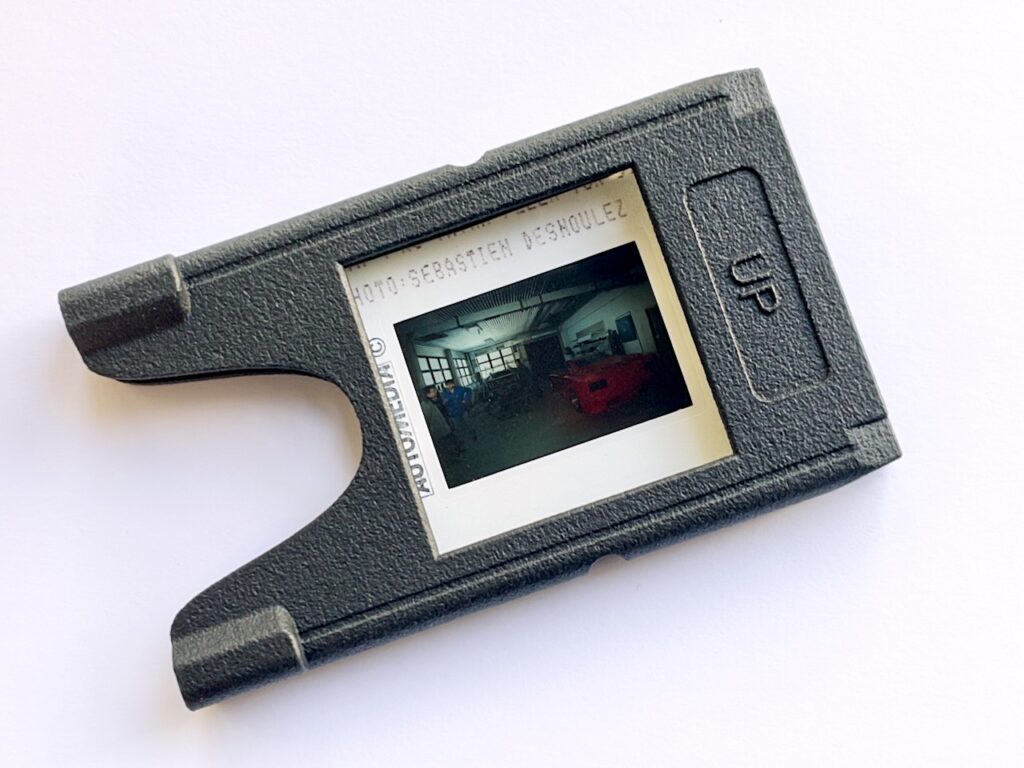 VALOI easy35 v2 – Slide holder – Photo © Sebastien Desnoulez
I also added the VALOI antistatic Duster brush to my order. It attaches magnetically to the housing and provides a final dust-removal stage after using a brush and a blower.
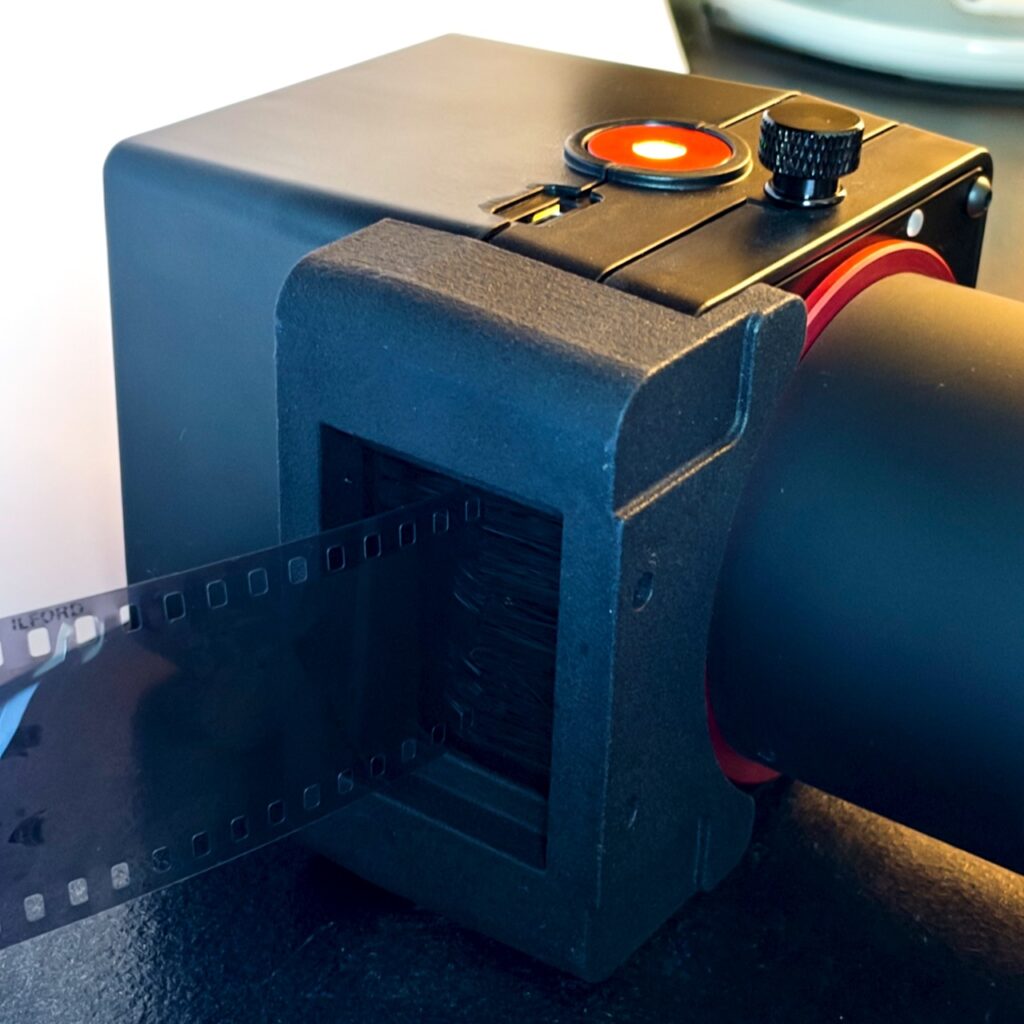 VALOI easy35 v2 – Antistatic Duster brush with magnetic mount – Photo © Sebastien Desnoulez
A film holder made especially by VALOI
With the JJC FDA K-1, my son had modified and 3D-printed a slide mount so that I could reproduce negatives together with their borders.
This solution worked, but it required me to cut the negative strips so that each individual frame could be inserted into the holder.
As VALOI clearly has considerable expertise in 3D printing, I contacted the company to ask whether it could offer me a more reliable solution. I had already exchanged messages with them before making my purchase to confirm the contents of the slide kit, and the communication had been particularly professional.
Arild eventually offered to produce a magnetic film holder especially for me, designed to accept a single frame. One of its two parts contains a recessed area that positions the film precisely. The other has a slight raised section that holds the negative flat and limits curling.
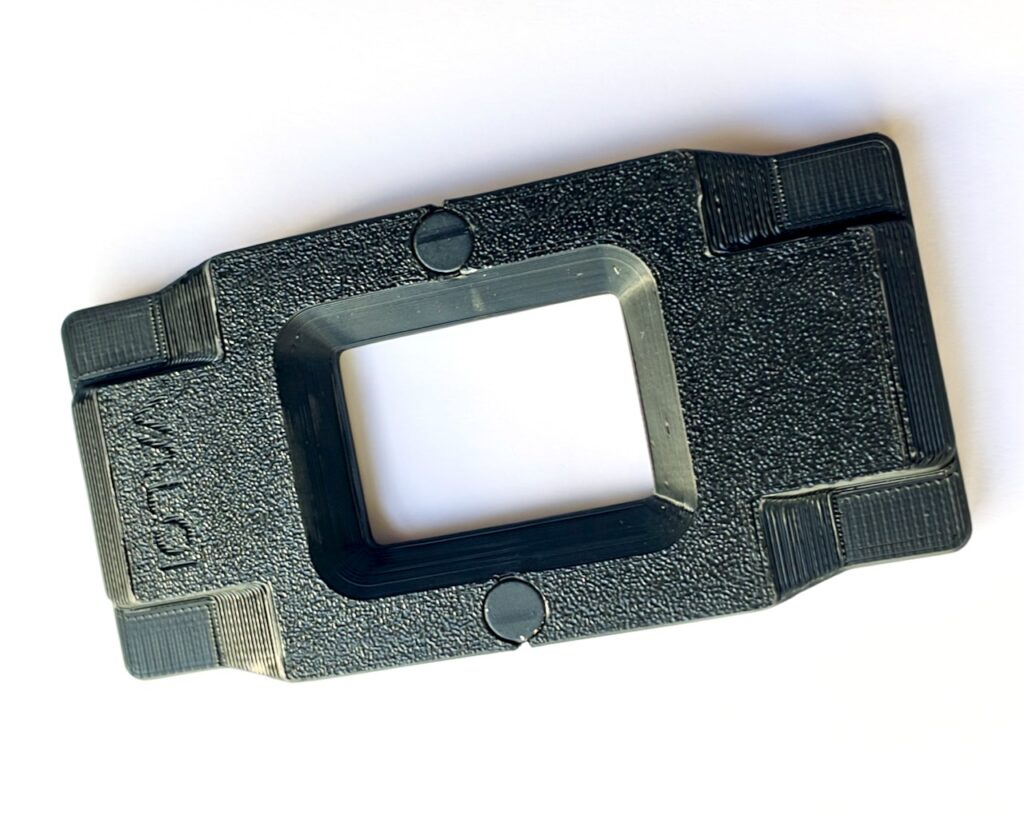
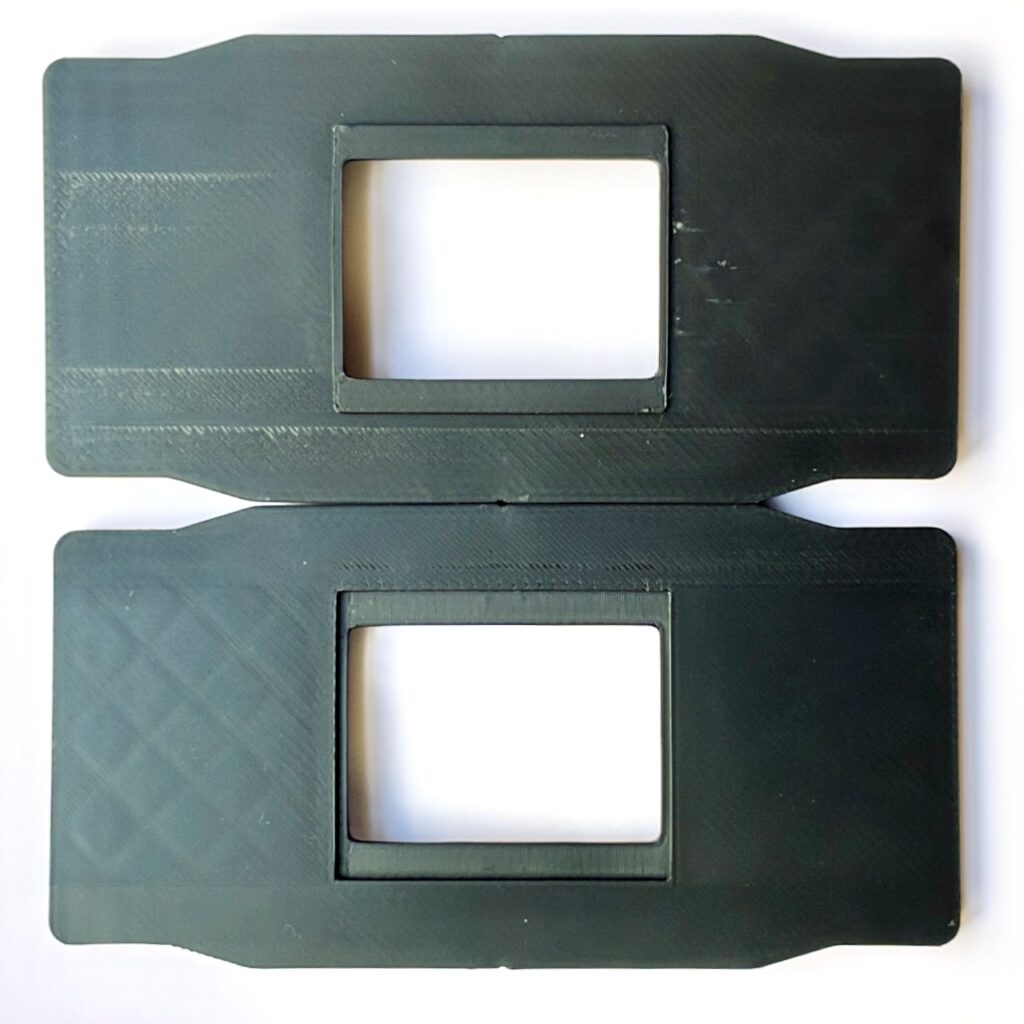
VALOI easy35 v2 – The two parts of the magnetic film holder made especially by VALOI – Photos © Sebastien Desnoulez
The result is far more accomplished than I had hoped.
Some companies still have the ability to delight their customers and turn them into ambassadors.
Setting it up with the Nikon Z8
The general operating principle is similar to that of the JJC FDA K-1. The unit containing the film holder and light source attaches directly to the front of the lens.
The easy35 v2 is supplied with seven tube sections:
- five 40mm tubes;
- one 20mm tube;
- one 10mm tube.
These components allow the distance between the lens and the film to be adjusted. The tubes have a native diameter of 62 mm, which directly matches both of my macro lenses: the Sigma MACRO 105 mm F2.8 EX DG OS HSM and the Nikon Nikkor Z MC 50 mm f/2.8. I therefore do not need to use the step-up or step-down rings supplied with the VALOI.
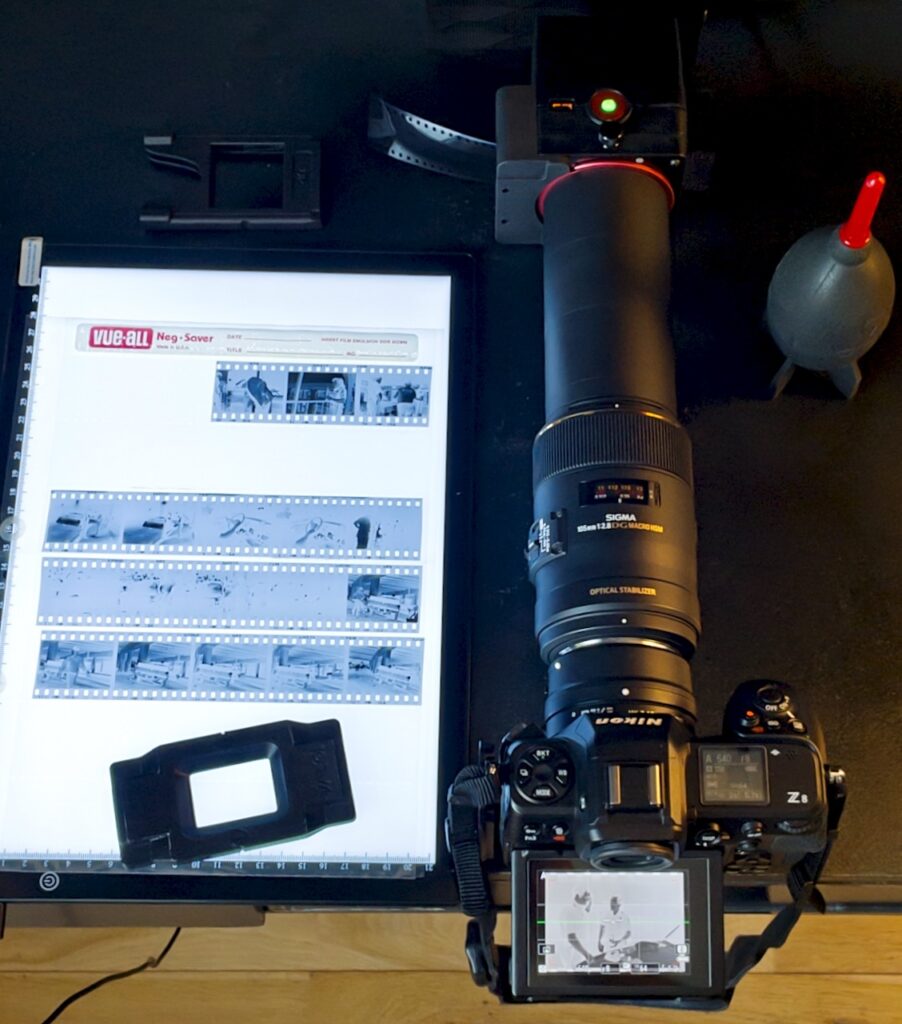 VALOI easy35 v2 – Setup with Nikon Z8 and Sigma 105mm Macro – Photo © Sebastien Desnoulez
Nikon Z MC 50mm or Sigma 105mm Macro?
I began my tests with both lenses.
I initially preferred the Nikon Z MC 50mm f/2.8. It is considerably more compact than the Sigma 105mm and produces a shorter, lighter setup.
However, I noticed barrel distortion along the edges of the negatives. Straight lines curve outwards, giving the image a slightly swollen shape similar to that of a barrel.
This distortion remains visible despite enabling the in-camera corrections and the lens profile in Lightroom.
In Lightroom, I obtain straighter lines by opening the Lens Corrections panel and reducing the Distortion value from 100 to approximately 77.
I had already suspected this issue when using the JJC FDA K-1. The VALOI film holder, which reveals the straight edges of the negative, makes it considerably more obvious.
I therefore ultimately chose the Sigma MACRO 105mm F2.8 EX DG OS HSM. It is bulkier, but its flat field, sharpness and extremely low distortion make it ideally suited to this type of reproduction work.
Finding the right combination to optimise framing
The final section of the JJC featured a sliding tube, making it very easy to adjust the distance between the lens and the film so that the slide or negative occupied almost the entire sensor area.
The tubes supplied with the VALOI have fixed lengths. You therefore need to experiment with different combinations of VALOI tubes and, if necessary, an extension tube to find the distance best suited to the lens you are using.
After testing several combinations, I ultimately settled on the Sigma 105mm with an 18mm Meike extension tube and three 40mm VALOI tubes. This setup gives me very tight framing of the negative in the standard film holder, with only a small margin remaining around the image, while making the best use of the sensor’s resolution.
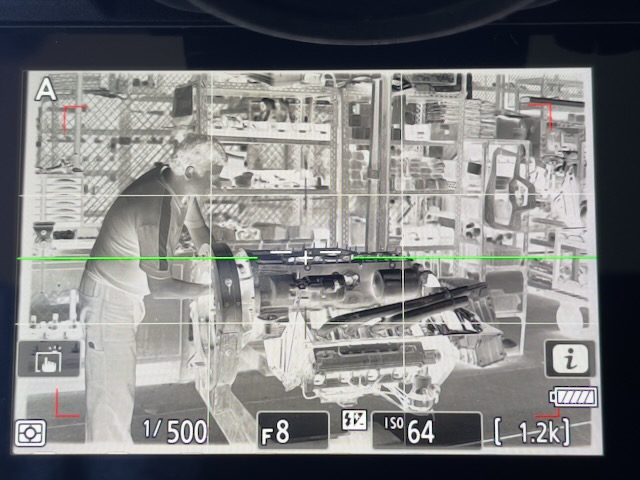
VALOI easy35 v2 – Negative preview on the Nikon Z8 screen with Sigma 105mm, 18mm Meike extension tube and three 40mm VALOI tubes – Photo © Sebastien Desnoulez
VALOI also offers an optional helicoid providing 20mm of continuous adjustment, allowing this distance to be fine-tuned without changing the tube combination. I have not tested it, however.
A slight crop is generally still required in Lightroom or Photoshop, mainly to remove the visible margin of the film holder and precisely adjust the image edges. With the Nikon Z8’s 45-megapixel sensor, the loss of resolution is now very small. The available definition also remains higher than the resolution actually recorded by most of the 35mm films I scan, as I explain in my article Digital sensor versus film resolution comparison.
50 slides digitised in 8 minutes
To measure the actual speed of the VALOI easy35 v2, I timed the capture of a batch of 50 slides.
Before digitising, it took me 6 minutes to remove the slides from their plastic storage sheets, make two passes with a brush over each side of the batch, and then two passes with a blower over each side. I do not include this time in the VALOI’s performance figures: this preventive dust removal is necessary regardless of the digitising method in order to minimise dust retouching later in Lightroom or Photoshop.
The actual acquisition of the 50 slides took 8 minutes. This includes inserting each slide, adjusting its position in the holder, checking focus, triggering the exposure with a 2-second self-timer, and then inserting the next slide, which automatically ejects the previous one. One of the 50 slides was mounted in a cardboard frame and had to be placed in the special film holder before being digitised.
After cropping, the resulting files measure approximately 7466 × 4939 pixels. For batch digitising, this workflow is difficult to match with a flatbed scanner or a Nikon Coolscan, both of which must perform a complete scan of each image. With the Nikon Z8 and VALOI easy35 v2, acquisition is completed in a single exposure, so most of the time is spent handling the slides rather than capturing the image itself.
I also do not include the time required to process and retouch each file after digitising. That work depends on the condition of each image and remains necessary regardless of the acquisition method used.
Light quality and evenness
With slides, I have not observed any particular problems. The light is distributed evenly across the entire image, with no visible darkening in the corners.
The behaviour can be slightly different with some very contrasty black-and-white negatives.
The dark areas in the final image correspond to the most transparent areas of the negative. On some of my Ilford HP5 films that were developed to a fairly high contrast at the time, particularly those exposed at ISO 1600, these areas contain very little density.
When I increase the contrast significantly during digital processing, the light passing through the perforations can spread slightly into the edges of the image. The effect remains extremely subtle and is only visible under particular conditions.
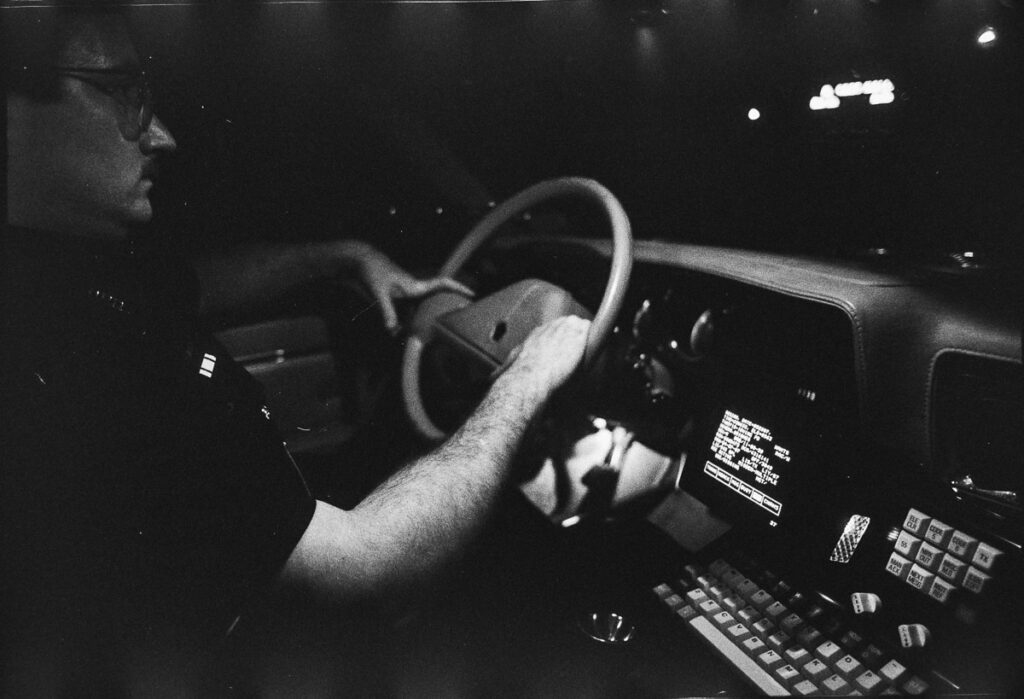 VALOI easy35 v2 – Flare caused by a heavily underexposed film: Ilford HP5 exposed at ISO 1600 using only the car’s interior light – Photo © Sebastien Desnoulez
This is not a defect in the VALOI light source, but a consequence of the extremely low density of certain negatives produced under difficult lighting conditions. Most users will probably never encounter this issue unless they also need to digitise reportage films exposed at ISO 1600.
My verdict on the VALOI easy35 v2
I am very satisfied with this purchase and with the quality of my communication with VALOI.
The research and development, mechanical design, new light source, interchangeable film holders and manufacturing precision justify the price of the system.
The holder for film strips allows the negative to be advanced quickly without removing it after each frame. The slide holder is even more efficient, as each new mounted slide automatically ejects the previous one.
The easy35 v2 does not, of course, offer the complete automation of a Nikon SF-200 feeder mounted on a Coolscan LS-4000 or a SlideSnap Pro system using a Kodak Carousel projector. It nevertheless provides a fast workflow without relying on an ageing scanner, a complex mechanism or a device that may be difficult to maintain.
For my purposes, this simplicity is preferable to an overly complicated system.
The simplest solutions are often the most effective, provided that they have been genuinely well designed.
About the author
Sebastien Desnoulez is a photographer, author and image maker based in Paris. His work spans architectural photography, landscape photography and travel photography, with particular attention to composition, lines, light, blur and visual accidents. Trained in photography in the mid-1980s, he covered Formula 1 and reported from around the world before developing a fine art photography practice built around the tension between graphic rigour and visual instability. He also shares his technical experience through practical articles for passionate photographers, drawing on a strong visual culture acquired in both film and digital photography.
VALOI easy35 v2 FAQ
Why use the VALOI easy35 v2 rather than a film scanner?
The VALOI easy35 v2 allows negatives and slides to be digitised using a digital camera. Combined with a high-resolution sensor and a good macro lens, it delivers excellent image quality while significantly reducing the time required to scan large quantities of film.
Can the VALOI easy35 v2 scan the black border of a negative?
Yes, provided that you use a film holder whose opening reveals the edges and perforations of the film. The holder I selected for negative strips preserves the original composition without cropping the image.
Which lens should be used with the VALOI easy35 v2?
I tested the Nikon Nikkor Z MC 50mm f/2.8 and the Sigma MACRO 105mm F2.8 EX DG OS HSM. The Nikon is more compact, but in my setup the Sigma 105mm produces a more even image, with better flatness of field and considerably less distortion.
Which setup do I use with the Sigma 105mm?
After testing several combinations, I use the Sigma MACRO 105mm F2.8 EX DG OS HSM with an 18mm Meike extension tube and three 40mm VALOI tubes. This setup allows me to frame the negative very tightly in the standard film holder and greatly reduces the amount of cropping required.
Is the VALOI easy35 v2 light source even?
With slides, the illumination is even across the entire image. On a few very transparent black-and-white negatives, particularly some Ilford HP5 films exposed at ISO 1600 and developed to a high contrast, a very slight spread of light from the perforations can appear near the edges.
Can slides be digitised quickly with the VALOI easy35 v2?
Yes. In my test, capturing 50 slides took 8 minutes, including inserting each slide, adjusting its position, checking focus and triggering the exposure with a 2-second self-timer. Each new slide automatically ejects the previous one. This time does not include preliminary dust removal, which is necessary regardless of the digitising method, or subsequent file processing.
This article is not sponsored. The VALOI easy35 v2 and its accessories were purchased for digitising my photographic archives.
Tags